NYT Reports on Navalny's Exchanges with Associates
Describes Prison Life as 'Space Travel'
Russian anti-government activist Aleksei Navalny suddenly died at the No. 3 prison in the Yamal-Nenets Autonomous Okrug, located in the Arctic region of Siberia. Amid numerous questions surrounding Navalny's death, his close associates and Western countries have raised suspicions of murder, holding Russian President Vladimir Putin and the government accountable. On the 19th (local time), The New York Times (NYT) published an article titled "Aleksei Navalny's Last Few Months of Statements," which reexamined his life through excerpts of handwritten letters he sent to acquaintances during his final months and interviews with those close to him.
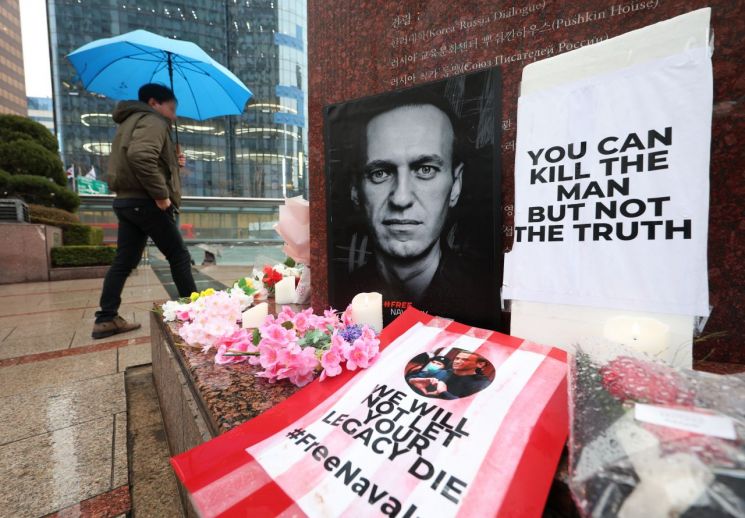 On the afternoon of the 20th, a memorial space for Russian anti-government activist Alexei Navalny was set up in front of the statue of Aleksandr Sergeyevich Pushkin in front of Lotte Department Store in Jung-gu, Seoul.
 [Photo by Yonhap News]
In a letter sent last September from Ilya Krasilshchik, a media entrepreneur and acquaintance, Navalny expressed hope for democracy, stating, "Just as South Korea transitioned from dictatorship to democracy, Russia can do the same," and added, "Hope. My belief in this is firm." Navalny, who was 47 at the time of his death, was imprisoned in January 2021 and described his incarceration as a "space voyage."
He spent most of his time reading on the concrete floor of a solitary cell measuring 2 meters wide by 3 meters long. Over the course of a year, he read 44 books in English. Additionally, Navalny maintained communication with the outside world by exchanging letters with acquaintances. His ability to correspond was made possible by the digitalization of the Russian prison system, which took place during Putin's 24 years in power. People could send letters to Navalny through a website by paying 40 cents per page, and after a typical 1-2 week censorship period, they would receive scanned replies.
Navalny's health deteriorated during his imprisonment. Russian authorities reportedly denied him medical and dental treatment. However, according to the NYT, his mental state remained intact. Notably, Navalny protested against the Russian government during court hearings concerning new criminal cases aimed at extending his sentence or addressing complaints about medical treatment. In July of last year, when the Russian court sentenced him to an additional 19 years, he shouted "crazy" at the judges and police officers present in the courtroom.
The Strength to Endure Imprisonment Was 'Reading'
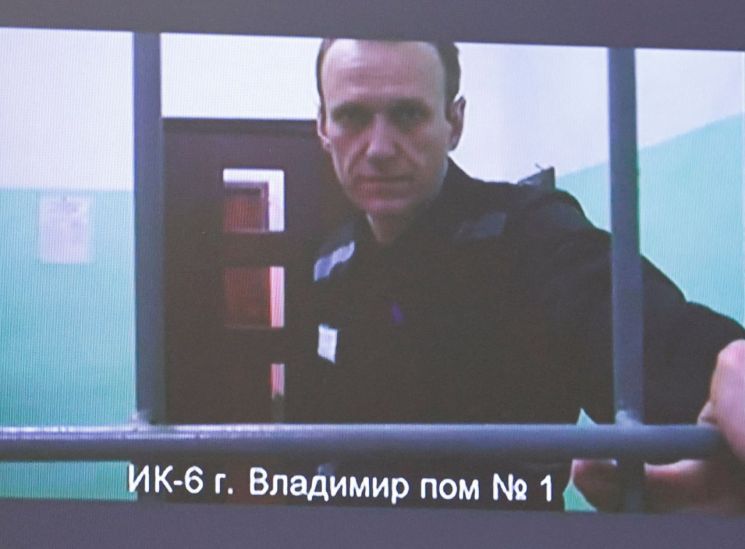 Alexei Navalny appearing via video at a court in the Vladimir region prison in Russia last year. On this day, the court dismissed Navalny's appeal against his 19-year prison sentence on extremism charges.
 [Photo by Reuters·Yonhap News]
The strength that helped Navalny endure his difficult imprisonment was reading. In a letter sent to an acquaintance last April, he said, "I prefer to read 10 books simultaneously and switch between them," adding, "I always despised memoirs, but for some reason, I have come to like them." He told the court, "I want to have 10 books in my cell," and sent acquaintances a list of recommended books. After months of hunger strikes, he wrote in one letter that he reread Aleksandr Solzhenitsyn's novel One Day in the Life of Ivan Denisovich, which deals with Stalin's labor camps, and noted, "Only now have I begun to understand the corruption of Soviet-era labor camps."
Navalny also exchanged letters with Kerry Kennedy, daughter of former U.S. President Robert F. Kennedy. After news of Navalny's death was announced, Kerry Kennedy posted a copy of a letter written in English by Navalny on Instagram. In the post, Navalny thanked her for sending a poster quoting her father's speech about "how the relentless waves of hope can break down the strongest walls of oppression." Navalny also revealed that he cried several times while reading books about Kennedy during his lifetime.
The last letter Navalny sent arrived on the 13th, shortly before his death. His whereabouts suddenly became unknown in December of last year. In a letter sent at that time, Navalny shared his thoughts on American politics, warning about the possibility of former President Trump being elected. On the 25th of the same month, colleagues discovered that Navalny had been transferred to the No. 3 prison in the Yamal-Nenets Autonomous Okrug, the northernmost part of Siberia in Russia.
Earlier, Russian correctional authorities announced on the 16th that Navalny lost consciousness and collapsed after a walk, dying suddenly. However, even on the fourth day after his death, the exact cause of Navalny's death remains unknown, and the whereabouts of his body have not been confirmed. President Putin has not made any statements for four days.
© The Asia Business Daily(www.asiae.co.kr). All rights reserved.
!["The Woman Who Threw Herself into the Water Clutching a Stolen Dior Bag"...A Grotesque Success Story That Shakes the Korean Psyche [Slate]](https://cwcontent.asiae.co.kr/asiaresize/183/2026021902243444107_1771435474.jpg)

















