Real Estate PF Loan Default Prevention National Assembly Forum Held
"Financial Companies Should Lower PF Loan Concentration"
"Work Needed to Smooth Out Real Estate Price Volatility"
"A method should be introduced to set provisions for part of the income generated from bridge loans and project financing (PF) by financial companies." (Lee Kwang-su, CEO of Gwangsu Bokdeokbang)
"Financial institutions engaging in PF loans should build diversified loan portfolios to reduce loan concentration." (Im Jae-man, Professor of Real Estate at Sejong University)
"The government should smooth market prices to prevent PF risks caused by real estate price surges and crashes." (Kim Ha-young, Professor of Economics at Jeonbuk National University)
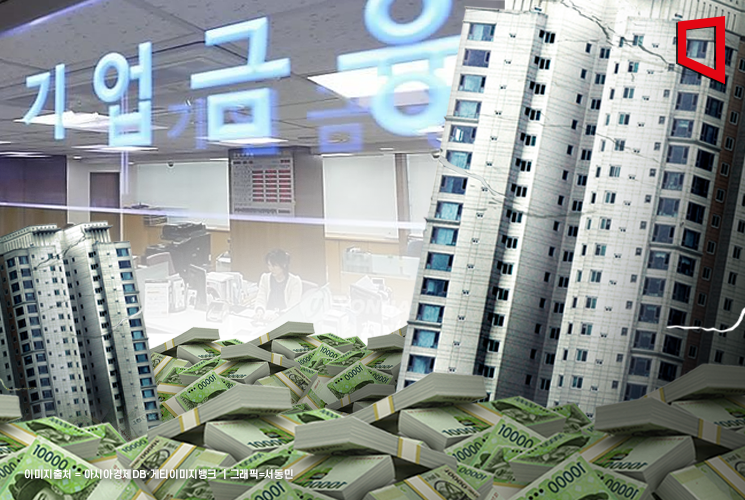
As interest rates rise and the real estate market stagnates, the ballooning real estate PF loans are emerging as risks for the construction and financial industries. The scale of real estate PF loans is twice that of 2009-2010, when a massive insolvency crisis occurred among construction companies due to the global financial crisis. On the 20th, a seminar was held hosted by Rep. Yang Jeong-sook of the National Assembly’s Political Affairs Committee and the People's Hope Headquarters of the People's Solidarity for Participatory Democracy to discuss measures to prevent real estate PF loan defaults.
Lee Kwang-su, CEO of Gwangsu Bokdeokbang and a presenter at the seminar, stated, "Korean-style real estate PF has recurring problems due to issues such as guarantee-based rather than asset-based structures, short-term funding loan structures, and imbalanced sharing of profits and risks." As a solution, he mentioned, "There is a need to secure public land through systematic restructuring of distressed PF via light auctions and a land purchase system." Lee also said, "In the long term, risks related to construction companies’ responsibilities such as credit enhancement (guarantees) and completion guarantees should be reflected in accounting books. Provisions should be applied to bridge loans and PF by financial companies, and a method to set provisions for part of the income generated should also be introduced."
Kim Ha-young, Professor of Economics at Jeonbuk National University, diagnosed that structural problems such as the real estate cycle in Korea and the preference for large-scale complexes are causing PF defaults. He explained that real estate prices sharply rise due to low interest rates combined with the 'all-in phenomenon' and 'irrational overheating,' then inevitably fall due to the long development period (land acquisition, permits, construction planning, construction, development), causing cyclical PF defaults.
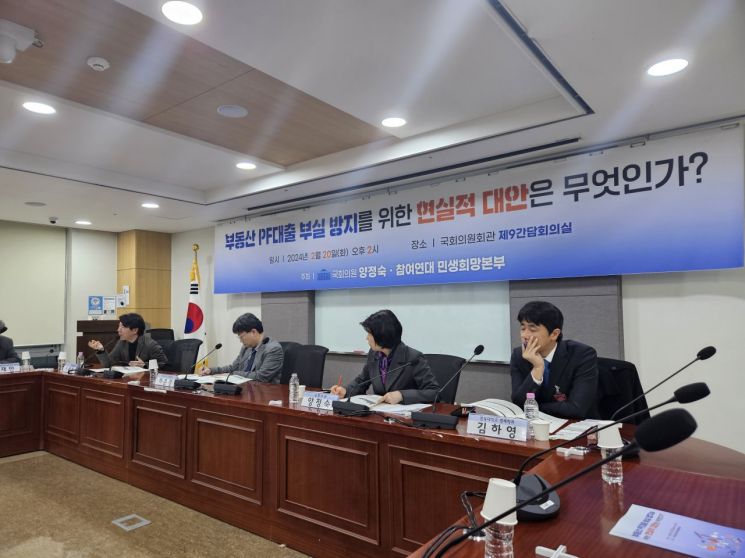 On the 20th, a discussion titled "What Are Practical Alternatives to Preventing Real Estate PF Loan Defaults?" was held in Meeting Room 7 of the National Assembly Members' Office Building, hosted by the Office of National Assembly Member Yang Jeong-suk and the People's Solidarity for Participatory Democracy's Livelihood Hope Headquarters.
He said, "Compared to foreigners who prefer detached houses, housing development takes much longer, and the longer the development period in the real estate cycle, the longer the risk naturally becomes." As a countermeasure, Professor Kim suggested, "Financial risks should be dispersed among various market participants (investors, developers, construction companies)," and "the government needs to ease supply regulations and manage the market so that housing price fluctuations are as 'smoothed' as possible."
Professor Ha Jun-kyung of Hanyang University’s Department of Economics, who chaired the seminar, pointed out, "This is also the structure of East Asian development projects, where a dynamic corporation can undertake real estate projects under its own responsibility even without equity capital, which is problematic." He added, "The preference for 'large-scale apartment complexes' is because they have high liquidity and value as assets from the consumer perspective, which relates to the growth model focused on development during the high-growth period."
Risks related to developers were also commonly highlighted. Lawyer Lee Kang-hoon (former Chair of the Civil Economy Committee at the People's Solidarity for Participatory Democracy) mentioned, "Developers start without equity capital, which means there is no risk hedge." Jin Yang-gyu, Head of Securities Support Division 1 at the Korea Financial Investment Association, said, "We recognize the need for systematic reassessment and restructuring of distressed PF, and financial sectors will derive restructuring plans through mutual consultations." Rep. Yang, who hosted the event, urged, "The government and financial authorities should not evade responsibility for the recurring real estate PF loan defaults unique to Korea but should promptly present measures to manage the situation, prevent recurrence, and stabilize real estate buyers and the national economy."
Meanwhile, according to the Korea Construction Industry Research Institute’s (KCON) report titled 'Real Estate PF Crisis: Diagnosis, Outlook, and Recommendations,' the officially known scale of real estate PF loans was 134.3 trillion KRW as of the end of September last year. When including PF loan balances executed by institutions such as Saemaeul Geumgo and securitized amounts, the actual scale of real estate PF loans is estimated to reach 202.6 trillion KRW. This exceeds twice the estimated 100.2 trillion KRW during the global financial crisis.
© The Asia Business Daily(www.asiae.co.kr). All rights reserved.
![User Who Sold Erroneously Deposited Bitcoins to Repay Debt and Fund Entertainment... What Did the Supreme Court Decide in 2021? [Legal Issue Check]](https://cwcontent.asiae.co.kr/asiaresize/183/2026020910431234020_1770601391.png)

















