'ScopeEye' Displays Various Surgery Information and Videos Simultaneously
"No Dizziness Even After 12 Hours of Surgery Wearing It"
"(Doctors) say they are people who do 'doridori' (head shaking). Surgery is being performed while constantly switching between looking at the monitor and the patient. We started from the question of how to improve this and developed the product."
Seungjun Lim, CEO of MediThinkQ, who developed the medical augmented reality (AR) wearable display ScopeEye, explained the reason for developing ScopeEye at a press conference held on the 20th in Yeouido, Yeongdeungpo-gu, Seoul.
In the operating room, surgeons rely on various imaging tools such as endoscopes and medical navigation systems, in addition to their own eyes, during surgery. However, these tools currently provide images through separate monitors, so doctors have to frequently turn their heads to look at the monitors as well as the patient during surgery. CEO Lim explained the current situation, saying, "Doctors say they can't stand the monitors. They perform surgeries for 12 hours a day, and having to look at the monitors inevitably causes neck pain."
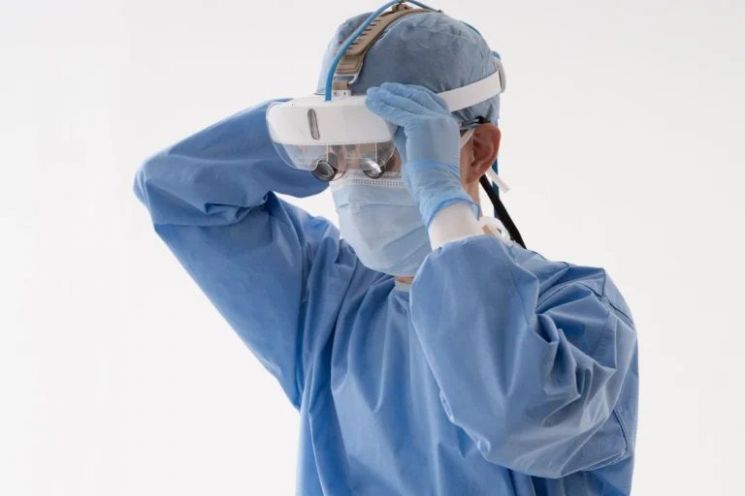
ScopeEye is an AR device worn like a cap on the head. At the press conference, trying on ScopeEye allowed vivid confirmation of various information such as the patient's pulse and various medical images like endoscopy right in front of the eyes. It could be worn over glasses, and there was no feeling of discomfort when looking down, so it seemed unlikely to interfere with actual surgery. Regarding dizziness issues raised with recent virtual reality (VR) devices like Apple Vision Pro, CEO Lim explained, "There was a doctor who performed surgery for 12 hours wearing ScopeEye, and among thousands of surgeries, no one has ever reported dizziness," adding, "You can perfectly see the outside world and comfortably perform activities."
MediThinkQ is entering the global market through collaboration with global partners from production to supply of ScopeEye. In January, they signed an exclusive distribution agreement with global medical device company Medtronic for the entire United States. Then, this month, they received an investment of $2.1 million (about 2.8 billion KRW) from Singapore-based global medical device contract development and manufacturing organization (CDMO) JLK Technology, while granting JLK exclusive production rights to secure stable production capacity.
CEO Lim said, "Surgeries on the spine or skull require alternating between looking at the monitor and the patient, which is very dangerous, but Medtronic highly evaluated that our product enables safe and effective surgery," adding, "Last year’s sales were 1.2 billion KRW, and this year we expect about a tenfold growth to 13 billion KRW, with Medtronic accounting for about half of that." Hee-yeol Lee, CEO of Ventureblick, which supports MediThinkQ through the healthcare nurturing program 'Super Incubator,' emphasized the contract with Medtronic, saying, "This is the first case among Korean companies where the global number one company directly sells the product," and "Previous cases were mainly consumables, and this is the first device to enter the main operating room."
 Seungjun Lim, CEO of Medithink, which developed the medical augmented reality (AR) wearable display ScopeEye, is speaking at a press conference held on the 20th in Yeouido, Yeongdeungpo-gu, Seoul.
 [Photo by Chunhee Lee]
MediThinkQ plans to continue its overseas expansion, having signed a sales contract with Medtronic Japan last year and started sales there. Currently, ScopeEye has received medical device approvals from regulatory agencies in the United States, Korea, Japan, and Europe. In the second quarter of this year, they plan to launch a 3D microscope product that connects an optical solution module in addition to the existing 2D microscope.
Regarding concerns about continuous sales growth, which is often considered a weakness of medical device sales companies, CEO Lim explained, "We have a business model where products are continuously replaced and used," adding, "Like upgrading smartphones, we upgrade annually and create personalized products, while also considering a rental business model."
© The Asia Business Daily(www.asiae.co.kr). All rights reserved.
![User Who Sold Erroneously Deposited Bitcoins to Repay Debt and Fund Entertainment... What Did the Supreme Court Decide in 2021? [Legal Issue Check]](https://cwcontent.asiae.co.kr/asiaresize/183/2026020910431234020_1770601391.png)
















