Impact of Continued Increase in Mortgage Loans as of Last Year's Q4
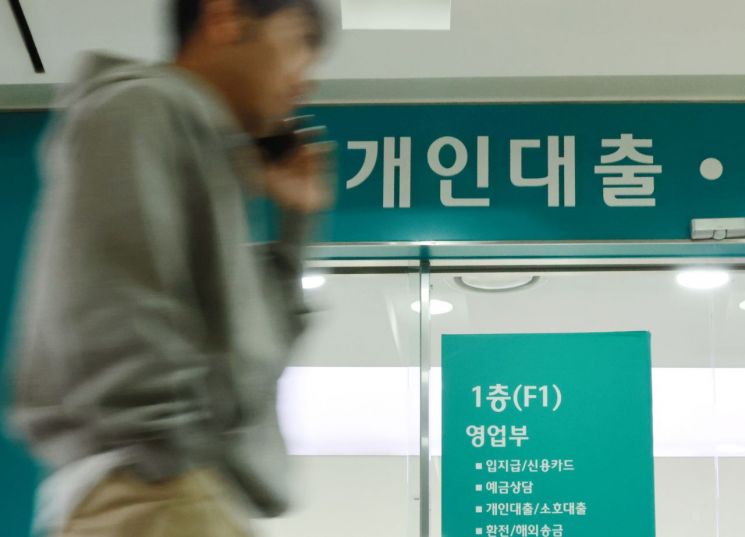 Customers are passing by in front of the loan counter at a bank branch in downtown Seoul.
 [Image source=Yonhap News]
Household credit (debt) in South Korea increased again in the fourth quarter of last year. The main factor was the continued rise in mortgage loans despite high interest rates.
According to the "2023 Q4 Household Credit (Provisional)" report released by the Bank of Korea on the 20th, the household credit balance at the end of the fourth quarter last year was 1,886.4 trillion won, an increase of 8 trillion won compared to the end of the previous quarter.
Household credit refers to the comprehensive household debt, including loans received by households from banks, insurance companies, and lending institutions, plus card usage amounts before payment (sales credit).
The household credit balance had reached a record high of 1,878.3 trillion won in the previous quarter, but it surpassed that in the fourth quarter. Household credit decreased from Q4 2022 to Q1 last year due to the impact of interest rate hikes, but showed an increasing trend for three consecutive quarters starting from Q2 last year.
The majority of household credit is household loans, which amounted to 1,768.3 trillion won in Q4, an increase of 6.5 trillion won from the end of the previous quarter. The significant factor was the 15.2 trillion won increase in mortgage loans compared to the previous quarter. On the other hand, other loans including credit loans decreased by 8.7 trillion won, marking the ninth consecutive quarter of decline.
The mortgage loan balance increased to 1,064.3 trillion won, continuing the rise seen in Q1 (1,017.7 trillion won), Q2 (1,031.8 trillion won), and Q3 (1,049.1 trillion won). However, the rate of increase slowed compared to the previous quarter.
By deposit-taking institutions, both deposit banks and non-bank deposit-taking institutions saw increases in household loans, while other loans decreased.
The sales credit (card payment) balance in Q4 was 118.1 trillion won, up 1.5 trillion won from the previous quarter, maintaining an increase for two consecutive quarters. The growth in credit card usage was driven by increased travel and leisure demand.
Seo Jeong-seok, head of the Financial Statistics Team at the Bank of Korea, explained, "Household credit balance increased due to the rise in mortgage loans in Q4," but added, "The growth rate has slowed, and even on an annual basis, the increase is lower than before, indicating that the government's household debt management measures are having an effect."
© The Asia Business Daily(www.asiae.co.kr). All rights reserved.

















