Fierce Battles in Han River and Nakdong River Belts
Growing Centrifugal Forces Amidst Ruling and Opposition Nomination Disputes
Debate Between Movement Faction Purge Theory and Regime Judgment Theory
The 22nd general election is just 50 days away. The People Power Party aims to secure a stable foundation for the Yoon Seok-yeol administration, now in its third year, through a victory in the election. Conversely, the Democratic Party of Korea seeks to maintain its position as the first party with a majority to sustain a favorable atmosphere leading up to the next presidential election. The three key issues that both ruling and opposition parties are focusing on in this election are analyzed as the 'Hangang-Suwon-Nakdonggang Belt,' 'nomination controversies,' and 'framing.'
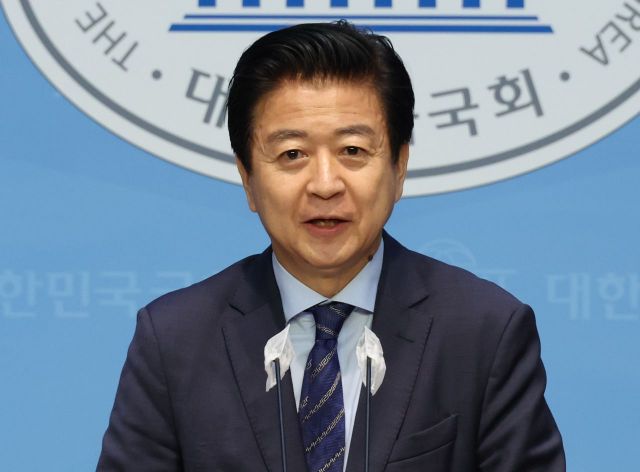 Democratic Party of Korea lawmaker No Woong-rae is holding a press conference on the 22nd general election candidacy at the National Assembly on the 14th. [Image source=Yonhap News]
Who Will Control the Hangang-Suwon-Nakdonggang Belt?
The ruling and opposition parties are competing over the 'Hangang Belt,' which includes constituencies along the Han River in Seoul such as Mapo, Dongjak, Yongsan, Seongdong, and Gwangjin. In the 21st general election, except for Yoon Young-se of the People Power Party in Yongsan, all these areas were won by the Democratic Party of Korea. The ruling party is also attempting to seize opposition seats in Suwon and the Yeongnam region. Among the five constituencies in Suwon, the party has decided on uncontested nominations for Gap, Byeong, and Jeong districts. Additionally, five-term lawmaker Seo Byung-soo and three-term lawmakers Kim Tae-ho and Cho Hae-jin have been sent to challenging districts in the Nakdonggang Belt, including Busan Buk, Gangseo Gap, Gyeongnam Yangsan Eul, and Gimhae Eul. The goal is to quickly prepare for the election and capture all five constituencies previously held by the Democratic Party.
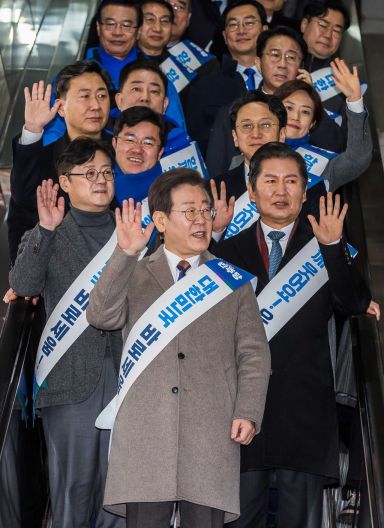 Lee Jae-myung, leader of the Democratic Party of Korea, visited Yongsan Station in Seoul on the 8th to greet returning holiday travelers. Photo by Kang Jin-hyung aymsdream@
Both Parties Seek Nomination Solutions... Controversies Are a Problem
As the nomination process reaches its midpoint, noise and controversies have begun to grow in both parties, which are emphasizing system-based nominations. The Democratic Party faced backlash from incumbent lawmakers when notifying the bottom 20% in performance evaluations of elected officials. Kim Young-joo, the Deputy Speaker of the National Assembly, announced her resignation from the party after being notified she was in the bottom 20%. It is reported that lawmaker Lee Su-jin told Democratic Party leader Lee Jae-myung in a group chat for party members to "step down to a secondary position." The ruling party is also experiencing controversies. After being cut off from the nomination, People Power Party lawmaker Seo Jeong-sook held a press conference the day before, stating, "Excluding excellent incumbent lawmakers without even holding a primary?is this really system-based and fair nomination?" With the election system decided as a semi-proportional representation, both parties are considering satellite party formations alongside nominations. There remains a possibility of conflicts between major parties and satellite parties over the order of proportional representation candidates.
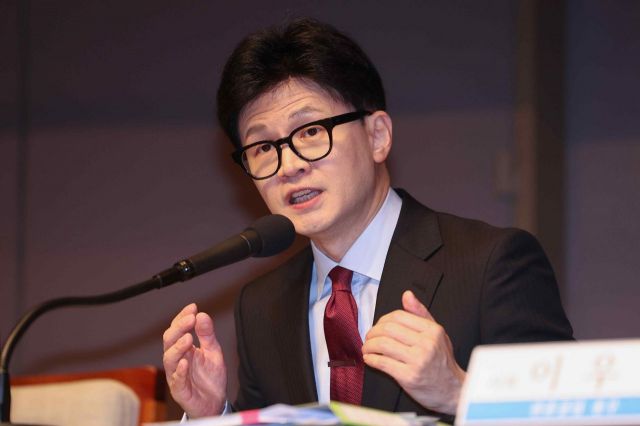 Handonghun, Emergency Response Committee Chairman of the People Power Party, is speaking at the Kwanhun Club invitation debate held at the Korea Press Center in Jung-gu, Seoul on the 7th. Photo by National Assembly Press Photographers Group
"Movement Faction Purge Theory" vs. "Regime Judgment Theory"... The Parties Are Engaged in a Framing War
Both ruling and opposition parties are striving to seize the framing advantage ahead of the general election. The ruling party has promoted the 'movement faction purge theory.' Nominations have also been conducted in line with this theory. The People Power Party gave uncontested nominations to former lawmaker Yoon Hee-sook in Jung-Seongdong Gap, Seoul, where former Blue House Chief of Staff Lim Jong-seok was preparing to run, and to Ho Joon-seok, the party’s spokesperson for the emergency committee, in Guro Gap, Seoul, where former Unification Minister Lee In-young is located. After completing his interview on the 13th, spokesperson Ho stated, "(The movement faction) has worked hard and fulfilled its historical mission, so now it should rest."
The Democratic Party has advanced the 'regime judgment theory,' targeting President Yoon and First Lady Kim Keon-hee. Floor leader Hong Ik-pyo said in a National Assembly speech on the 20th, "There is no trace of the fairness and common sense that President Yoon promised the people." The Democratic Party is gathering figures who stand in opposition to President Yoon, including approving the reinstatement of former lawmaker Lee Eon-ju the day before.
© The Asia Business Daily(www.asiae.co.kr). All rights reserved.
![Clutching a Stolen Dior Bag, Saying "I Hate Being Poor but Real"... The Grotesque Con of a "Human Knockoff" [Slate]](https://cwcontent.asiae.co.kr/asiaresize/183/2026021902243444107_1771435474.jpg)













