Excluded from Industry Bonus Rally Amid Merger Issue
"Discussing with Creditors" Only Principled Response
Last year, as pent-up travel demand from COVID-19 burst forth, airlines that achieved strong performance decided to pay bonuses to their employees. The atmosphere is to share the rewards for enduring the hardships together. However, at Asiana Airlines, which has been excluded from this 'bonus rally' due to cost management ahead of its merger with Korean Air, employee dissatisfaction is rising. It is reported that the company is considering a plan to provide small rewards to employees.
According to industry sources on the 20th, Asiana Airlines is contemplating sharing performance with employees under the names of safety incentives or sponsorship funds. Safety incentives are a type of reward paid when departments such as maintenance and operations exceed certain internal safety standards, regardless of business performance. The reason for pursuing performance rewards under different names rather than bonuses is that despite the airline industry's boom, the situation is not favorable for paying bonuses. Currently, Asiana Airlines spends most of its earnings on costs such as interest. As of the third quarter of last year, short-term borrowings remained at about 1.8 trillion won. This explains why operating profit decreased by 45.4% year-on-year despite achieving a record-high revenue of 6.5321 trillion won.
However, employee dissatisfaction is growing. Korean Air, a peer company, has set bonuses at 407% of the base salary, and Jin Air is also considering a 200% bonus. In particular, Korean Air additionally paid safety incentives equivalent to about 100% of the base salary last month.
One employee expressed dissatisfaction, saying, "I don't understand why the fruits of the achievements made after sharing the pain, including unavoidable leave due to COVID-19, are not shared." He added, "It is really regrettable that the management receives salaries more than twenty times the average employee salary." According to the company's 2022 business report, Jeong Seong-gwon, an advisor to Asiana Airlines (former vice president and CEO), received a total salary of 1.3344 billion won, including severance pay of about 790 million won. At that time, the average employee salary at Asiana Airlines was 62.34 million won. Over the past four years, Asiana Airlines employees' base salary has only increased by 2.5%.
At a recent town hall meeting held by CEO Won Yu-seok with executives in charge of finance and legal affairs and all employees, complaints about bonuses poured in.
Meanwhile, a spokesperson for Asiana Airlines explained, "We have been conducting wage collective bargaining with the labor union since November last year, so nothing has been decided yet."
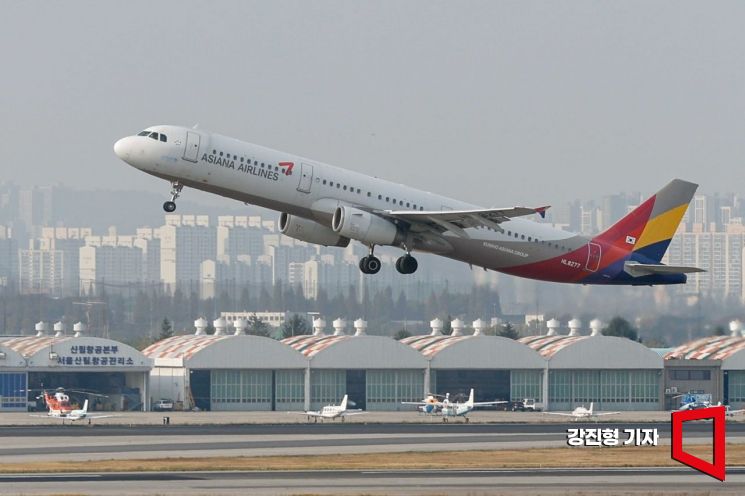 In relation to the merger of Korean Air and Asiana Airlines, discussions on the sale of Asiana Airlines' cargo business are scheduled at the board meeting on the 2nd. An Asiana Airlines aircraft is taking off at Gimpo Airport in Gangseo-gu, Seoul. Photo by Jinhyung Kang aymsdream@
© The Asia Business Daily(www.asiae.co.kr). All rights reserved.

















