Held on 17th and 19th under the chairmanship of the Deputy Mayor for Administration, attended by university and general hospital directors, Fire and Disaster Headquarters, etc.
Operation of Emergency Medical Response Situation Room, establishment o
Busan City held consecutive emergency medical response meetings chaired by Deputy Mayor Lee Jun-seung at City Hall on the 17th and 19th in response to the collective action of resident doctors.
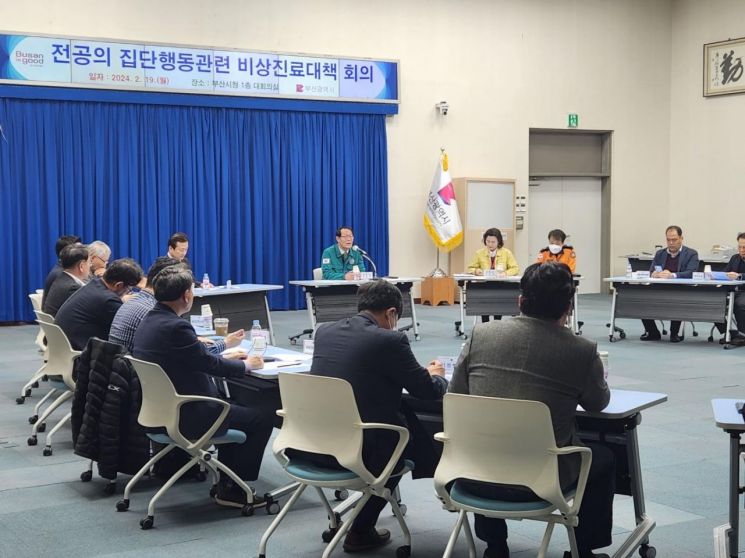
The meetings were organized to closely discuss emergency medical response measures with related organizations in preparation for the expected resignation of resident doctors.
Through these meetings, the city focused on discussing hospital situations and countermeasures, as well as measures to minimize patient inconvenience due to the shortage of resident doctors. They also shared recent trends in the medical community and the city’s current emergency medical response plans.
The meeting on the 17th was held at 10 a.m., attended by university hospital directors and the director of Busan Medical Center.
The meeting on the 19th was held at 3:30 p.m., attended by general hospital directors and the Fire and Disaster Headquarters.
On that day, Deputy Mayor Lee urged hospital directors to prepare emergency medical response plans for each hospital to maintain essential functions such as emergency care, intensive care, surgery, and dialysis, so that citizen inconvenience could be minimized.
He also requested that medical institutions work to stabilize medical services, warning that if the collective action of resident doctors and others prolongs, citizens’ safety and health could be threatened.
Participants agreed on the importance of the roles of not only university hospitals but also general hospitals and the Fire and Disaster Headquarters in preventing medical service gaps, as well as the need for distributing care for moderate to severe patients and cooperating in appropriate patient transfers.
The city is implementing emergency medical response measures based on the city’s health care crisis management action manual to prevent medical service gaps.
Since the 6th, an emergency medical response situation room has been operating to continuously monitor trends in the medical community in response to the collective action.
Requests have been made to four public medical institutions and 18 training hospitals to establish and implement emergency medical response plans.
In the event of medical service gaps caused by collective resignation or collective work stoppage of resident doctors, the city plans to encourage and inspect the implementation of emergency medical response plans prepared by medical institutions and emergency medical institutions.
Additionally, to minimize inconvenience for citizens in accessing medical services, information on open medical institutions will be provided on the city and district/county websites.
Deputy Mayor Lee Jun-seung stated, “We have sought emergency medical cooperation from public medical institutions, university hospitals, and general hospitals to minimize medical service gaps caused by the collective action of the medical community,” adding, “We hope resident doctors and others will refrain from collective actions for the safety and health of citizens,” and urged, “Citizens are also asked to use nearby local clinics and hospitals first unless it is a severe or emergency situation.”
© The Asia Business Daily(www.asiae.co.kr). All rights reserved.
![User Who Sold Erroneously Deposited Bitcoins to Repay Debt and Fund Entertainment... What Did the Supreme Court Decide in 2021? [Legal Issue Check]](https://cwcontent.asiae.co.kr/asiaresize/183/2026020910431234020_1770601391.png)















