"Rather than the medical workforce issue, the problem is the avoidance of certain specialties"
Geum Tae-seop "Considering differential fee increases for local medical shortages"
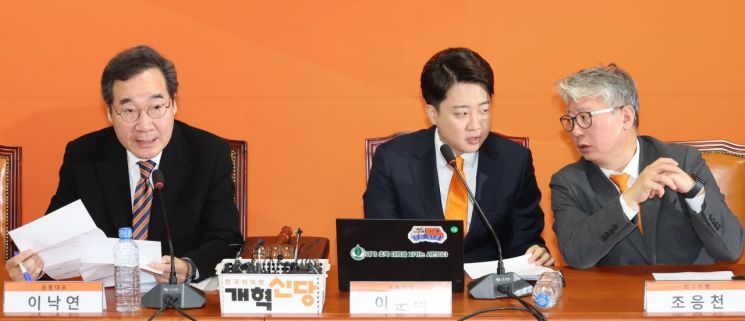
Lee Jun-seok, co-leader of the Reform New Party, pointed out on the 19th that the government's policy on increasing medical school quotas may be part of an election strategy to gain public support ahead of the general election. Instead of focusing on expanding medical school quotas, Lee emphasized the need for reforming the fee structure.
At the Reform New Party's Supreme Council meeting that day, Co-leader Lee criticized the policy to increase medical school quotas by 2,000, saying, "Is it just a coincidence that the long-standing discussion on expanding medical school quotas is announced just two months before the parliamentary election?" and asked, "Is this a well-prepared reform?" He also pointed out, "At a time when less than nine months remain before the college entrance exam, do they not know what impact announcing an increase of 2,000 medical school quotas from 3,000 starting next year will have on the exam?"
Regarding doctors' opposition, he said, "It is nothing special," and mentioned, "Even if the number of private taxi licenses in Seoul were increased by 62% at once, or the number of convenience stores per unit area were increased by 66%, there would be fierce resistance." He referred to outpatient visits per person and average life expectancy, stating, "Our healthcare system operates very efficiently by international standards."
Lee described the essence of the controversy, saying, "Ultimately, the problem is not a shortage of doctors but the avoidance of certain specialties," and added, "They claim to increase residents in unpopular fields like pediatrics, but in reality, they are attacking the high-income medical profession to gain temporary public support by selling dog meat." He continued, "It is not that low birth rates exist because there are no pediatricians, but rather, because of low birth rates, there is no motivation to open pediatric clinics." He said, "For the Yoon Seok-yeol administration's approach to be fair and reasonable, it must first recognize the problem of the distorted fee structure that forces doctors to see one patient every six minutes through low-cost, high-volume medical practices. They must also present alternatives on how to operate obstetrics and pediatrics, pay nurses' salaries, and open and run hospitals in 34 local governments where fewer than 100 newborns are discharged annually under the current fee system."
Lee emphasized, "Ultimately, there is no answer other than reforming the fee structure."
Geum Tae-seop, a Supreme Council member of the Reform New Party, also raised the fee issue as a solution to the lack of medical personnel in rural areas. Geum pointed out, "One of the biggest reasons for needing to increase medical school quotas is to solve the shortage of essential medical services in rural areas, but this cannot be solved simply by increasing medical school quotas," citing "the helicopter transfer incident involving Lee Jae-myung, leader of the Democratic Party of Korea," as a clear example. He said, "Although Lee could have been adequately treated at Pusan National University, he used a loophole to take a helicopter to Seoul National University." He added, "As patients from rural areas flock to hospitals in Seoul, rural medical institutions inevitably face worsening financial difficulties and declining medical standards." Mentioning the decline in rural populations, he said, "Experts consistently point out that to rebuild essential rural medical services, the demand and supply of medical services in rural areas must be self-sustaining," and suggested, "It is necessary to consider raising rural medical fees differentially until a certain point." He further proposed, "When rural healthcare approaches Seoul's level, we should consider reviving the previously implemented wide-area medical service zone system."
© The Asia Business Daily(www.asiae.co.kr). All rights reserved.

















