Despite the last policy proposal in January, Seoul City pushes forward with additional construction... Waste reduction must be prioritized before it's too late
Notable for institutionalizing the nation's first incineration waste reduction policy
District Mayor Park Gang-su: "Mapo-gu's initiative will serve as a catalyst for positive change toward carbon neutrality"
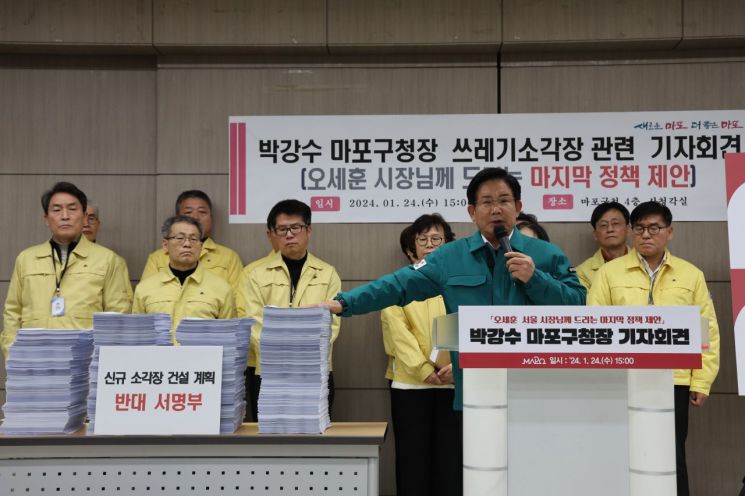
On the 16th, Mapo-gu (Mayor Park Gang-su) urgently submitted the "Ordinance on Waste Reduction in Mapo-gu, Seoul" containing administrative and institutional measures for carbon neutrality efforts and incineration waste reduction in the era of climate crisis to the 266th Mapo-gu Council extraordinary session.
This was in response to Seoul City's unilateral decision to forcibly proceed with the additional construction of an incineration plant despite the last policy proposal by Mayor Park Gang-su of Mapo-gu on January 24th against the additional construction, including conducting an environmental impact assessment and requesting a land category change for the planned site, which is a soil contamination area.
The ordinance submitted by the district includes groundbreaking measures for reducing incineration waste such as ?promoting coffee grounds recycling ?strengthening the obligation for business waste emitters to report ?expanding installation and operation of zero-incineration stores ?raising the price of volume-based waste bags ?disclosing waste generation and reduction status ?operating a waste reduction promotion council.
In particular, the ordinance features special policies that Mapo-gu is introducing for the first time nationwide.
Previously, even if the total daily waste of a building with multiple businesses exceeded 300kg, the district directly incinerated or landfilled all waste without requiring business waste emitter reporting. Going forward, buildings that generate large amounts of waste will be considered business waste emitters and required to report regardless of each business's daily waste amount if the total daily waste exceeds 300kg.
Additionally, for ‘apartment complexes’ under Article 2, Paragraph 1, Subparagraph 1 of the Apartment Housing Act and buildings newly constructed under Article 11 of the Building Act, the district can require the installation of zero-incineration stores, establishing an institutional foundation for proper waste separation from points where large amounts of household waste are generated.
Notably, new provisions were added to activate the recycling of coffee grounds, which have high value as recyclable resources but are currently incinerated or landfilled, allowing their discharge and collection.
According to the district, activating coffee grounds recycling can recycle an average of 3.5kg of coffee grounds per coffee shop per day, and if 1,585 coffee shops in Mapo-gu participate, it is expected to reduce incineration waste by 5,548kg daily.
Furthermore, to improve residents’ awareness of waste reduction and encourage active participation, the district will disclose monthly waste generation and reduction status by neighborhood on its website.
This allows residents to directly check how much waste is generated and reduced in their area and take appropriate measures.
Meanwhile, the district plans to strengthen the polluter pays principle to induce actual waste reduction and promote proper waste separation. Given public opinion that inexpensive volume-based waste bags reduce recycling rates, the district aims to enhance the polluter pays principle through regulatory amendments to increase recycling rates and encourage residents’ active participation in waste separation.
A district official said, “Looking at the policies and statistics promoted by Seoul City, after the introduction of the volume-based waste system, waste generation decreased by 8% in the first year (1995) compared to the previous year and by 11% in the second year compared to the year before introduction,” adding, “If institutional measures that can induce proper waste separation are established, household waste can be significantly reduced.”
Additionally, the district expanded the key collection items for efficient collection of recyclable resources. Previously defined as 12 items from paper to clothing, the key collection items were expanded to include coffee grounds and sewing fabrics, reflecting the district’s characteristics with many coffee shops and small-scale garment factories.
Thus, the ordinance highlights Mapo-gu’s exceptional dedication and efforts to reduce incineration waste.
Mayor Park Gang-su of Mapo-gu said, “This ordinance is an important first step that strengthens Mapo-gu’s advanced environmental policies and efforts to reduce incineration waste while actively encouraging residents’ participation,” adding, “If our efforts spread beyond Seoul City to the entire country, it will serve as a catalyst for positive change toward carbon neutrality in the era of climate crisis.”
© The Asia Business Daily(www.asiae.co.kr). All rights reserved.

















