KDCA Announces Key Policy Plans for 2024
Expectations for "Complete Return to Normal Life from COVID-19"
"Preparedness for Endemic Infectious Diseases and Super-Aged Society Illnesses"
The government plans to lower the COVID-19 crisis level from 'Alert' to 'Caution' as early as the first half of this year and transition the COVID-19 vaccine to a national mandatory immunization. Additionally, to proactively respond to new infectious diseases after the pandemic, it will establish an 'Infectious Disease Big Data Platform' to realize science- and data-based quarantine measures and focus on a quarantine system aimed at preventing the spread of chronic diseases and infectious diseases on a regular basis, emphasizing 'prevention' and 'management.' Alongside this, measures to prepare for the increasing elderly population will be put in place, such as expanding items like bone density tests in the National Health and Nutrition Examination Survey.
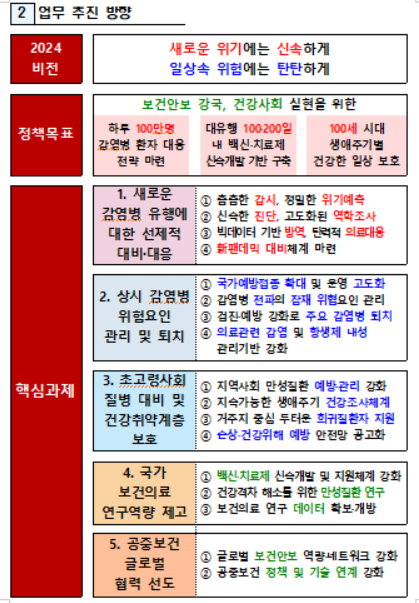
On the 19th, the Korea Disease Control and Prevention Agency (KDCA) announced its '2024 Major Policy Plan' under the theme 'Swiftly for new crises, firmly for everyday risks.' This is the first policy announcement since lowering the COVID-19 crisis level from 'Severe' to 'Alert' last June. This year, the KDCA will focus on 'complete recovery to normal life from COVID-19' while preparing policies centered on five key tasks: ▲ proactive preparation and response to new infectious disease outbreaks ▲ management and eradication of ongoing infectious disease risk factors ▲ preparation for diseases in a super-aged society and protection of vulnerable health groups ▲ enhancement of national health and medical research capabilities ▲ leading global public health cooperation.
First, after evaluating the situation such as the decrease in COVID-19 patients this year, the KDCA plans to lower the COVID-19 crisis level (Interest-Caution-Alert-Severe) from the current 'Alert' to 'Caution' and establish quarantine and special support systems at the same level as influenza. COVID-19 therapeutics will be covered by health insurance to be supplied within the routine medical system, and the COVID-19 vaccine will be transitioned to a national mandatory immunization. The timing for lowering the crisis level will be decided by comprehensively considering domestic and international quarantine situations.
The KDCA intends to build a meticulous quarantine and medical system to proactively respond not only to COVID-19 but also to new infectious disease outbreaks. To this end, it plans to establish an infectious disease big data platform in the first half of the year to activate information sharing on infectious diseases and to secure regional medical capacity by starting construction of an infectious disease specialized hospital in the Honam region. To prepare for the most likely candidate for a major infectious disease pandemic, 'influenza,' a 'Influenza Pandemic Preparedness Plan' will be established within the second quarter. Furthermore, the number of sentinel surveillance institutions for 11 types of respiratory infectious diseases, including COVID-19, will be expanded from the current 196 to 300, and a 'Mortality Sentinel Surveillance Plan' will be prepared within the second half of the year to enable epidemiological investigations of unusual deaths.
Efforts to prevent ongoing infectious diseases will also be made through expanded vaccination and focused management of high-risk groups. Life-cycle vaccinations will be promoted, starting in April with the introduction of the 15-valent pneumococcal conjugate vaccine (PCV15) for infants and young children into the national immunization program, and items with verified introduction validity such as shingles vaccination will be expanded. Additionally, management will be strengthened for tick-borne infectious diseases and mosquito-borne infectious diseases like dengue fever imported from overseas, and early detection of hepatitis C, which is crucial, will be pursued by introducing it into the national health screening. To eradicate malaria by 2030, the 'Second Malaria Re-eradication Action Plan' will also be established in April.
To prepare for a super-aged society, policies will focus on preventing chronic diseases. The KDCA will expand the education and counseling targets of hypertension and diabetes registration education centers from people in their 30s and 40s and the elderly to include those in their 20s, and considering social changes such as the increase in the elderly population, it will expand survey items in the National Health and Nutrition Examination Survey to include bone density tests, elderly functional status scales, and physical activity measurements.
In addition, a dual-track strategy of in-house development and global cooperation will be pursued for vaccine and therapeutic development, and the operation of the 'National Advanced Vaccine Development Center' will strengthen development infrastructure such as a vaccine antigen library. In the first half of the year, an execution strategy for therapeutic development in the event of new infectious disease crises will be prepared, and plans to secure vaccine sovereignty through proactive vaccine development and domestic production, including participation in multinational joint clinical trials, will be implemented.
Jiyoungmi, Commissioner of the KDCA, emphasized, "We will respond swiftly and thoroughly in times of crisis while firmly protecting public health from everyday risks," adding, "Based on the major policy plan announced today, we will select and implement nine key focus tasks for 2024."
© The Asia Business Daily(www.asiae.co.kr). All rights reserved.
![From Hostess to Organ Seller to High Society... The Grotesque Scam of a "Human Counterfeit" Shaking the Korean Psyche [Slate]](https://cwcontent.asiae.co.kr/asiaresize/183/2026021902243444107_1771435474.jpg)
















