Potassium-competitive acid blockers (P-CABs), which overcome the drawbacks of existing gastroesophageal reflux disease (GERD) treatments, are rapidly dominating the market. While early developers express expectations for growth into 'global blockbusters,' efforts to develop follow-up new drugs and generics are also ongoing.
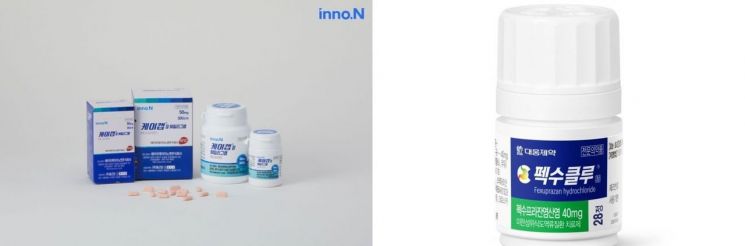 P-CAB class gastroesophageal reflux disease treatments, HK Innoen's K-CAB and Daewoong Pharmaceutical's Pexuclu (from left)
 [Photo by each company]
Gastroesophageal reflux disease is a condition where food and stomach acid flow back into the esophagus, causing pain. The number of patients is rapidly increasing due to westernized dietary habits such as increased consumption of coffee and carbonated drinks. According to the Health Insurance Review & Assessment Service on the 18th, the number of patients rose from 4.44 million in 2018 to 4.9 million in 2022.
However, the existing standard treatment, proton pump inhibitors (PPIs), must be taken 30 minutes to 1 hour before meals, and their effects only appear 6 to 7 hours after ingestion, presenting certain limitations. In contrast, P-CABs can be taken regardless of meals, act quickly immediately after administration, and have long-lasting effects, thus capturing both convenience and efficacy, rapidly gaining market dominance.
The combined prescription amount of P-CAB formulations, including HK inno.N's K-CAB (approximately 150 billion KRW) and Daewoong Pharmaceutical's Pexuclu (approximately 50 billion KRW), grew to the 200 billion KRW range last year. The market share of P-CABs has also risen to around 20%. Even by individual formulation, K-CAB ranks first and Pexuclu second in market share among all GERD treatments.
Overseas expansion is also active. HK inno.N has set a local sales target of 2 trillion KRW annually for K-CAB by 2030. It is sold in seven countries including China, the Philippines, and Indonesia, and in total, technology or finished products have been exported to 35 countries. Pexuclu also began its market entry with a launch in the Philippines last year and is currently knocking on the doors of 24 countries. Daewoong Pharmaceutical expects blockbuster growth with annual sales of 1 trillion KRW through expansion into 100 countries by 2027.
Other pharmaceutical companies are also actively developing P-CABs. The most advanced is Jeil Pharmaceutical. Through its subsidiary Onconic Therapeutics, it completed phase 3 clinical trials of Zastaprazan (development code JP-1366) and applied for approval from the Korean Ministry of Food and Drug Safety in June last year. Ildong Pharmaceutical recently received approval from the Ministry for phase 2 clinical trials of its new drug candidate ID120040002. Clinical trials are planned to start next month and conclude by February 2025.
As the market grows rapidly, generic developers are also accelerating development. Although K-CAB’s patent expires in 2031, generic developers plan to circumvent this and launch as early as 2026. More than 80 companies have filed related patent lawsuits. Samchundang Pharmaceutical has already completed bioequivalence studies, while Pharmgen Science and Aliko Pharmaceutical are currently conducting bioequivalence tests.
© The Asia Business Daily(www.asiae.co.kr). All rights reserved.
![Clutching a Stolen Dior Bag, Saying "I Hate Being Poor but Real"... The Grotesque Con of a "Human Knockoff" [Slate]](https://cwcontent.asiae.co.kr/asiaresize/183/2026021902243444107_1771435474.jpg)
















