Comprehensive Consideration of Expert Committee and Monitoring Team Opinions
The National Education Commission will discuss whether to revise the curriculum to establish grounds related to the international foreign language high schools and autonomous private high schools (Jasago) that have been decided to be maintained.
On the afternoon of the 16th, the National Education Commission announced that it will hold its 26th meeting to deliberate on the 'Request for Establishment or Change of National Curriculum (related to Jasago, etc.)'. Earlier, the Yoon Seok-yeol administration overturned the previous government's policy to abolish foreign language high schools, Jasago, and international high schools, and revived the grounds for their maintenance through an enforcement ordinance revision on the 16th of last month.
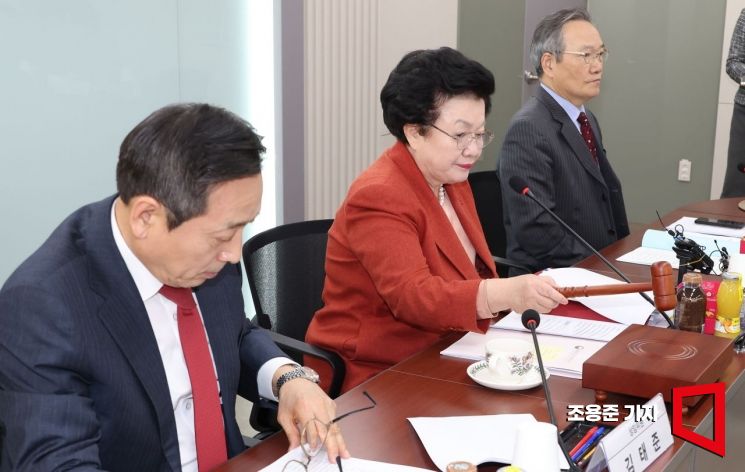 Lee Baeyong, Chairman of the National Education Commission, is striking the gavel at the first plenary meeting of the National Education Commission held on January 12 at the Government Seoul Office in Jongno-gu, Seoul. Photo by Jo Yongjun jun21@
Accordingly, the National Education Commission will decide whether to proceed with the establishment or revision of the curriculum requested by the Ministry of Education following the revival of Jasago, international high schools, and foreign language high schools. The decision will be made comprehensively considering the prior review by the 'National Curriculum Expert Committee' and the opinions collected by the 'National Curriculum Monitoring Group'.
During the meeting, the plan for the composition and operation of the 2nd National Curriculum Monitoring Group will also be reported. The monitoring group will play a role in conveying voices from the education field. The major activities of the Public Participation Committee last year and its operation plan for this year will also be reported as agenda items. The Public Participation Committee is composed of 500 citizens and has expressed opinions on various educational issues such as the '2028 University Entrance System Reform Draft Forum'.
The Ministry of Education will provide a report on the Education Development Special Zones. These zones are policies promoted to nurture local talents and establish a foundation for their settlement in the region. The National Education Commission plans to continue discussions focusing on the impact of the Education Development Special Zones on regional development and the education field.
Chairman Lee Baeyong stated, "Listening to the voices of the people with an open mind while communicating with the field on educational issues is an important role of the National Education Commission," and added, "We will continue to actively collect opinions through the National Curriculum Monitoring Group and the Public Participation Committee and strive to establish mid- to long-term education plans that meet the expectations of the public."
© The Asia Business Daily(www.asiae.co.kr). All rights reserved.
![Clutching a Stolen Dior Bag, Saying "I Hate Being Poor but Real"... The Grotesque Con of a "Human Knockoff" [Slate]](https://cwcontent.asiae.co.kr/asiaresize/183/2026021902243444107_1771435474.jpg)
















