Opened the seasoning container to organize it and found trash inside
Fortunately, the restaurant owner discovered it first, so there was no major damage
Netizens are outraged over a story about a troublesome customer who pretended to clean up the table after dining at a restaurant but actually put trash inside the seasoning containers. On the 16th, a post titled "The customer cleans up so well like this" was uploaded to the self-employed community 'Apeunikka Sajangida' (Because It Hurts, I'm the Boss). The author, presumed to be running a restaurant, Mr. A, shared the situation, saying, "After the customer finished their meal, they closed the lids of the perilla seed container, the sansho pepper container, and the rice lid, stacked the dishes high, and cleaned up well."
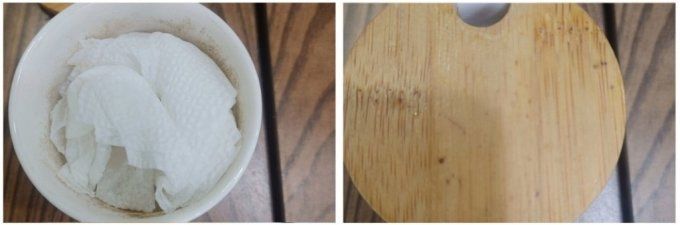 Netizens are outraged by a story of a troublesome customer who pretended to clean up the table after dining at a restaurant but secretly put trash inside the condiment containers. On the 16th, a post titled "The customer cleans up so well like this" was uploaded to the self-employed community "Apeunikka Sajangida." [Photo by Online Community "Apeunikka Sajangida"]
He continued, "I noticed powder on the lid of the sansho pepper powder container, so I opened the lid to wipe it off, but found trash inside," and shared a photo. The photo showed used tissues and other trash inside the seasoning container. Mr. A explained, "Our store usually checks and refills the perilla seed and sansho pepper containers thoroughly at the end of lunch and dinner service times, wiping them clean," and added, "If I hadn't discovered it first and another customer had, they would have been very upset," expressing relief.
He added, "Previously, there was a customer who rolled up used tissues and stuffed them inside the napkin box, so I wonder if it might be the same person," and urged, "Customers, please do not stuff tissues anywhere; just throw them away properly." Netizens who read Mr. A's story expressed shared outrage at the customer's behavior, commenting, "I thought I was mistaken. I couldn't believe my eyes," "A new type of troublesome customer," and "What if you hadn't opened it?"
Previous Acts Can Be Punished as Obstruction of Business
In January last year, there was an incident at a large Japanese franchise conveyor belt sushi restaurant that caused a nationwide uproar in Japan by spitting on sushi. Known as the 'Sushi Terror' incident, a high school student, Mr. B, eventually dropped out of school. Mr. B visited the restaurant and engaged in disruptive acts such as spitting on soy sauce bottles, water cups, and sushi on the conveyor belt used by other customers, filming the acts and posting them on social media. Due to Mr. B's actions, the stock price of F&L, the parent company of Akindo Sushiro, which operates 'Sushiro,' plummeted nearly 5%, wiping out about 160 billion yen in market capitalization in a single day.
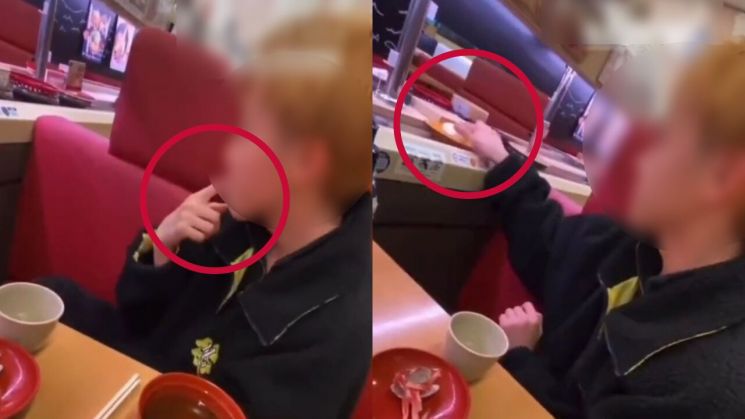 Around January last year, there was an incident at a large Japanese franchise conveyor belt sushi restaurant where someone was caught spitting on sushi, causing a nationwide uproar in Japan. This incident, known as the "Sushi Terror," ultimately led to high school student B dropping out.
 [Photo by X (formerly Twitter)]
This commotion led to the discovery of numerous excessive nuisance videos on Japanese social media. Local experts noted, "Even if the offenders are minors, the affected businesses maintain a strict stance in responding," and warned, "The perpetrators might have considered it a harmless prank, but they could face much harsher consequences than expected."
Additionally, engaging in nuisance acts such as licking the mouth of soy sauce bottles can result in civil and criminal penalties. A representative criminal charge is property damage. This crime involves damaging or harming another person's property, but even if no physical damage occurs, acts that psychologically render the property unusable or reduce its value are also considered damage, punishable by imprisonment of up to three years or a fine of up to 300,000 yen.
If the video spreads and causes damage to the business, the person who filmed it may be charged with obstruction of business by deception or intimidation. Both offenses carry penalties under Japanese criminal law of up to three years imprisonment or fines up to 500,000 yen. Moreover, not only the perpetrator but also accomplices who encouraged the filming can be charged with complicity or aiding and abetting and punished accordingly.
Under domestic criminal law, similarly, putting trash inside seasoning containers can be punished as obstruction of business. Since obstruction of business is a crime applied in various real-life situations, anyone can be suspected. The scope of 'business' itself includes economic activities as well as non-profit or mental administrative tasks.
© The Asia Business Daily(www.asiae.co.kr). All rights reserved.


















