Presiding Over the 12th Public Discussion in Daejeon
"Upgrading as a Science and Technology Hub"
Introduction of Research Scholarships for STEM Graduate Students
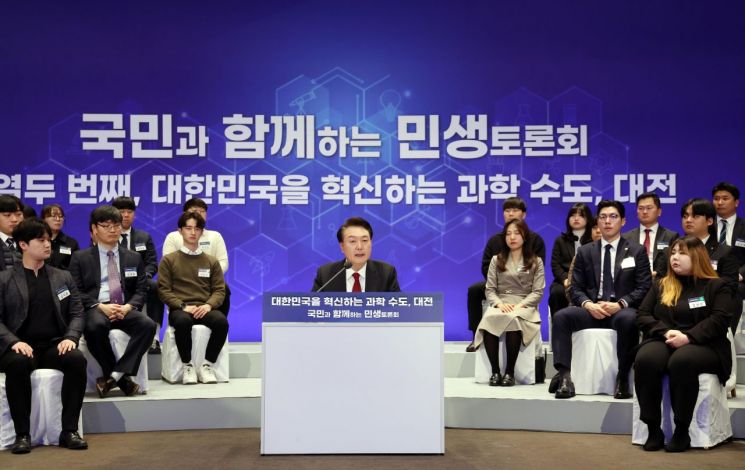 President Yoon Suk-yeol is speaking at the 12th "Public Livelihood Discussion" held under the theme "Daejeon, the Science Capital Innovating the Republic of Korea" on the 16th at ICC Hotel in Yuseong-gu, Daejeon.
 [Image source=Yonhap News]
President Yoon Suk-yeol indicated on the 16th that he plans to rapidly develop the Daejeon 2nd Daedeok Research Complex into an advanced cluster that organically combines research and development with service industries such as law, finance, and accounting, similar to the Boston Bio Cluster in the United States, alongside the 1st Complex.
On the same day, President Yoon held the twelfth public discussion forum titled "Daejeon, the Science Capital Innovating the Republic of Korea" at the Daejeon ICC Hotel in the morning, announcing his intention to nurture Daejeon as a global hub of an innovation cluster befitting its status as the science capital.
Having visited Busan on the 13th for the first time in a non-capital region to hold a public discussion forum, President Yoon emphasized upgrading Daejeon as a science and technology mecca during his second regional public discussion forum visit.
In his opening remarks, President Yoon stressed, "The most certain way to enhance national science and technology competitiveness is to nurture future talent," promising, "We will ensure that science and engineering students can focus on their studies and research without worrying about tuition or living expenses."
To this end, President Yoon announced the introduction of a 'stipend' research living scholarship for full-time science and engineering graduate students participating in national research and development, providing a minimum of 800,000 KRW per month for master's students and 1,100,000 KRW for doctoral students. Additionally, the government scholarship budget will be increased by approximately 130 billion KRW this year, and the Presidential Science Scholarship, previously only available to undergraduates, will be expanded to graduate students, supporting an average of 25 million KRW per person annually.
President Yoon stated, "We have deregulated a total of 26 government-funded research institutes (including affiliated institutes), including 16 located in Daejeon, from public institution status for the first time in 16 years, freeing them from various regulations unsuitable for research institutions," and urged, "I hope these institutes will be reborn as flexible and dynamic research organizations attracting excellent researchers from around the world."
He further called for breaking down barriers between these research institutes to create an environment where researchers can freely interact and collaborate, and for upgrading compensation systems and organizational and personnel management systems to flexibly recruit outstanding researchers.
President Yoon emphasized that Daejeon will be transformed to expand urban openness and connectivity befitting its status as the science capital. He said, "We will underground the Gyeongbu and Honam railway lines that hinder Daejeon's urban development and promptly initiate the feasibility study for the public-private partnership project of the 'Daejeon-Sejong-Cheongju CTX (Chungcheong Train Express)' to enable synergy between Sejong's administrative functions and Cheongju's bio and semiconductor industries, aiming to realize the project within my term."
Moreover, he stressed that the 2nd Daedeok Research Complex, pledged during the presidential campaign, will be rapidly developed alongside the 1st Complex into an advanced cluster that organically integrates research and development with service industries such as law, finance, and accounting, similar to the Boston Bio Cluster in the United States.
President Yoon stated, "To foster advanced science and technology, the past support methods are insufficient," adding, "Research and development must be organically combined with service industries such as law, finance, and accounting, like the Boston Bio Cluster in the U.S." He explained that this approach would translate research and development outcomes into high economic value, creating a virtuous cycle of reinvestment that further activates research and development.
President Yoon concluded, "By combining the 1st special zone and the newly established 2nd special zone, we will create the world's top-level Daejeon advanced cluster in fields such as nano, semiconductors, bio, aerospace, and defense industries," and added, "I hope the central government ministries and Daejeon city will work as one team to swiftly advance this initiative."
© The Asia Business Daily(www.asiae.co.kr). All rights reserved.

















