KAMA Analysis... Up 36% in 4 Years
Strong Sales of SUVs and Hybrid Cars
Last year, the average price of new cars in South Korea reached 49 million won.
On the 15th, the Korea Automobile Mobility Industry Association (KAMA) announced in its "2023 New Vehicle Registration Status Analysis" report that the average price of newly registered passenger cars last year was 49.22 million won. This amount represents a 2.4% increase compared to the previous year. It includes value-added tax and other charges incurred when purchasing a vehicle.
The average price of passenger cars, which was 36.2 million won in 2019, rose to ▲39.84 million won in 2020 ▲44.44 million won in 2021 ▲48.06 million won in 2022, and reached 49.22 million won last year, marking an increase of 13.02 million won (36.0%) over four years. If this trend continues, the average price of new passenger cars this year is expected to exceed 50 million won.
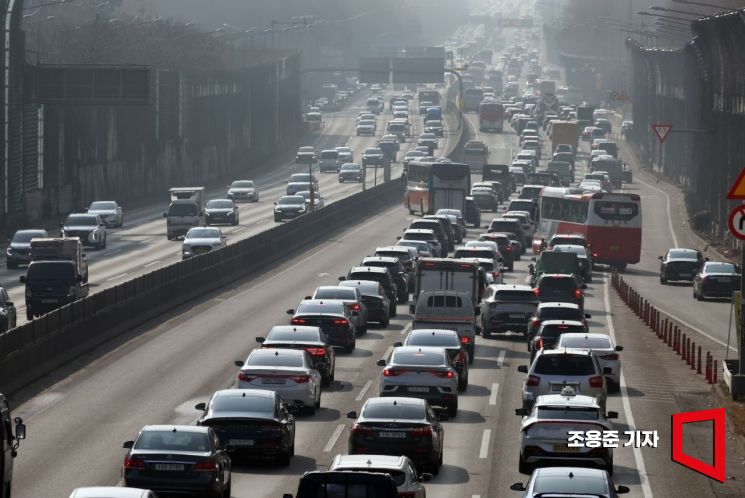 Cars lined up on the highway. The photo is not related to the specific content of the article. Photo by Jo Yongjun jun21@
The number of newly registered vehicles last year increased by 3.9% from the previous year to 1,749,000 units. Domestic cars saw a 5.9% increase to 1,453,000 units, while imported cars decreased by 4.8% to 296,000 units. Imported cars, which recorded a record market share of 18.5% in 2022, experienced a decline in sales due to a reverse base effect, the popularity of domestic luxury models, and weakened consumer sentiment, resulting in a 1.6 percentage point drop in market share.
By vehicle type, passenger cars increased by 4.8% year-on-year, supported by record sales of sports utility vehicles (SUVs). By body type, SUVs saw a 10.8% increase to 824,000 units registered, setting an all-time high due to expanded choices including new electric vehicles. By fuel type, hybrid vehicles continued their strong performance. Hybrid vehicle sales rose 42.5% year-on-year to 391,000 units, increasing their market share from 16.3% to 22.3%. Electric vehicle registrations decreased by 1.1% to 162,000 units due to insufficient charging infrastructure and weakened consumer conditions, while hydrogen fuel cell vehicle registrations dropped 54.4% to 4,707 units. The market share of diesel vehicles fell below 10% for the first time, standing at 7%.
The total acquisition amount for vehicles last year was 78.5 trillion won, a 6.6% increase. The strong sales of high value-added vehicles such as SUVs and hybrid cars, along with increased preference for luxury vehicles, pushed the total acquisition amount to a record high. The performance of Japanese and Chinese imported cars was also notable last year. Registrations of German and American brands decreased by 6.4% and 17.0% respectively compared to the previous year, while Japanese brands increased by 35.5%. In particular, Chinese imported cars surged 107.3% to 26,000 units, driven by the popularity of the Chinese-made Tesla Model Y.
© The Asia Business Daily(www.asiae.co.kr). All rights reserved.

















