Contains 8% More Protein and 7% More Fat Than Regular Rice
'Cultured Meat' Made by Attaching Bovine Stem Cells to Rice
Domestic researchers have developed a so-called 'beef rice' by attaching bovine stem cells to rice.
Rice structured for mass culturing of bovine cells... "Meets food safety requirements, composed of ingredients with low risk of causing food allergies"
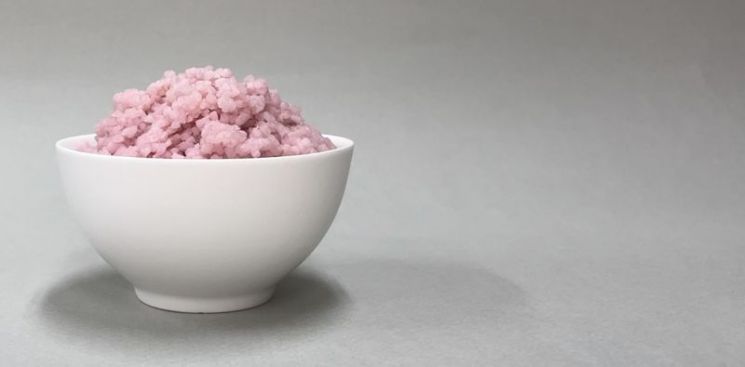 Professor Hong Jin-gi and his research team at Yonsei University developed a new cultured meat by attaching bovine stem cells to rice. The photo shows rice cooked with the so-called 'beef rice.' [Image source=Yonsei University]
According to the content revealed on the 15th in the academic journal Matter by Professor Hong Jin-gi's team from the Department of Chemical and Biological Engineering at Yonsei University, 'beef rice' containing 8% more protein and 7% more fat than regular rice has been developed. This pinkish beef rice is actually 'cultured meat' (meat produced by cell culture). Dr. Park So-hyun, a postdoctoral researcher at Johns Hopkins University who participated in the development of beef rice, explained, "This rice itself is highly nutritious, but it can be further enhanced by adding livestock cells."
When producing cultured meat, four factors are known to be most important: the type of cells used, the type of culture medium, the scaffold used to grow the cells, and how the product is processed into food. In particular, to form tissue by cells gathering together, a scaffold that surrounds the cells and allows three-dimensional growth is necessary. Professor Hong's research team focused on rice while searching for scaffold candidates to mass culture bovine cells. Rice is ideally structured for cell growth because it has very fine pores where cells can penetrate and grow in every corner. Additionally, rice contains nutrients necessary for the growth of bovine stem cells, making it an ideal scaffold. Professor Hong added, "When living bovine cells are harvested and cultured separately, they do not grow well, but we confirmed that they grow well on rice."
The research team coated the rice with gelatin extracted from fish to help cells adhere better to the rice. Then, bovine muscle and fat stem cells were seeded onto this rice and cultured in laboratory dishes for 9 to 11 days. The researchers explained, "The beef rice produced in this way meets food safety requirements and is composed of ingredients with a low risk of causing food allergies."
When cooked, the texture is firm and crumbly... "Expected to contribute to environmental conservation and food aid upon commercialization"
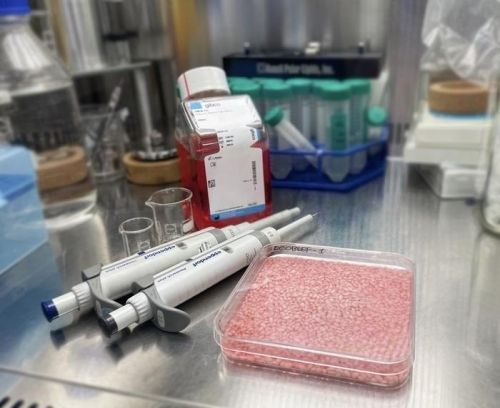 Professor Hong Jin-gi and his research team at Yonsei University developed new cultured meat by attaching bovine stem cells to rice. The photo shows the cultivation of beef rice. [Image source=Yonsei University]
However, when cooked as rice, beef rice was neither sticky nor chewy like regular rice, nor was it soft. Rather, it was firmer and more prone to crumbling. Compared to Japonica rice, beef rice is known to have a texture similar to Indica rice. Furthermore, beef rice with a high muscle content emitted odors similar to beef or almonds, and when the fat content increased, it smelled like cream, butter, or coconut oil. Additional research is needed to commercialize it like regular rice. The research team plans to continue studies to increase the amount of muscle and fat growing on the rice.
Nonetheless, the researchers predicted a high possibility of commercialization due to the low food safety risks and relatively simple production process of beef rice. Dr. Park said, "While beef approaches 20,000 KRW per kilogram, if beef rice culturing is commercialized, beef rice could cost about 3,000 KRW per kilogram," adding, "This beef rice could play roles in food aid during famines, military rations, and even space food in the future."
It is also expected to be a better choice for the environment. It is estimated to significantly reduce carbon dioxide emissions compared to obtaining beef through livestock farming. Dr. Park explained, "Producing 100g of protein from beef rice emits 6.27 kg of carbon dioxide, whereas beef obtained from livestock farming is estimated to emit 49.89 kg of carbon dioxide."
Foreign media also paid attention to this beef rice. On the same day, the British BBC referred to beef rice as "a new type of hybrid food that could be an affordable and environmentally friendly protein source." However, the foreign media added, "If it is released to the market, it remains to be seen whether consumers will accept it."
© The Asia Business Daily(www.asiae.co.kr). All rights reserved.


















