Causes of Winter Foraging Activity and Male-Female Movement During Breeding Season
Water deer sightings are increasing in urban and mountainous residential areas in Gangwon Province. Experts attribute this to feeding activities and the breeding season.
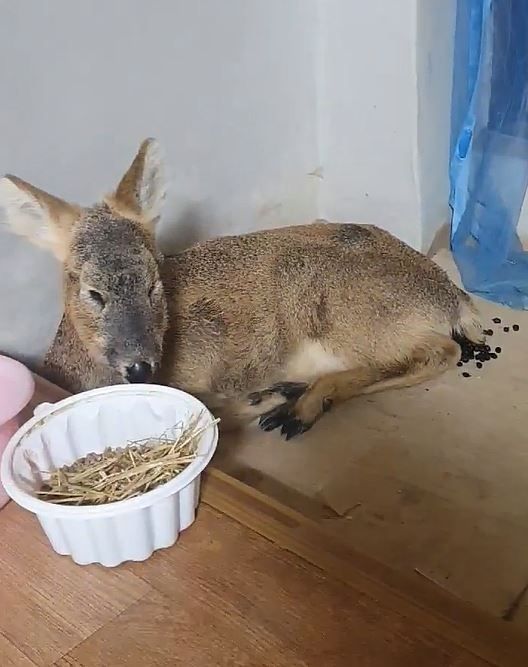 A water deer resting inside a house, found in front of a house in Daegwallyeong, Pyeongchang. [Image source=Kwon Tae-woo (51)·Yonhap News]
On the 14th, Yonhap News reported a story about a water deer found in front of the house of Kwon Tae-woo (51) and his family in Daegwallyeong, Pyeongchang-gun, at around 1:30 p.m. the previous day. Judging that they could not leave the water deer outside until evening when the temperature dropped, the Kwon family brought the motionless water deer lying in the yard into their home. Kwon explained, "It seemed to have no energy at all, probably because it hadn't eaten properly all winter," adding, "We decided to keep it inside and feed it until we handed it over to a rescue organization." Pyeongchang-gun plans to send the water deer rescued by the Kwon family to the Gangwon National University Wildlife Rescue Center on the 15th. After the rescue measures, if the water deer's health recovers, it will be released back into the wild.
This is not the first time Kwon has found a water deer. Earlier, on the 8th, he spotted another water deer near a road close to his house. He honked the horn from inside his car, but the water deer did not move, and he said that sightings of water deer have become more frequent recently.
Experts say there are various reasons why water deer appear in urban or residential areas like this. First, in areas like Daegwallyeong where accumulated snow does not melt for a long time, water deer are more likely to descend to lowlands or residential areas in search of food. Also, February is the breeding season for water deer, and frequent movement of males and females leads to sightings near roadsides, farmlands, and urban areas. However, since water deer are wild animals, it can be dangerous to bring them inside or keep them just because they are found.
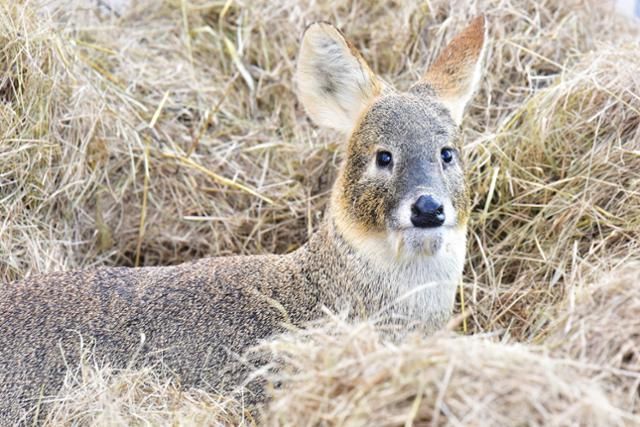
Kim Jong-taek, professor of veterinary medicine at Gangwon National University and director of the Wildlife Rescue Center, said, "It depends on the situation, but wild animals being held by humans can be dangerous for the animals," adding, "If the animal is judged to be in a dangerous state, it is appropriate to attempt warming and dehydration correction measures under expert guidance."
Water deer are mammals belonging to the order Artiodactyla and family Cervidae, with a body length of about 77.5 to 100 cm and a weight of 9 to 11 kg. Both males and females lack antlers, but the upper canine teeth are developed into tusk-like shapes. Scientifically, water deer are native species found only in Korea and China worldwide and are internationally endangered. However, among the deer species in Korea, water deer have the largest population and are not designated as endangered wildlife. On the contrary, the population of water deer in Korea is steadily increasing, causing damage to crops by invading farmlands, leading local governments to implement policies to prevent damage caused by water deer and other wild animals.
© The Asia Business Daily(www.asiae.co.kr). All rights reserved.


















