Reproducing Artisans' Know-How and Skills with AI
"Artificial Intelligence Can Contribute to Technology Transmission"
The aging population in Japan, which began more than a decade ago, has also swept into the "tuna industry." In Japan, a representative high-end tuna consumer country, tuna experts classify grades every year by assessing the aroma and flesh color of tuna. However, recently, due to a shortage of labor and fewer people willing to learn tuna appraisal, this tradition is said to be on the verge of extinction.
Amid this situation, a "Tuna Appraiser Artificial Intelligence (AI)" has emerged as a savior to replace tuna experts. Deep learning AI, trained on cross-sectional photos of hundreds of tuna, determines the quality of tuna instead of humans.
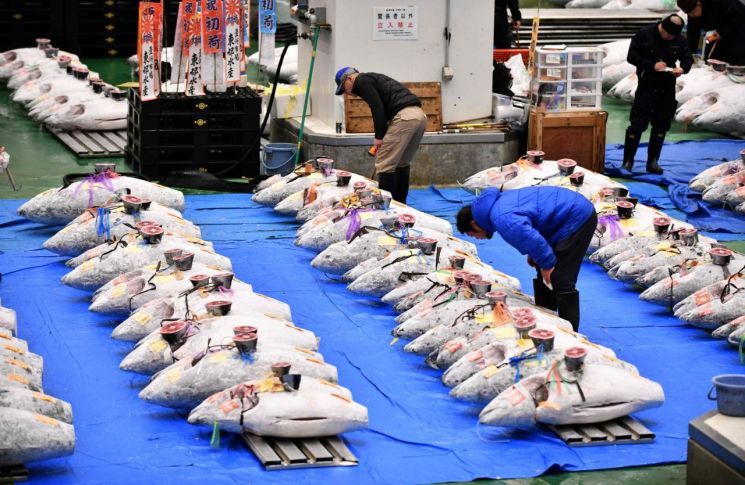 Tuna graders are Japanese artisans who select only the highest grade tuna. They are key experts in the global tuna market.
 [Image source=EPA Yonhap News]
The Japanese daily newspaper Sankei Shimbun spotlighted the tuna appraisal AI service "Tuna Scope" on the 13th (local time). Tuna Scope is a computer vision AI developed by Dentsu, one of Japan's top five advertising companies. It was trained using photos of the flesh of hundreds of tuna as learning data and can appraise the condition and grade of tuna based on cross-sectional materials.
The usage is simple. Run the application (app) installed on a smartphone and take a photo of the cross-section of the tuna you want to appraise with the camera. Then, the AI embedded in the app processes the captured image and assigns a grade to the tuna.
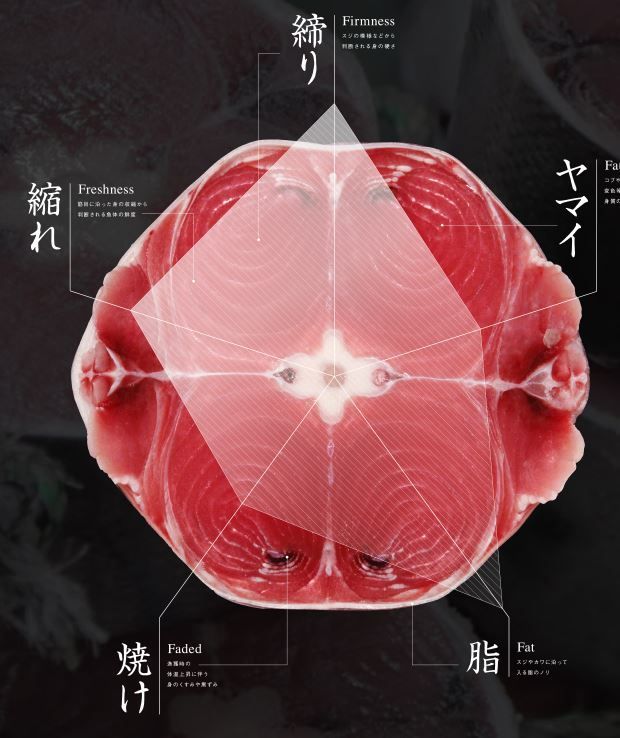 How Dentsu's 'Tuna Scope' Identifies Tuna. Experts believe that the key to determining the taste of tuna lies in the otoro (fatty belly), and Tuna Scope classifies grades by examining the shape and cross-sectional images of the otoro.
 [Image source=Dentsu]
Tuna quality can be determined through various information such as the tail, aroma, flesh color, and fat distribution. Industry experts select only the highest quality tuna with sharp discernment, enabling Japan's fisheries industry to reliably supply premium tuna to "big-spending" customers every year.
The problem is that recently, the tradition of tuna experts is on the verge of disappearing. Tuna experts are trained through rigorous practical experience and an apprenticeship-style transfer of know-how. One must spend decades roaming fish markets, learning to appraise tuna by sight to become an excellent appraiser. Due to these characteristics, even large corporations reportedly find it difficult to hire proper tuna appraisal artisans.
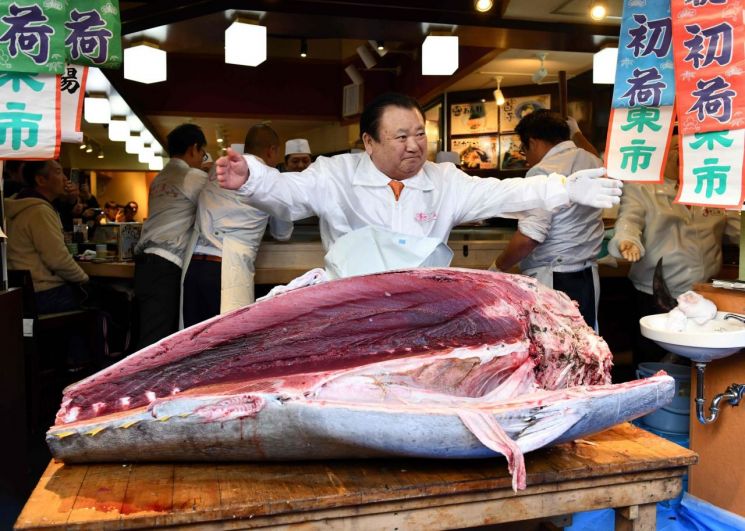 Like other masters, tuna grading also requires decades of training and education.
 [Image source=EPA Yonhap News]
However, there are almost no young apprentices willing to silently endure the grueling repetitive work of wandering cold markets from dawn, and the existing experts are aging. Dentsu's "Tuna Scope" is an AI expert that will eventually replace human experts who will disappear someday.
In Japan, the development of appraisal AI like "Tuna Scope" is gaining popularity. Japanese electronics company Sharp unveiled an AI sensor capable of detecting aromas at its solo technology exhibition "Tech Day" last November. This AI analyzes the smell emitted by wine and can identify its type.
 Sharp Japan has developed an AI sensor that can identify the type of wine just by smelling it, similar to a sommelier. Photo is not related to any specific expression in the article [Image source=Pixabay]
Although AI is replacing existing human experts, this does not mean the need for human experts has diminished. On the contrary, experts are playing active roles as "teachers" who instruct AI.
For example, several tuna appraisers participated as advisors in the development of Tuna Scope. They were responsible for classifying the cross-sectional photo data of tuna used for learning by grade. This is a process of digitizing the experts' unique intuition, know-how, and details that cannot be expressed in words and reproducing them on a computer.
Thanks to these characteristics, expectations are rising that AI can become a substitute for "artisans" facing extinction. Professor Hiroshi Watanuki of the Graduate School of Science and Engineering at Saitama University in Japan said, "AI that identifies and reproduces the characteristics of certain tasks has a high affinity with the skills of Japanese artisans," and predicted, "It can contribute to solving labor shortages and the transmission of skills that require apprenticeship-style training."
© The Asia Business Daily(www.asiae.co.kr). All rights reserved.



















