Mungyeong Firefighter Dies in Line of Duty
'Sandwich Panels' Increase Casualties
Despite Stricter Regulations... "9 out of 10 Sites Noncompliant"
Recently, a fire broke out at a meat processing factory in Mungyeong-si, Gyeongbuk Province. The cause that escalated this accident, which resulted in the deaths of two firefighters, was the 'sandwich panel.' Sandwich panels are building materials that have insulation materials such as Styrofoam or urethane foam sandwiched between steel plates or boards. They were the cause of the 1999 fire at the Sea Land Youth Training Center, which killed 23 people. Although 25 years have passed since this accident, sandwich panels are still pointed out as the cause of fire disasters. Despite strengthened regulations, accidents continue to recur, and industry experts agree that urgent measures are needed to ensure compliance with current laws.
According to the Ministry of Land, Infrastructure and Transport on the 14th, an investigation of sandwich panels from 10 companies certified for using the standard model last November found that 9 were non-compliant products. This is why there are claims that although laws have been strengthened, actual public safety has not been secured. Additionally, the Korea Institute of Civil Engineering and Building Technology conducted unannounced inspections of construction sites and building material factories nationwide in 2022, and out of 208 locations, 62 were judged to have insulation materials that did not meet performance standards.
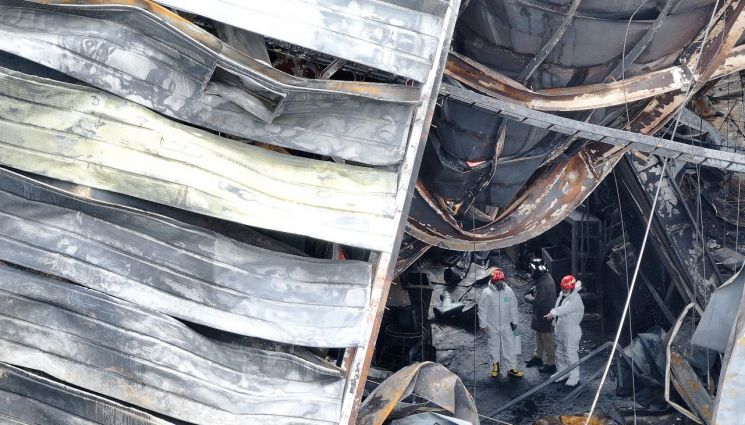 On the afternoon of the 6th, the Joint Accident Investigation Team of the National Fire Agency is inspecting the site of a fire at a meat processing plant in Singi-dong, Mungyeong-si, Gyeongbuk. [Image source=Yonhap News]
Repeated Disasters Despite Strengthened Regulations
The reason non-compliant products flood the market is analyzed by the industry as loopholes in the law. When sandwich panels were pointed out as the cause of the Sea Land fire disaster in 1999, the government mandated in 2001 that the core (the insulation material inside the steel plate) of sandwich panels use flame-retardant materials that do not easily catch fire. Previously, it was not a problem if the core was made of combustible materials. However, the new regulation also had issues. It was sufficient if the insulation material merely contained flame-retardant components. Kim Hak-gyeong, General Manager (Executive Director) of the KCC Insulation Business Division, who has worked in insulation-related fields for 28 years, said, “At that time, the important factor was not how long the sandwich panel core could withstand fire, but whether it passed the test.” “As a result, products designed only to pass certification tests, which were difficult to mass-produce or apply on-site, received certification, leading to absurd situations,” he added.
The disasters inevitably repeated. These included the 2008 frozen warehouse fire in Icheon-si, Gyeonggi Province; the 2013 frozen warehouse fire in Anseong-si, Gyeonggi Province; the 2016 fire at Daegu Seomun Market; and the 2020 logistics warehouse fire in Icheon. All were accidents where sandwich panels were identified as factors that worsened the damage. In response, the government strengthened regulations in December 2021 to require insulation materials to be made of semi-noncombustible or higher-grade materials.
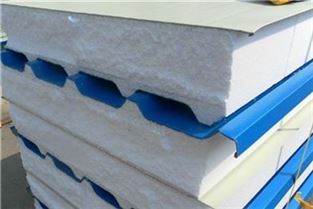 Sandwich panel appearance.
Need for Government Support and Enhanced On-Site Monitoring
There are alternatives to the sandwich panel core, which is vulnerable to fire. One such alternative is 'glass wool,' an insulation material made by melting glass raw materials such as silica sand at high temperatures and forming inorganic fibers into wool. In terms of performance, glass wool, a non-combustible insulation material, should have been used, but practicality at construction sites became an issue. Sandwich panels are relatively easier to cut and transport on-site compared to glass wool. Professor Lee Young-joo of the Department of Fire and Disaster Prevention at Kyungil University explained, “Glass wool has limitations in terms of workability,” and added, “It requires careful judgment in various aspects rather than simply insisting that non-combustible materials are always the right choice just because of fire safety.”
Cost is also a problem. The government has tried to strengthen insulation material standards every time disasters repeated, but was blocked by opposition from companies specializing in sandwich panel production. Producing glass wool requires an investment of at least 2 billion KRW, which small and medium-sized companies could not afford.
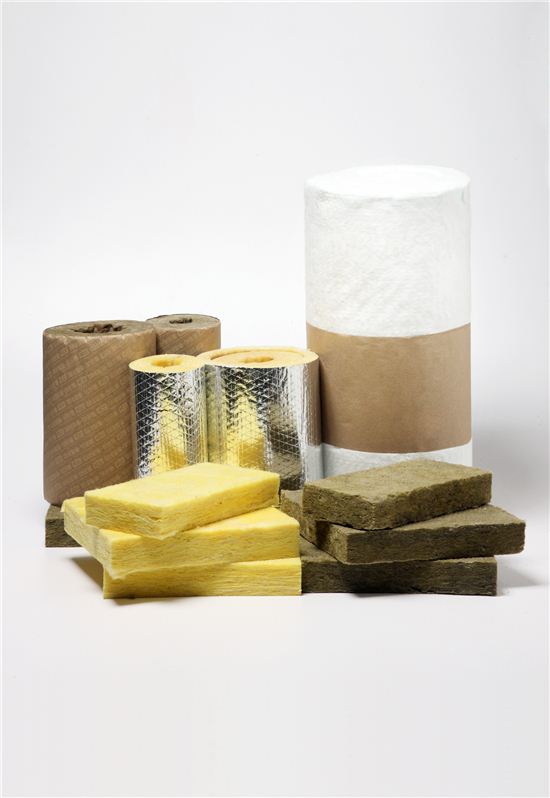 KCC fireproof insulation materials Serak Wool, Glass Wool, Mineral Wool. (Photo by KCC)
Experts point out that urgent measures are needed to ensure proper compliance with current laws. Ye In-hwan, Director of the Fire Safety Research Institute at the Korea Institute of Civil Engineering and Building Technology, said, “Since the problem lies in the distribution of defective products, rather than strengthening current regulations, measures are needed to ensure that existing regulations are properly followed.” Professor Lee emphasized, “Punishments such as recalls should be implemented when non-compliant products are detected.”
There are also opinions that, in the long term, insulation performance standards should be raised to non-combustible levels. General Manager Kim Hak-gyeong said, “After the Daegu subway disaster, all subway materials were changed to non-combustible materials,” and added, “Unlike sandwich panels, non-combustible materials like glass wool emit significantly fewer toxic gases.” He continued, “The government should support small and medium-sized companies producing sandwich panels to prevent their bankruptcy, while strengthening monitoring of products currently distributed on-site to prevent further disasters.”
© The Asia Business Daily(www.asiae.co.kr). All rights reserved.

![Clutching a Stolen Dior Bag, Saying "I Hate Being Poor but Real"... The Grotesque Con of a "Human Knockoff" [Slate]](https://cwcontent.asiae.co.kr/asiaresize/183/2026021902243444107_1771435474.jpg)















