Seoul City Distributes 102 Hydrogen Passenger Cars
Subsidy of 32.5 Million Won Provided... Half-Price Benefit
This year, Seoul citizens will be able to purchase hydrogen cars at half price.
On the 12th, the Seoul Metropolitan Government announced that it will invest about 16.6 billion KRW this year to supply 102 hydrogen passenger cars and 42 hydrogen buses. Applications for hydrogen passenger car purchase support will be accepted starting from the 13th.
Hydrogen car buyers can receive a subsidy of 32.5 million KRW along with tax reduction benefits. This means that hydrogen cars, which cost around 70 million KRW, can be purchased at half price. Eligible applicants include individuals, corporations, and organizations who have continuously resided in Seoul or have registered their main office in Seoul for at least 30 days prior to the application date.
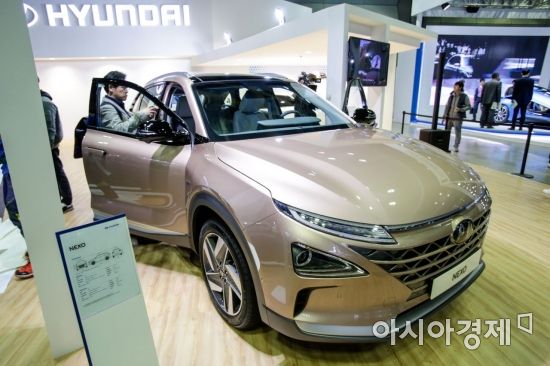 Hyundai Motor Company's sports utility hydrogen vehicle Nexo / Photo by Jinhyung Kang aymsdream@
Individuals can apply for one vehicle per person, while individual business owners, corporations, and organizations can apply for up to 20 vehicles per entity. The eligible hydrogen car model is the Hyundai Motor Company’s mid-size sport utility vehicle (SUV), Nexo. All application procedures are handled by the hydrogen car manufacturer and seller. However, the vehicle must be delivered within two months from the application date. In addition to the subsidy, buyers can receive up to 6.6 million KRW in tax reductions, 50% discounts on public parking fees and highway tolls, and exemption from congestion tolls in the Namsan Tunnel, among other benefits.
Currently, there are 10 hydrogen charging stations (14 chargers) in Seoul. This is sufficient to charge the 3,110 hydrogen vehicles registered in the city. Going forward, the city plans to steadily increase the number of charging stations in line with the growing number of hydrogen vehicles. By 2026, the city aims to convert about 1,300 buses, including 300 airport buses, city buses, and private company commuter buses, to hydrogen buses. This expansion of eco-friendly vehicles is intended to reduce fine dust in downtown Seoul and improve air quality by cutting greenhouse gas emissions.
Jung Sam-mo, Director of the Eco-friendly Vehicles Division at Seoul City, said, "To achieve carbon neutrality by 2050, we will expand the supply of eco-friendly hydrogen vehicles and steadily increase hydrogen car charging infrastructure. We hope for much interest and participation in hydrogen car adoption so that Seoul can become a leading city in hydrogen mobility."
Similar hydrogen car purchase support policies are being implemented in Donghae and Gangneung cities in Gangwon Province, Paju City in Gyeonggi Province, and Incheon City. Paju City plans to invest 7.4 billion KRW to supply 120 passenger cars and 10 high-floor buses (buses with two or more steps). Applications for the first batch (first half of the year) of 50 passenger cars began on the 1st. The purchase subsidy per passenger car is 32.5 million KRW.
Hydrogen cars, once regarded as the next-generation eco-friendly vehicles, recorded nearly a 30% decline last year due to limited hydrogen car models and insufficient charging infrastructure. The government plans to increase the number of domestic hydrogen charging stations from 192 in 2023 to 458 by 2030. It will also promote deregulation to facilitate the installation of charging stations in urban areas.
© The Asia Business Daily(www.asiae.co.kr). All rights reserved.
















