Hong Kong SCMP Reports Citing Mainland Chinese Media
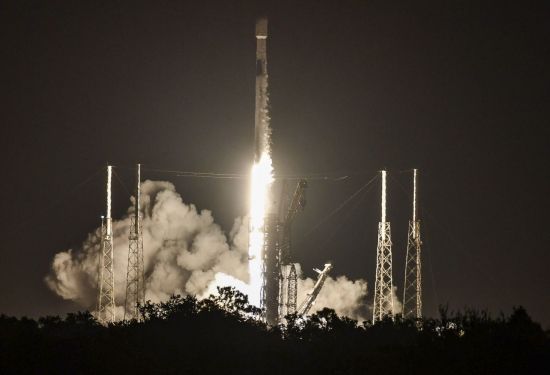 Amid intense space competition between the U.S. and China, a Chinese space startup is reportedly planning to unveil China's first reusable rocket by the end of the year. The photo shows the launch of SpaceX's Falcon 9 rocket in the U.S. at the end of October last year.
 [Image source=Yonhap News]
Amid intense space competition between the U.S. and China, a Chinese space startup is reportedly planning to unveil China's first reusable rocket by the end of the year.
On the 12th, Hong Kong's South China Morning Post (SCMP), citing mainland Chinese media, reported that Liu Baichi, CEO of the space company Galactic Energy (星河動力), recently visited the Hainan launch center to brief employees on the rocket development status and discuss issues related to flight preparations such as the launch pad, satellite interface, and spacecraft tracking.
The rocket Galactic Energy is preparing is called "Zhishenxing (智神星, Pallas) 1." It is another name for the Greek goddess Athena and also the name of an asteroid inspired by her. The 49-meter-long kerosene-liquid oxygen rocket is designed to be reusable up to 50 times. The first stage rocket, equipped with seven domestically developed Chuangchong engines, can carry 5 tons (t) to low Earth orbit and 3 tons to a 700 km sun-synchronous orbit, SCMP explained.
According to Chinese media Hainanwang, when Liu Baichi visited the launch center, he said, "Galactic Energy has consistently focused on improving rocket engine performance to enhance launch capability," adding, "By November this year, Zhishenxing 1 will be ready for launch conditions." He further stated, "At that time, people will be able to appreciate the beauty of condensed human wisdom and science and technology in the form of the goddess Athena on the beaches of the South China Sea."
SCMP reported that when asked whether the first stage of Zhishenxing 1 would be recovered during its maiden flight, Galactic Energy declined to comment, saying, "It is not appropriate to disclose this information at this time." However, two insiders familiar with the matter predicted that the likelihood of recovery during the November launch is low, SCMP added.
Founded in 2018, Galactic Energy has established itself as a leader in China's commercial satellite sector. It holds the best launch record to date, including nine consecutive successful launches of the small solid-fuel rocket "Guxinxing (谷新星, Ceres) 1." In December last year, Galactic Energy announced it had secured 1.1 billion yuan (approximately 200 billion KRW) in funding for research and development of reusable launch vehicle technology and related infrastructure for Zhishenxing 1.
The reusable rocket sector has so far been dominated by the U.S. company SpaceX. SpaceX has partially reused the Falcon 9 and Falcon Heavy rockets to reduce launch costs and improve the profitability of orbital flights. In China, companies such as Xingjilongyao (星際榮耀, i-Space) and Lanjian Hangtian (藍箭航天, LandSpace) have entered the reusable rocket development race. They plan to recover their first-stage rockets for the first time in 2025.
China's commercial launch companies are actively developing technologies to reduce costs and secure contracts for the Chinese government's internet satellite constellation plans. To compete with SpaceX's Starlink, China has supported projects such as the "Guowang" plan, a broadband internet satellite constellation consisting of 13,000 satellites.
© The Asia Business Daily(www.asiae.co.kr). All rights reserved.
!["The Woman Who Threw Herself into the Water Clutching a Stolen Dior Bag"...A Grotesque Success Story That Shakes the Korean Psyche [Slate]](https://cwcontent.asiae.co.kr/asiaresize/183/2026021902243444107_1771435474.jpg)
















