Large Operating Losses Worsen Financial Situation
Accumulation of Unsold Local Units... Delay in Construction Cost Recovery
Heightened Attention to Loan and Contingent Liability Maturities Amid PF Extension Failure
Concerns about Shinsegae Construction continue unabated. Although the company issued private bonds worth 200 billion KRW with support from its affiliates and resolved some liquidity issues by merging Yeongnangho Resort, burdens from expanding unsold inventory and contingent liabilities persist. Amid deteriorating creditworthiness making fundraising difficult, the company faces the risk of a further credit rating downgrade following a significant decline in last year's performance.
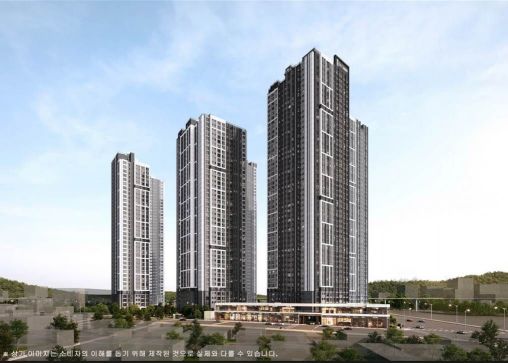 Aerial view of 'Billive Ascent' being constructed by Shinsegae Construction in the ultra-prime area near Yeonsinnae Station, Seoul
Shinsegae Construction recorded operating losses for two consecutive years due to rising construction costs and large-scale unsold inventory. Last year, it posted an operating loss of 187.81 billion KRW (preliminary results). The loss widened by 175.7 billion KRW compared to 12.1 billion KRW in 2022. The company explained, "Losses increased due to rising construction costs and the accumulation of provisions for expected losses related to unsold inventory."
The unsold inventory problem is considered severe at regional construction sites such as in Daegu. As of the end of September last year, the sales rate of ongoing construction projects excluding knowledge industry centers was only 53%. In particular, sales rates are quite low not only in regional projects in Busan and Daegu launched in the past two years but also in Seoul projects. The sales rates of major Daegu projects?Villiv Heritage, Villiv Lucent, and Villiv Radice?are only about 20%.
As unsold inventory increases, the company is also struggling to recover construction costs. Construction costs have risen significantly, and due to completion obligations, the company must continue investing in construction costs. A real estate project financing (PF) industry official said, "A sales rate of over 70% is required to recover construction costs through deposits, interim payments, and final payments from buyers," adding, "The sales rate is too low, so fund recovery is not proceeding smoothly." Villiv Daegu, completed in August last year, failed to extend the maturity of its PF loan worth about 140 billion KRW and has entered the public auction process for unsold units.
Concerns also exist regarding contingent liabilities such as guarantees or debt assumption related to PF borrowings. According to Korea Ratings, as of the end of last year, Shinsegae Construction's PF contingent liabilities stood at about 134 billion KRW. These include interest payment guarantees for the Guri Galmae Knowledge Industry Center (42 billion KRW), joint guarantees (12 billion KRW) and capital supplementation (30 billion KRW) for the Yeonsinnae complex development, and joint guarantees (50 billion KRW) for the Mokdong KT site development project. Among these, the Mokdong KT site development project has not yet started construction, and the Yeonsinnae complex development project is known to have a low sales rate.
In particular, the extension of bridge loan borrowings or main PF financing for non-started projects is uncertain. If Shinsegae Construction has provided guarantees or assumed debts, it may face repayment burdens on behalf of the developers. In February, the maturity of a 170 billion KRW bridge loan debt assumption agreement related to the former Pohang Station site development project came due. Shinsegae Construction holds a 47% stake in this large-scale development project, which plans to build a 70-story residential-commercial complex and hotel on the former Pohang Station site. When the bridge loan maturity came due, Shinsegae Construction reportedly increased the guarantee amount from 170 billion KRW to 200 billion KRW to refinance the loan.
As maturities of its own borrowings and contingent liabilities approach one after another, the company's creditworthiness continues to deteriorate. Shinsegae Construction's credit rating is A with a 'negative' outlook. Due to the significant deterioration in last year's performance, the likelihood of a downgrade to A- has increased. A PF industry official expressed concern, saying, "Just as Shinsegae failed to extend the main PF for some Villiv projects, there may be more cases where maturing borrowings or contingent liabilities are not extended, forcing Shinsegae Construction to repay on its own or bear responsibility on behalf of developers."
Shinsegae Construction plans to improve its financial situation and reduce liquidity risks through additional measures. Previously, it issued private bonds worth 200 billion KRW with support from the Korea Development Bank and its affiliate Shinsegae Property. It also secured liquidity of about 50 billion KRW by merging Yeongnangho Resort, enabling the use of cash flow from the resort division for debt repayment purposes. The company is also reportedly preparing to reduce its debt ratio, which is currently over 600%.
An investment banking (IB) industry official commented, "Lotte Construction, once considered a risk group like Shinsegae Construction, overcame its immediate crisis after affiliates and financial companies formed a fund worth 2.3 trillion KRW to support liquidity," adding, "Shinsegae Construction is improving its liquidity situation with affiliate support, but it is still far from alleviating market concerns."
© The Asia Business Daily(www.asiae.co.kr). All rights reserved.

















