KB Financial 80%↑ YoY... Woori Financial 4%↓
Hana·Shinhan Financial, 51%↑·65%↑ YoY
Differences in Non-Bank Portfolio Highlighted
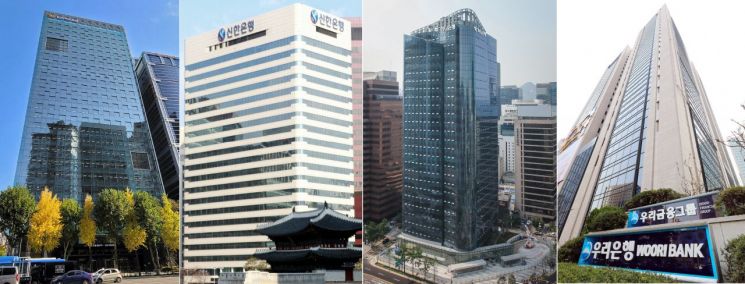
The non-interest income of the four major financial holding companies exceeded 10 trillion won for the first time last year, but the fortunes of individual financial holding companies varied significantly. Non-interest income refers to earnings excluding interest income, which is the difference between interest revenue and interest expenses, and includes various fees such as remittance, foreign exchange, bancassurance, and trust fees, as well as income from bonds, derivatives, and real estate. The scale and proportion of non-interest income serve as indicators to gauge the diversification of revenue and growth potential of specific financial institutions.
According to the financial sector on the 11th, the non-interest income of the four major financial holding companies?KB Financial, Shinhan, Hana, and Woori?last year totaled 10.5187 trillion won, a 48.0% increase from the previous year. KB Financial saw an 80.4% increase to 4.0874 trillion won, Hana Financial rose 65.3% to 1.907 trillion won, and Shinhan Financial recorded a 51.0% increase to 3.4295 trillion won, while Woori Financial decreased by 4.7% to 1.0948 trillion won.
The sharp rise in KB Financial’s non-interest income was driven by strengthening competitiveness in the group’s core business sectors and efforts to diversify its non-bank portfolio through mergers and acquisitions (M&A). Pure fee income alone reached 3.6735 trillion won, and other operating income also benefited from strong performances in securities and derivatives. When announcing last year’s results, KB Financial explained, "Despite the expanding uncertainties, we demonstrated profit-generating capability through steady performance improvement centered on non-interest income and stable cost management."
Hana Financial’s non-interest income surged last year, boosted by strong securities, foreign exchange, and derivatives trading results from major affiliates in the first half, along with steady fee income. Hana Financial’s annual fee income was 1.7961 trillion won, and trading evaluation gains amounted to 863.1 billion won. Hana Financial stated, "Improvements in accumulated fees such as operating leases and retirement pensions, as well as increased securities trading evaluation gains due to financial market volatility, contributed to the growth."
Shinhan Financial, which recorded the third-highest increase in non-bank sector performance among major financial holding companies, also benefited significantly from improved income from bonds and other securities, foreign exchange, derivatives, and insurance, including fee income. In particular, income from securities, derivatives, foreign exchange, and insurance surged by more than 249% year-on-year to 1.82 trillion won. Fee income increased by 9.7% during the same period, reaching 233.7 billion won.
On the other hand, Woori Financial’s non-interest income contracted due to the inclusion of figures related to support for livelihood finance. Even excluding these figures, the growth was only about 10%. Woori Financial explained, "Despite a challenging business environment, fee income showed stable growth, and income related to securities increased compared to the previous year," attributing the results to the inclusion of livelihood finance figures. However, the gap with KB Financial reached approximately 3 trillion won.
Major financial holding companies are expected to continue deliberating strategies to expand the proportion of non-interest income this year. The bank dependency ratio of KB Financial and Shinhan Financial is around 60%, while Hana Financial and Woori Financial stand at 94% and 99%, respectively. Woori Financial and Hana Financial, which have high net income dependency on banks, are likely to attempt mergers and acquisitions (M&A) to increase the non-bank sector’s share alongside efforts to turn around affiliate performance.
For now, Woori Financial, which has a weak non-bank portfolio, is taking the most proactive steps. In a conference call announcing management results, Woori Financial stated, "All potential targets, regardless of size, are under consideration for entry into the securities business," adding, "The securities firm frequently mentioned in the media (Korea Post Securities) is one of them."
© The Asia Business Daily(www.asiae.co.kr). All rights reserved.
![Clutching a Stolen Dior Bag, Saying "I Hate Being Poor but Real"... The Grotesque Con of a "Human Knockoff" [Slate]](https://cwcontent.asiae.co.kr/asiaresize/183/2026021902243444107_1771435474.jpg)
















