Three Students Decode 2,000 Characters Using AI
Presumed Written by Epicurean School Philosopher
Ancient papyrus documents buried under volcanic ash during the eruption of Mount Vesuvius 2,000 years ago have been deciphered with the help of advanced technologies such as artificial intelligence (AI) and computed tomography (CT).
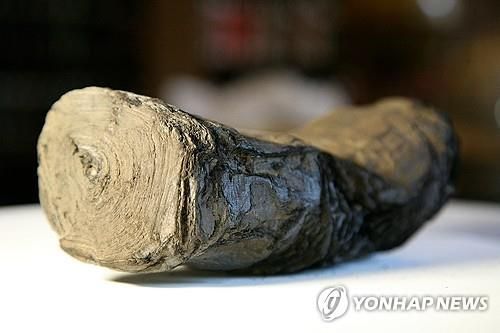
On the 7th (local time), US broadcaster CNN and others reported that an international research team consisting of three university and graduate students from Egypt, Switzerland, and the United States used AI to read more than 2,000 Greek characters from the "Herculaneum scrolls." The Herculaneum scrolls refer to about 1,000 papyrus documents excavated in 1750 from the ancient Roman city of Herculaneum. These documents, found in an ancient luxury villa, were charred by the heat of volcanic ash during the eruption of Mount Vesuvius in AD 79 and further damaged over the 2,000 years, making them fragile and prone to crumbling.
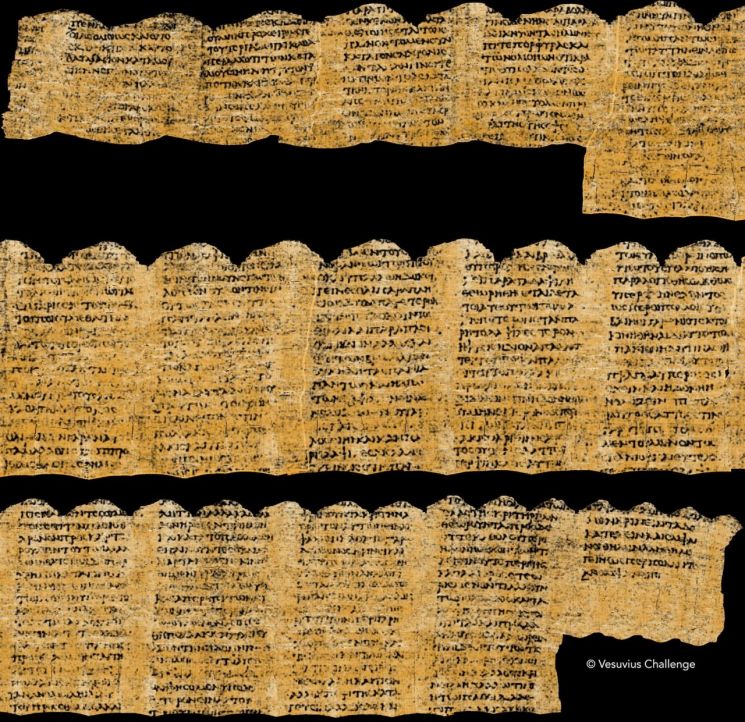 Deciphered content of the Herculaneum scrolls using AI
[Image source: Provided by Vesuvius Challenge, Yonhap News]
During the eruption of Mount Vesuvius, volcanic ash and soil covered Pompeii and the nearby town of Herculaneum. As a result, all the scroll documents in a library villa in Herculaneum turned into charcoal lumps. Since their excavation in 1750, scholars have tried for over 270 years to uncover the contents of these documents but repeatedly failed because the documents were too fragile to be unrolled.
Researchers thought that AI technology might allow them to read the contents of the documents, so they gathered sponsors and held the "Vesuvius Challenge" competition. A large cash prize was promised to the team that could read the documents. The team that succeeded in deciphering 2,000 characters this time consisted of three members, including a computer science doctoral student interning at the space company SpaceX and a robotics student from Switzerland. They applied AI machine learning to high-resolution CT images of the scrolls, which were pre-released by the competition organizers, virtually unrolled the scrolls, and estimated and confirmed the characters written inside.
As a result, they were able to decipher about 2,000 characters, corresponding to 5% of the entire scroll. The document is believed to have been written by Philodemus (110 BC?35 BC), a philosopher of the Epicurean school who emphasized the pleasures of life. In the scroll, he wrote about "pleasure through goods," stating, "In the case of food, we do not believe that deficiency is more pleasurable than abundance," and that "such questions will continue to be asked in the future."
The discovery site of this scroll also appears to be related to the Epicurean school. The villa is believed to have belonged to Lucius Calpurnius Piso, a Roman Republic politician and father-in-law of Julius Caesar, who was a patron of the Epicurean school. Philodemus, the author of the document, is thought to have resided as a resident philosopher at the villa where the document was found.
The Vesuvius Challenge stated that the challenge to decipher the Herculaneum papyri will continue and awarded this team a prize of $700,000 (approximately 930 million KRW).
© The Asia Business Daily(www.asiae.co.kr). All rights reserved.
![Clutching a Stolen Dior Bag, Saying "I Hate Being Poor but Real"... The Grotesque Con of a "Human Knockoff" [Slate]](https://cwcontent.asiae.co.kr/asiaresize/183/2026021902243444107_1771435474.jpg)

















