London Natural History Museum '2023 Wildlife Photographer of the Year'
Winner "Hopes to Bring Hope Amid Climate Change"
A photo capturing the 'anxious rest' of a polar bear in the rapidly melting Arctic Ocean Svalbard archipelago due to climate change was selected as the best wildlife photo of last year. The polar bear, curled up and taking a nap on a precarious 'ice bed' that could break at any moment, has a peaceful expression. On the 7th (local time), the Natural History Museum in London announced that the British amateur photographer Nima Sarikhani's entry, "Ice Bed," was chosen as the 2023 "Wildlife Photographer of the Year" winner.
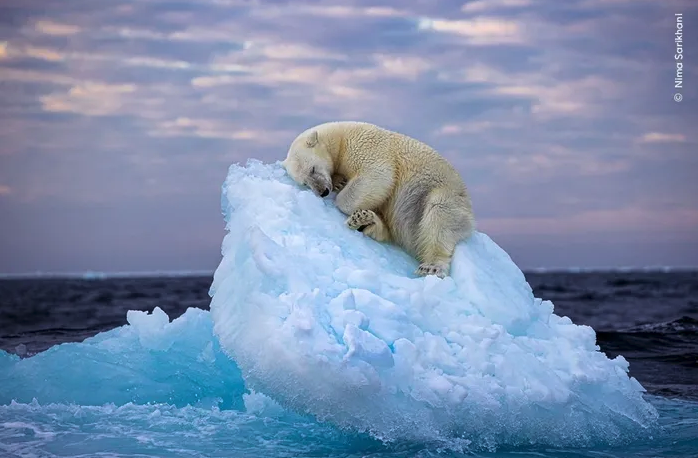 'Ice Bed,' selected as the 2023 winner of the 'Wildlife Photographer of the Year' hosted by the Natural History Museum, London
 [Photo by Natural History Museum, London]
The museum shortlisted 25 finalists selected by an expert panel from over 50,000 entries submitted last year. Among these, the winning work was chosen through a public vote that received the highest number of votes. A record-breaking 75,000 people participated in the voting. The photo was taken by Sarikhani after a three-day wait in Norway's Svalbard archipelago. The photo was captured just before midnight, showing a male polar bear scratching off small icebergs with its paw to create a resting place before falling asleep under the midnight sun.
Sarikhani, who took the photo, said, "Climate change is the greatest challenge humanity faces, but I hope this photo brings hope," adding, "I hope there is still time to correct the chaos we have caused."
Douglas Gurr, director of the Natural History Museum in London, commented, "Through this heart-wrenching work, we confront the beauty and fragility of the Earth," and evaluated, "The ice bed visually reminds us of the inseparable bond between animals and their habitats while showing the adverse effects of climate change and habitat destruction." The museum plans to exhibit the five final nominees, including "Ice Bed," until June 30.
Polar Bears at Risk of Losing Their Habitat Due to Glacier Disappearance
Polar bears have become symbols of danger due to global warming. They primarily hunt prey such as seals on the sea ice that spreads over the continental shelf of the Arctic Ocean. The reduction of Arctic sea ice caused by global warming is a disaster threatening the survival of the species. It means fewer hunting grounds where prey is easy to catch and increasingly fierce competition to find good hunting spots.
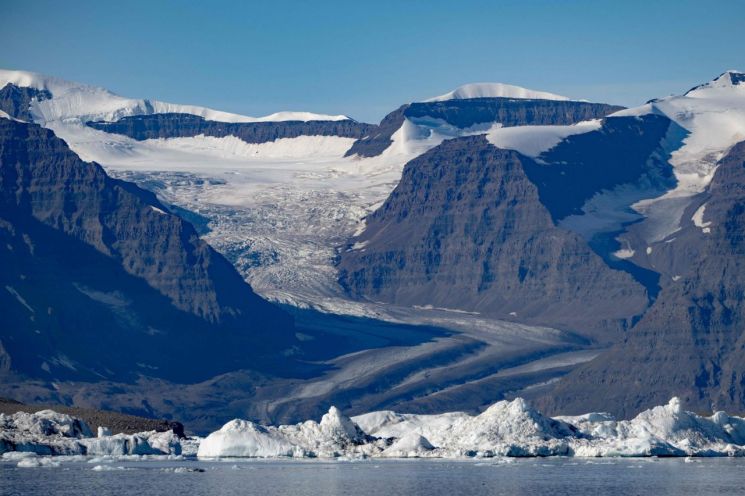 Due to the disappearance of glaciers, even the territories where polar bears live have vanished, putting them at risk of becoming refugees who have lost their habitats. Arctic sea ice reaches its maximum extent in March according to seasonal cycles, then melts during spring and summer to reach its minimum extent in September. Recently, the U.S. National Snow and Ice Data Center announced that the sea ice extent in September was about 6.45 million km² in 1979 but decreased to 4.13 million km² in 2021. During that period, an area of ice more than ten times the size of the Korean Peninsula evaporated. The Snow and Ice Data Center analyzed that the Arctic sea ice extent decreases by an average of 13.1% every ten years.
 [Photo by AFP·Yonhap News]
Scientists predict that as a result, the period during which polar bears can eat and accumulate fat will shorten, and the period they must endure starvation will lengthen, leading to the disappearance of up to two-thirds of the world's polar bears by the mid-21st century. This is the reason for the "tears of the polar bear." Efforts to save them from misfortune led to polar bears being designated as an endangered species under the U.S. Endangered Species Act (ESA) in 2008. This was the first time the U.S. listed a species as endangered due to global warming.
Moreover, the disappearance of glaciers has put polar bears at risk of becoming refugees, losing their living territory. Arctic sea ice reaches its maximum extent in March due to seasonal cycles and melts in spring and summer, reaching its minimum extent in September. Recently, the U.S. National Snow and Ice Data Center announced that the sea ice extent in September was about 6.45 million km² in 1979 but decreased to 4.13 million km² in 2021. During that time, more than ten times the area of the Korean Peninsula in ice has vanished. The Snow and Ice Data Center analyzed that the Arctic sea ice extent decreases by an average of 13.1% every ten years.
The area is not the only problem. Another important indicator evaluating the quality of Arctic sea ice is the age of the ice. Sea ice formed by freezing seawater is divided into first-year ice, which forms in winter and melts in summer, and multi-year ice, which survives one or more summers without melting. Multi-year ice can reach a thickness of up to 4 meters, but first-year ice is at most about half as thick and melts more easily than multi-year ice. Multi-year ice plays a crucial role in the extent and quality of Arctic sea ice. Multi-year ice decreased from 4.4 million km² in September 1985 to 1.29 million km² in September 2021. Thick ice over four years old accounted for 30.6% in 1985 but only 3.5% in 2021. This means most Arctic sea ice has changed to thin ice less than one year old.
The National Institute of Meteorological Sciences predicts that the average annual ice volume in the Arctic will decrease by at least 19% and up to 76% by the end of the 21st century compared to the present. It is analyzed that ice will almost disappear in the Arctic during summer after the mid-21st century. Some studies suggest an even earlier disappearance. The loss of Arctic sea ice causes feedback effects, leading to significant impacts on the Arctic and global climate, and will lead the species known as polar bears down the path of extinction.
© The Asia Business Daily(www.asiae.co.kr). All rights reserved.

![Clutching a Stolen Dior Bag, Saying "I Hate Being Poor but Real"... The Grotesque Con of a "Human Knockoff" [Slate]](https://cwcontent.asiae.co.kr/asiaresize/183/2026021902243444107_1771435474.jpg)















