Industry Raises Concerns Over Spread of Unsold Units... Proposes CR REITs
Unsold CR REITs Introduced and Operated During Financial Crisis
Ministry of Land, Infrastructure and Transport: "Overall Decrease in Unsold Units... Will Monitor Trends"
The 'Corporate Restructuring (CR) REITs' card to resolve unsold housing has surfaced. The industry raised the CR REITs card this year amid concerns over the spread of unsold units, but the government reportedly viewed it as premature. The government's stance is to monitor the resolution trend, as the so-called 'January 10 Supply Measures' include tax benefits for buyers of unsold housing after local completion or businesses utilizing them as rentals.
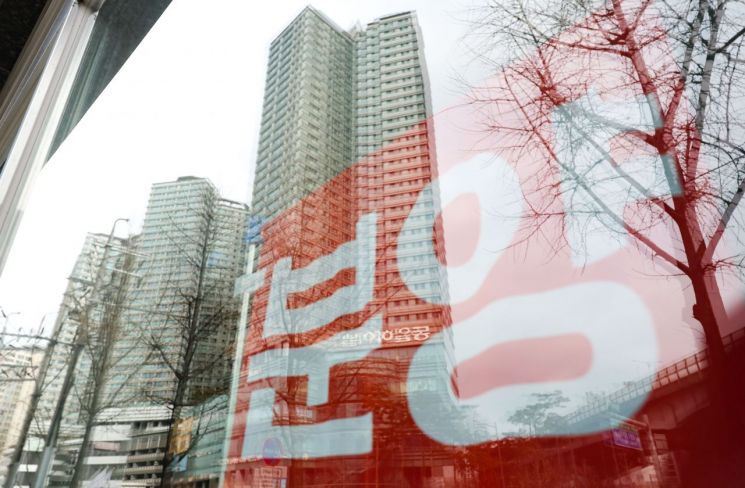
According to the Ministry of Land, Infrastructure and Transport on the 8th, four construction associations?the Korea Housing Association, the Korea Housing Builders Association, the Korea Real Estate Development Association, and the Korea REITs Association?proposed the necessity of 'unsold CR REITs' during a meeting with Jin Hyun-hwan, the first vice minister of MOLIT, on the 6th. They argued for reviving CR REITs, which were implemented to resolve unsold housing backlogs during the 2008 global financial crisis, to purchase and operate unsold housing. It is reported that some construction companies, including Kumho Industrial, also participated in this meeting.
REITs (Real Estate Investment Trusts) are products that collect funds from investors to invest in domestic and international real estate, then regularly distribute profits such as rental income or capital gains. Unsold CR REITs have the same basic structure but limit their investment targets to unsold housing.
After the financial crisis, nine unsold CR REITs were operated, purchasing 3,404 unsold housing units. According to the Korea Research Institute for Human Settlements, construction companies holding unsold projects at that time faced losses exceeding 30%. However, through CR REITs, the loss scale was reduced to around 7%. Investors earned returns of about 6-7% annually. Currently, 14 CR REITs are in operation, but none invest in unsold housing.
The industry voices the need to reintroduce unsold CR REITs amid expectations of reduced subscription demand due to this year's real estate market downturn and growing liquidity concerns. The Korea Housing Builders Association urged the activation of unsold CR REITs in a proposal submitted last month to the Presidential Office and MOLIT, stating, "Considering the crisis level felt in the actual market, more bold and preemptive measures are necessary."
However, the government countered that it is too early to concretize such discussions. It argued that comparing the current situation to the financial crisis period, when unsold housing exceeded 100,000 units and reached 160,000 units, is inappropriate. Especially, the government’s position is that it is not too late to discuss after assessing the policy effect of reducing tax burdens only on unsold housing after completion in local areas to improve local housing business conditions.
MOLIT decided to reduce the original acquisition tax by up to 50% for one year for businesses utilizing local unsold housing completed this year with an acquisition price of 300 million KRW or less and exclusive area of 85㎡ or less as rental housing (with contracts of two years or more). Tax benefits also apply to the first buyers of unsold housing after completion. Buyers of unsold housing with an exclusive area of 85㎡ or less and priced at 600 million KRW or less within the next two years can receive an exception to exclude the house from the tax calculation. The same applies to existing one-house owners who purchase such units.
A MOLIT official said, "Compared to 2008-2009 when unsold CR REITs were introduced, unsold housing is not yet at a serious level." He added, "Although the number of unsold houses increased in December last year, it had decreased for nine consecutive months prior. We will continue to monitor the trend." He also said, "If unsold housing continues to accumulate as the industry fears, we may consider expanding the scope of tax benefits beyond local unsold housing after completion."
According to MOLIT, the nationwide decline in unsold housing stopped at the end of last year. As of the end of December last year, there were 62,489 units, an increase of 7.9% (4,564 units) from the previous month. After recording 75,359 units in January last year, the number decreased for nine consecutive months from March but turned to increase again last month. In particular, unsold housing after completion stood at 10,857 units for three consecutive months above 10,000 units, with about 80% concentrated in local areas. The highest numbers were in Jeonnam (1,212 units), Gyeongnam (1,116 units), Jeju (1,059 units), and Daegu (1,044 units), in that order.
© The Asia Business Daily(www.asiae.co.kr). All rights reserved.
![Clutching a Stolen Dior Bag, Saying "I Hate Being Poor but Real"... The Grotesque Con of a "Human Knockoff" [Slate]](https://cwcontent.asiae.co.kr/asiaresize/183/2026021902243444107_1771435474.jpg)











