US Congressional Budget Office (CBO) Report
Deficit-to-GDP Ratio 5.6% This Year → 6.1% Within 10 Years
Debt-to-GDP Ratio 116% by 2034
The U.S. federal government's annual fiscal deficit is projected by the Congressional Budget Office (CBO) to increase from $1.6 trillion (2,124 trillion won) this year to $2.6 trillion (approximately 3,452 trillion won) within 10 years. As mandatory spending and interest costs on national debt rise, the fiscal deficit is expected to expand, causing the national debt to balloon like a snowball. The debt-to-GDP ratio of the United States is estimated to rise to 116% in 10 years.
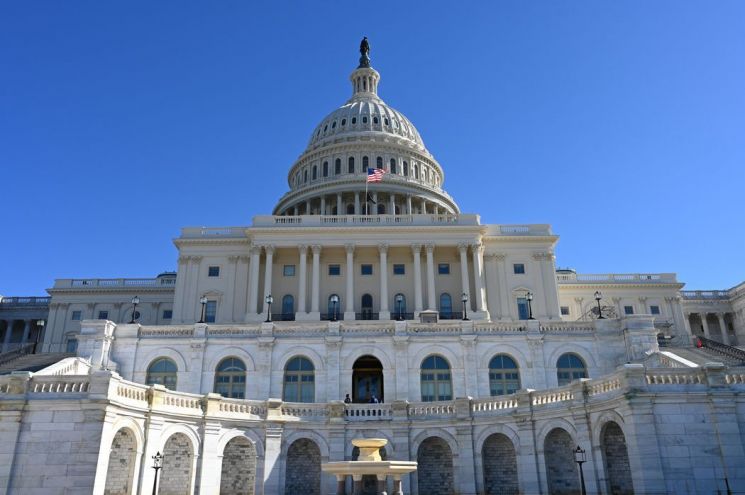
According to the CBO on the 7th (local time), the U.S. government's fiscal deficit as a percentage of GDP is expected to increase from 5.6% this year to 6.1% within 10 years. This level far exceeds the 50-year average of 3.7%.
The CBO expects the U.S. fiscal deficit to grow to $2.6 trillion annually within 10 years. This equates to a deficit accumulating at $7.1 billion (approximately 9.43 trillion won) per day.
Rapid increases in Social Security spending and national debt interest costs are cited as the main causes of the expanding fiscal deficit. The CBO projects that after 2025, mandatory spending will increase, and government expenditure burdens will sharply rise due to elder care and medical costs. U.S. Medicare spending is expected to increase from 3.1% of GDP in 2023 to 4.2% in 2034. Social Security spending is estimated to rise from 5% to 5.9% of GDP during the same period.
The interest burden on the national debt is also expected to increase significantly. According to the CBO, the federal government's net interest payments as a share of GDP next year will be the highest since 1940. The persistent fiscal deficit has led to issuing national debt to operate the government, causing the debt to balloon, and the high interest rates have further increased the interest burden. The U.S. benchmark interest rate surged from 0?0.25% in January 2022 to 5.25?5.5% currently. The government's net interest payments as a percentage of GDP are projected to rise from 3.2% in 2025 to 3.9% within 10 years. Philip Swagel, CBO Director, said, "The government's net interest costs are currently similar to the defense budget but will increase to $1.6 trillion, about 1.5 times higher, within 10 years."
In the short term, the fiscal deficit is expected to improve this year. The U.S. government's annual fiscal deficit is projected at $1.6 trillion this year, slightly down from $1.7 trillion (approximately 2,257 trillion won) last year. Bipartisan budget agreements early last year, a strong economy, and increased tax revenues are expected to drive the deficit reduction. However, even this year's projected deficit remains historically high, excluding the pandemic years of 2020?2021 when the national emergency was rapidly spreading.
As the fiscal deficit continues, the U.S. national debt is also expected to keep increasing. The CBO forecasts the government's debt-to-GDP ratio to soar from 97.3% in 2023 to 116% in 2034. This means the debt burden on Americans will increase at a rate far exceeding economic growth.
The chronic U.S. fiscal deficit has led to concerns about default and downgrades of the national credit rating. Global credit rating agency Fitch downgraded the U.S. sovereign credit rating from 'AAA' to 'AA+' in August last year due to fiscal deficit and national debt issues. Moody's lowered the U.S. rating outlook from 'stable' to 'negative' in November last year. The U.S. has a federal debt ceiling, and as chronic deficits have caused debt to rise continuously, Congress has raised this limit several times in the past to prevent default. The debt ceiling was also raised last year.
Jason Furman, a Harvard University economics professor, said, "The CBO confirms what we all knew?that the U.S. government's debt is heading in an unsustainable direction."
Meanwhile, through its economic outlook for this year, the CBO expects the Federal Reserve (Fed) to lower interest rates in the latter half of this year. With a slight rise in unemployment and a slowing U.S. economy, inflation is expected to stabilize near 2% by year-end.
© The Asia Business Daily(www.asiae.co.kr). All rights reserved.
![Clutching a Stolen Dior Bag, Saying "I Hate Being Poor but Real"... The Grotesque Con of a "Human Knockoff" [Slate]](https://cwcontent.asiae.co.kr/asiaresize/183/2026021902243444107_1771435474.jpg)
















