San-eun-Haejingong "Management Intervention and Audit Inevitable"
Harim Con "Transaction Only Holding Majority Shareholder Status"
Concerns Over Delay Amid 'Skepticism' on Rapid Resale
The attempt to sell HMM, the only domestic national shipping company, has failed. The Pan Ocean-JKL Partners consortium of Harim Group, selected as the preferred negotiation partner on December 20 last year, ended seven weeks of negotiations without results after refusing to accept the management involvement conditions demanded by KDB Industrial Bank and the Korea Ocean Business Corporation.
Both sides, who agonized over the negotiation schedule even extending it once, failed to find common ground between economic and security logic and the logic of complete privatization. Future resale efforts are also expected to be challenging. The shipping industry has entered a full downturn after the great boom during the COVID-19 pandemic, and recent global shipping alliances are undergoing mergers and acquisitions, creating an environment where it will be difficult for a buyer to readily embrace HMM for the time being.
According to the financial sector on the 8th, during the seven-week M&A negotiation process for HMM, the seller's economic and security logic and the buyer's restructuring and privatization logic were reported to have been in a tense standoff. The issue of management involvement by the seller emerged as a key point, making even opening the negotiation table difficult. In response, KDB Industrial Bank, representing the creditors, declared the breakdown of negotiations, stating, "We engaged in sincere negotiations under mutual trust during the negotiation period, but final breakdown occurred due to differences on some issues." Meanwhile, the Harim consortium sharply countered, saying, "Any private company would find it difficult to accept a deal that only guarantees the status of the largest shareholder without securing actual management rights."
During the seven-week negotiation period, both sides fiercely contested three main issues: ▲ a three-year deferral of converting HMM's 1.68 trillion won perpetual bonds into common stock ▲ limiting the validity period of the shareholder agreement, including the government creditors' right to appoint outside directors, to five years ▲ restrictions on the sale of shares held by financial investor JKL Partners. First, the Harim consortium requested a three-year deferral period for converting HMM's perpetual bonds into common stock, arguing that if converted, KDB and Korea Ocean Business Corporation's shareholding would reach 32.8%, nearly matching Harim's 38.9% (post-conversion), making it difficult to exercise full management rights. On the other hand, the seller rejected this, citing issues of breach of trust and the nature of the shipping industry as a national key industry, stating that a certain level of management intervention and oversight of HMM, the virtually sole national shipping company, is inevitable.
They also failed to find common ground regarding the 'stock holding conditions' of JKL Partners, a private equity fund (PEF) participating as a financial investor (FI). The Harim consortium requested that JKL be excluded from the five-year stock holding requirement, considering the PEF's nature of needing to recover investment after a certain period, but Korea Ocean Business Corporation opposed this, citing management stability. The Harim consortium again requested to reduce the share sale restriction period to three years, but this was not accepted, leading to the final breakdown of negotiations.
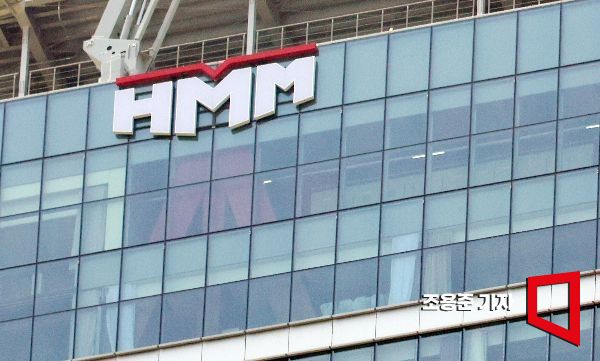 As the HMM acquisition battle officially begins, the HMM headquarters located in Park One Tower, Yeouido. Photo by Jo Yongjun jun21@
Was the breakdown anticipated? ... Differences in stance even between the seller, KDB, and Korea Ocean Business Corporation
The financial and shipping industries view the breakdown of HMM's M&A as the result of continuous clashes between the goals and values of each party. For KDB, the sale of HMM was urgent to manage deteriorating soundness. KDB's BIS (Bank for International Settlements) capital adequacy ratio was 16.0% at the end of 2021 but had fallen to 13.75% as of the end of September last year. Losses from Korea Electric Power Corporation (holding 32.9%) and HMM (29.2%) led to equity method losses and valuation losses, respectively, dragging down the BIS ratio.
Kang Seok-hoon, chairman of KDB, also emphasized the necessity of selling HMM for soundness management. At a press conference last year, he said, "If HMM's stock price moves by 1,000 won or KEPCO's deficit moves by 1 trillion won, KDB's BIS ratio moves by 7 basis points (1bp=0.01%), which affects about 1.8 trillion won of funding capacity," emphasizing, "Selling HMM is necessary to stabilize KDB's financial structure."
However, as a policy financial institution, KDB could not exclude economic and security logic regarding the country's only national shipping company. A 'safety device' in the form of management involvement was necessary for stable operation. Concerns also arose that if the Harim consortium, perceived as financially weak, acquired HMM, they might use internal reserves, along with the risk of breach of trust if the remaining perpetual bonds were not converted into common stock.
Korea Ocean Business Corporation and the Ministry of Oceans and Fisheries, which were directly or indirectly involved with the creditors, reportedly took a tougher stance on economic and security logic. Korea Ocean Business Corporation, established after the bankruptcy of Hanjin Shipping, one of the world's top four shipping companies, has led large-scale fleet expansion of HMM since its launch in 2018 under the banner of 'shipping industry reconstruction.'
Accordingly, during the negotiation process, Korea Ocean Business Corporation strongly opposed the buyer's requests for deferral of stock conversion of remaining perpetual bonds and relaxation of the five-year stock holding condition. They argued that a company with sufficient strength should acquire HMM and that management intervention is inevitable as a national key industry. Former Minister of Oceans and Fisheries Cho Seung-hwan also issued a warning before the selection of the preferred negotiation partner last year, stating, "A company with a high understanding of the shipping industry and capable of properly leading the company should take charge."
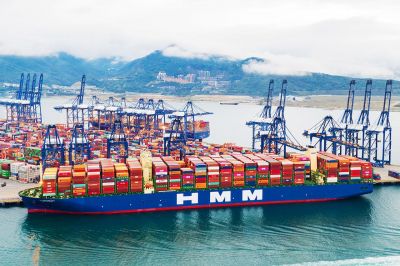
Harim Group's overambitious acquisition plan... KDB fears missing the shipping industry restructuring
The acquiring party, Harim Group, faced difficulties in raising funds to swallow the larger HMM. HMM's assets based on fair value amount to 25.8 trillion won, larger than Harim Group's approximately 17 trillion won. However, as of the end of September last year, Harim's cash and cash equivalents (cash, cash equivalents, and short-term financial assets) were about 1.29 trillion won, far short of the acquisition price of 6.4 trillion won. This led to concerns likened to "a shrimp swallowing a whale," with many fearing the winner's curse.
Accordingly, Harim sought to securitize various assets of its subsidiary Pan Ocean and partnered with private equity fund JKL as a financial investor. Therefore, the seller's 'five-year stock holding condition' was a difficult card for the Harim consortium to accept. Ultimately, the mismatch in scale, insufficient to swallow the big fish called HMM, became a stumbling block. A financial sector official said, "Korea Ocean Business Corporation was established with the single purpose of normalizing and promoting the domestic shipping industry after the Hanjin Shipping incident," adding, "Losing influence over HMM, which can be considered the only domestic container shipping company, would have been an unacceptable blow to its raison d'?tre."
KDB and Korea Ocean Business Corporation plan to relaunch the sale of HMM, but rapid resumption is unlikely. As revealed in this sale, the presence of KDB and Korea Ocean Business Corporation may be a burden to potential buyers. The shipping industry has entered a downturn amid ongoing economic recessions centered on China and others. In early January 2022, during the height of the COVID-19 pandemic, the Shanghai Containerized Freight Index (SCFI) reached an all-time high of 5109.6 but has since declined. It recently recovered to around 2200 due to the 'Red Sea incident.'
In particular, reduced cargo volumes and the increased shipping capacity (freight capacity) expanded by each shipping company during the boom period are now backfiring on the shipping industry. The Baltic and International Maritime Council (BIMCO), an international shipowners' association, forecasts that new container ship capacity this year will increase by 41% year-on-year to 3.1 million TEU (twenty-foot equivalent units), and total capacity will rise by 10%.
Global shipping companies attempting mergers and alliances pose another threat. Maersk of Denmark (currently '2M'), the world's second-largest shipping company, and Germany's Hapag-Lloyd (currently 'THE Alliance'), ranked fifth, plan to form a new shipping alliance starting next year. Notably, Hapag-Lloyd holds the largest capacity in 'THE Alliance,' of which HMM is a full member. Given the industry's cartel-like operation of shipping alliances, such mergers and alliances could pose a significant threat to HMM.
An official from KDB said, "(With the breakdown of negotiations) this sale process has ended," adding, "We need to discuss new sale procedures through separate creditor consultations." A shipping industry insider said, "Due to the shipping industry's characteristics of large cyclical fluctuations, new investments are difficult without companies having strong financial strength, so companies are hesitant to step forward," adding, "The presence of various stakeholders such as KDB and Korea Ocean Business Corporation may also be a burden."
© The Asia Business Daily(www.asiae.co.kr). All rights reserved.


















