POSCO to Build 2.5 Million Ton Electric Furnace in Gwangyang
Invests 600 Billion KRW to Transition to Low-Carbon Production System
Industry Increasing Intermediate Electric Furnaces for Hydrogen Reduction Steelmaking
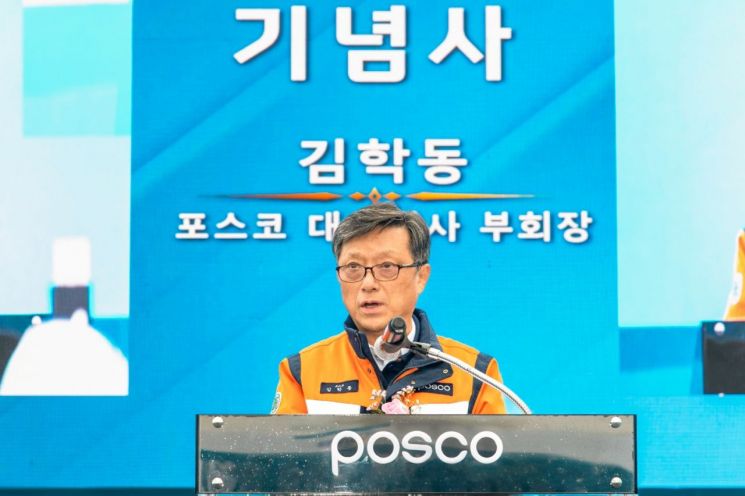 On the 6th, at the groundbreaking ceremony for the new electric furnace project at Gwangyang Steelworks, POSCO Vice Chairman and CEO Kim Hak-dong delivered a commemorative speech. Photo by POSCO
As the era of the ‘Goro (blast furnace)’ comes to an end, the steel industry is accelerating the arrival of the ‘carbon-free steel’ era.
According to the industry on the 7th, POSCO began construction yesterday on an electric arc furnace plant with an annual capacity of 2.5 million tons in Gwangyang, Jeollanam-do. POSCO decided to invest about 600 billion KRW to build a large electric arc furnace as part of its transition to a low-carbon production system. The plant is scheduled to be completed by the end of 2025 and to start full-scale operation from 2026. This move is intended to respond to global decarbonization policies and the demand for low-carbon products.
The groundbreaking ceremony was attended by about 130 people, including Kim Hak-dong, Vice Chairman and CEO of POSCO, Park Chang-hwan, Jeollanam-do Deputy Governor for Political Affairs, Jung In-hwa, Mayor of Gwangyang, and POSCO executives and employees. Vice Chairman Kim Hak-dong said, "Amid rapidly changing management environments due to the global climate crisis and new trade regulations, we will swiftly establish a competitive low-carbon production system."
The method steel companies use to produce molten iron is broadly divided into ‘blast furnace’ and ‘electric arc furnace.’ The blast furnace produces molten iron by putting iron ore, coke, and limestone into a furnace. The electric arc furnace melts scrap metal to produce molten iron. Although the quality of molten iron from electric arc furnaces is lower than that from blast furnaces, carbon emissions are reduced by up to 75%. According to POSCO, carbon emissions per ton of steel product are 2.1 tons with the blast furnace method but decrease to 0.5 tons with the electric arc furnace method.
POSCO produces steel products by either directly using molten iron from the electric arc furnace or applying a hot metal mixing technology that blends molten iron from the blast furnace with that from the electric arc furnace. This hot metal mixing technology is also evaluated to enable the production of high-grade steel. Additionally, energy efficiency is improved by using exhaust gas generated during electric arc furnace operation to preheat scrap. When producing 2.5 million tons of molten iron annually through the electric arc furnace, it is expected to reduce carbon dioxide emissions by up to approximately 3.5 million tons per year compared to the blast furnace method.
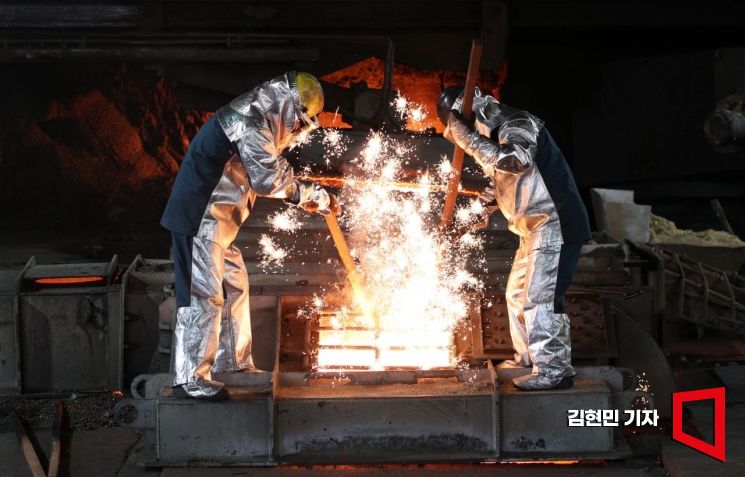 A worker organizing the tundish (the path through which molten steel passes) at Blast Furnace No. 2 of POSCO Pohang Steelworks to ensure smooth tapping. Photo by Hyunmin Kim and Jinhyung Kang kimhyun81@
The electric arc furnace is regarded as an intermediate step toward the commercialization of ‘hydrogen reduction steelmaking’ technology, which is the ultimate goal for steel companies to reduce carbon emissions by producing iron using hydrogen instead of fossil fuels. Although POSCO has mainly used the blast furnace method to produce molten iron, it has chosen the electric arc furnace as an intermediate step before commercializing hydrogen reduction steelmaking.
POSCO stated that the electric arc furnace will play a key role in building a pilot facility, which is a preliminary stage for implementing its proprietary hydrogen reduction steelmaking process called ‘HyREX.’ Recently, hydrogen reduction steelmaking technology has been recognized as a national strategic technology due to its strategic importance for national security and its impact on the overall national economy. POSCO’s Hydrogen Reduction Steelmaking Development Center plans to complete a HyREX pilot facility with an annual capacity of 300,000 tons by 2027 and verify its commercialization potential.
Hyundai Steel plans to establish ‘Hi-Cube,’ a carbon-neutral steel production system based on electric arc furnace technology, by 2030. Hi-Cube is Hyundai Steel’s proprietary hydrogen-based integrated steel production system. It advances the existing electric arc furnace method, which melts scrap metal, to a system capable of melting iron raw materials, removing impurities, and adding components. Dongkuk Steel is participating in the Ministry of Trade, Industry and Energy’s four major industry carbon-neutral development projects, specifically the steel sector’s project titled ‘Development of Energy Circulation Hyper Process Technology for Improving Electric Arc Furnace Efficiency.’ Dongkuk Steel plans to complete research on the hyper electric arc furnace process by 2028.
© The Asia Business Daily(www.asiae.co.kr). All rights reserved.
![Clutching a Stolen Dior Bag, Saying "I Hate Being Poor but Real"... The Grotesque Con of a "Human Knockoff" [Slate]](https://cwcontent.asiae.co.kr/asiaresize/183/2026021902243444107_1771435474.jpg)

















