"If There Are No Essential and Regional Medical Inflow Measures, Expansion Will Fail"
"Based on a nationwide public survey, it was initially proposed to increase the quota by about 3,000 students annually for 10 years, but we positively evaluate the government's decision to increase it by around 2,000."
Regarding the government's announcement on the 6th to expand next year's medical school quota by 2,000, civil society expressed a welcoming stance. On the same day, Yonhap News reported that although the number is less than what civic groups participating in medical issue consultations had demanded, they responded that it is acceptable.
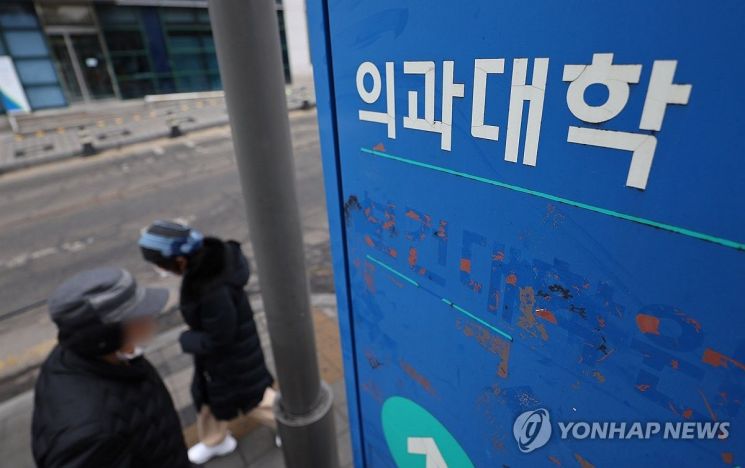
Jiyeon Jeong, Secretary General of the Korea Consumer Union, a private-sector participant in the Health and Medical Policy Deliberation Committee (HMPDC) that finalized the medical school quota increase, mentioned a "positive evaluation."
Won Young-hee, Director of the Korea Federation of Consumer Organizations, also a participant in the HMPDC, said, "Our position was that the quota should be increased by 3,000 to ensure sufficient medical personnel for essential and regional healthcare, but we think this is the government's best effort and an understandable number."
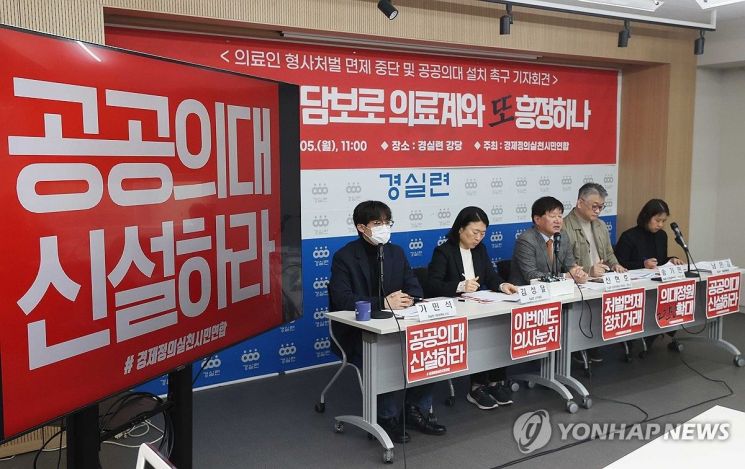 On the morning of the 5th, a press conference titled "Suspension of Criminal Immunity for Medical Personnel and Urging the Establishment of a Public Medical School" is being held at the Kyungsilyeon Auditorium in Jongno-gu, Seoul.
 [Photo by Yonhap News]
However, civil society organizations emphasized that this quota increase is not the "end" but the "beginning." They pointed out that additional policies are needed to ensure that the increased personnel properly serve in essential and regional healthcare fields.
Nam Eun-kyung, Director of the Citizens' Coalition for Economic Justice, stated, "Increasing the quota alone cannot save essential and regional healthcare," and insisted, "The Public Medical School Act and Regional Doctor System Act, which have the enforcement power to bring these doctors to the regions, must be passed by the National Assembly."
The Korean Health and Medical Industry Labor Union criticized the Korean Medical Association's warning on the same day that "if the government unilaterally pushes forward with the medical school quota expansion announcement, we will initiate a general strike" as "inappropriate."
They said, "The Ministry of Health and Welfare held 28 medical issue consultation meetings with the Medical Association, 33 communication sessions with the field, and 10 regional medical roundtables, undergoing a sufficient opinion-gathering process. Is it 'unilateral promotion' or 'hasty promotion' just because the government did not do as the Medical Association wanted?" they questioned.
They further criticized, "The reason for failing to agree on the medical school quota size lies with the Medical Association, which insisted on 'opposition for the sake of opposition.' Their claims are a shabby attitude trying to hide their own insincere negotiation behavior and shift the responsibility for the failed agreement onto the government."
Nam Eun-kyung of the Citizens' Coalition for Economic Justice said, "The government should no longer show leniency toward collective selfishness that holds public health hostage," adding, "A precedent must be set that even doctors will face appropriate consequences for illegal acts, which will eradicate the chronic practice of strike threats."
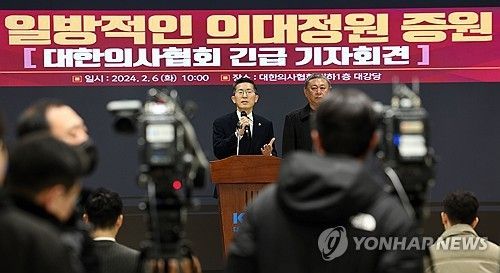 Emergency press conference by Lee Pil-su, President of the Korean Medical Association
 Photo by Yonhap News
Meanwhile, the medical school quota has remained at the same level since it was adjusted to 3,058 in 2006. During this prolonged freeze in the quota, phenomena such as "emergency room cycling" and "pediatric open runs" have occurred, raising concerns about the collapse of regional and essential healthcare.
Subsequently, the government has been reviewing the expansion of the medical school quota. As a result, on the 6th, the Ministry of Health and Welfare decided to increase the quota from 3,058 to 5,058 for the 2025 admissions. In response, medical organizations threatened to begin collective action.
© The Asia Business Daily(www.asiae.co.kr). All rights reserved.



















