Boston Museum of Fine Arts Donates Buddha's Relics Before Buddha's Birthday
Goryeo Masterpiece Relics Return to Homeland After 85 Years...
'Silver-Gilded Lama Pagoda-Shaped Reliquary' on Temporary Loan
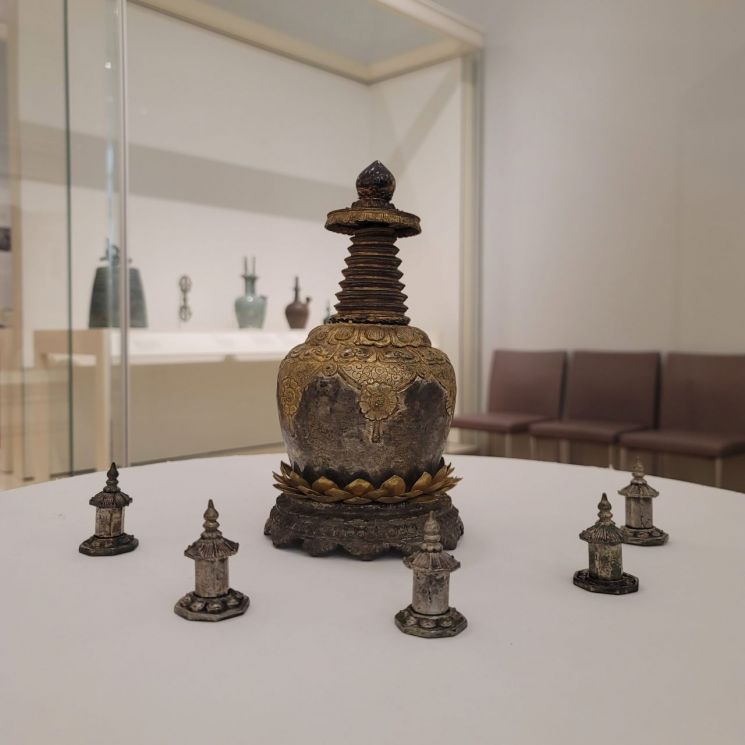
The relics of a monk from the Goryeo Dynasty, exhibited at the Museum of Fine Arts, Boston, are returning home after a series of twists and turns. It is the 'Silver-gilt Lama Pagoda-shaped Reliquary,' regarded as the essence of Goryeo Buddhist culture. On the 6th, the Cultural Heritage Administration announced, "We have agreed with the Museum of Fine Arts, Boston, to donate the relics to the Jogye Order of Korean Buddhism while also pursuing a plan to lend them for a certain period." The relics are bead-shaped bone fragments believed in Buddhism to be the result of true spiritual practice.
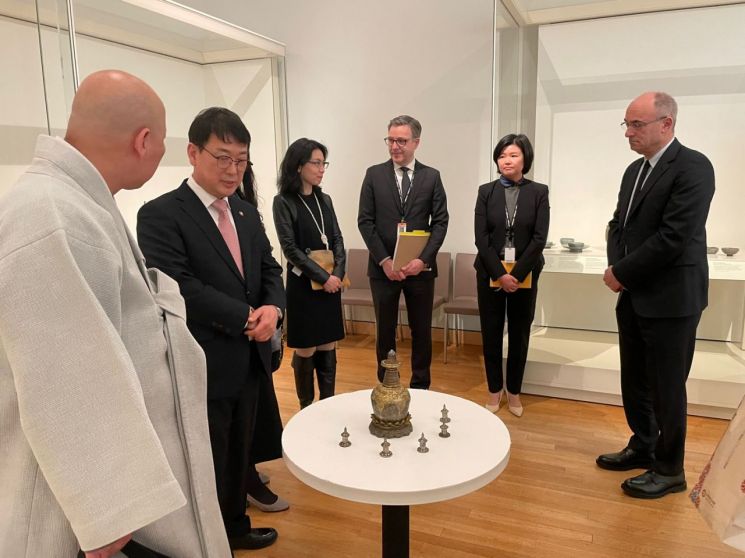
On the 5th (local time), Haegong, head of the Jogye Order's Cultural Department, Choi Eung-cheon, head of the Cultural Heritage Administration, and officials from the Museum of Fine Arts, Boston, met in Boston and shared the view that the relics are sacred objects revered in Buddhism. The museum plans to donate the relics contained in the silver-gilt Lama Pagoda-shaped reliquary before Buddha's Birthday (May 15). The Jogye Order plans to perform traditional rites locally and then bring the relics back to Korea. Haegong said, "We will deeply reflect on the meaning of Hwanjiboncheo (還至本處, a Buddhist term meaning 'returning to the original place') and respectfully enshrine the relics in accordance with the Dharma and principles." Afterwards, preservation measures will be decided through consultation between the Jogye Order, Hoeamsa Temple, and Bongseonsa Temple. They will also consider providing opportunities for Buddhists to view the relics.
Unlike the relics, the reliquary will be temporarily lent and exhibited domestically for a certain period. The schedule and method of lending have not yet been decided. Regarding the regret over the temporary lending, Choi Eung-cheon, head of the Cultural Heritage Administration, said, "We plan to steadily carry out the remaining tasks in close cooperation with the Jogye Order and the Museum of Fine Arts, Boston," adding, "We will continue to develop a mutually friendly relationship with the Museum of Fine Arts, Boston."
Religious circles and others consider the relics and the container holding them, the reliquary, as one. The Cultural Heritage Administration has been discussing the return of both since 2009. The Museum of Fine Arts, Boston, argued that there is no evidence that they were acquired illegally. They insisted on only returning the relics, and negotiations were effectively suspended from 2013.
Discussions resumed recently after First Lady Kim Keon-hee visited the Museum of Fine Arts, Boston, during President Yoon Suk-yeol's visit to the United States in April last year and proposed talks on the return. The Cultural Heritage Administration explained, "It is coming back to the country about a century after being taken abroad," and added, "It will greatly aid academic research and promotion related to Goryeo crafts."
The silver-gilt Lama Pagoda-shaped reliquary contains five small octagonal reliquaries. Inside are the true relics of Sakyamuni, one relic of Jigong (??1363), and two relics of Naong (1320?1376). Jigong was a monk widely known for teaching Buddhism in the Yuan Dynasty of China. Naong is well known as the teacher of King Gongmin (reigned 1351?1374).
The ceramic container is said to have been made after Naong's passing in the late Goryeo period. It was taken to Japan during the Japanese colonial period, and it is known that the Museum of Fine Arts, Boston, acquired it from a dealer in 1939. According to a publication issued by the Museum of Fine Arts, Boston, in 1941, the original enshrinement site was Hoeamsa Temple in Yangju, Gyeonggi Province.
© The Asia Business Daily(www.asiae.co.kr). All rights reserved.


















