"The expansion of the existing medical school quota in Gyeongnam is certain, and the establishment of a new medical school is hopeful."
On the 5th, Park Wan-su, Governor of Gyeongnam Province, announced at an expanded executive meeting held at the provincial office that a "green light" has been turned on for the increase in the quota of the Gyeongsang National University College of Medicine and the establishment of a new medical school, which Gyeongnam Province has been continuously demanding.
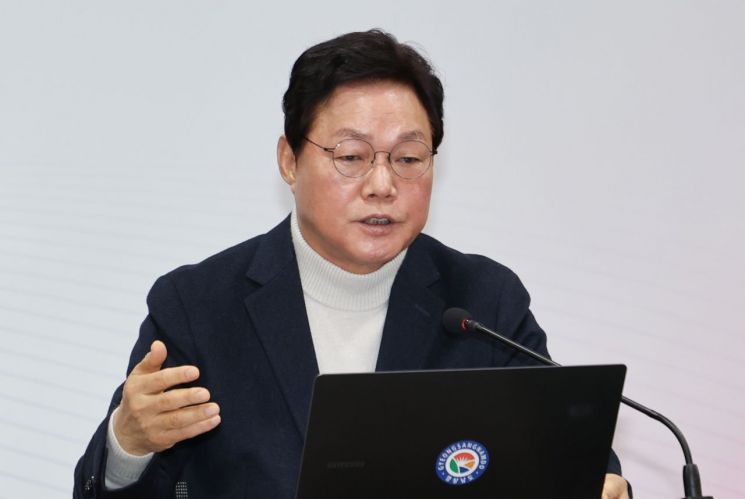 Governor Park Wansu of Gyeongnam Province is presiding over the expanded executive meeting. [Photo by Gyeongnam Provincial Government]
Governor Park referred to the results of discussions on increasing the medical school quota and establishing new medical schools during a meeting with Minister Cho Kyu-hong and other officials from the Ministry of Health and Welfare on the 31st of last month, explaining, "The government is almost certain to increase the medical school quota, and it will be increased within the capacity of existing medical schools."
He emphasized, "Gyeongsang National University has sufficient capacity to train more than 150 doctors without additional investment, so the increase in the medical school quota in Gyeongnam is considered certain."
Governor Park also conveyed that he received a response from the government ensuring that if a new medical school is promoted, Gyeongnam will be included as a new establishment area to avoid any disadvantages.
He added, "The government will first increase the medical school quota and then decide on the establishment of additional medical schools. We discussed that if the government promotes the establishment of new medical schools in the future, Gyeongnam Province will definitely be included in the new establishment areas."
Regarding the four essential medical policy packages announced by the government at the livelihood discussion on the 1st, Governor Park predicted that they will have a positive effect on expanding regional medical personnel.
"I believe this medical reform will be a groundbreaking turning point in Korea's medical policy," he said, analyzing, "The selection of more than 40% of the medical school quota outside the metropolitan area from local talents and the investment of 10 trillion won to increase essential medical fees by 2028 are encouraging for the region."
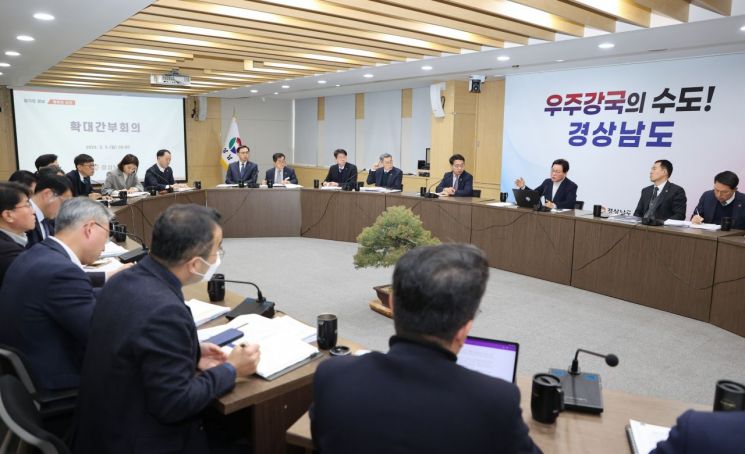 An expanded executive meeting attended by Governor Park Wan-su and senior officials is being held at the Gyeongnam Provincial Government Office.
 [Photo by Gyeongnam Provincial Government Office]
According to the province, the number of doctors in Gyeongnam Province, where 3.3 million people currently live, is 174.2 per 100,000 population, which is significantly lower than the national average of 218.4.
The number of specialists in essential medical fields is also lower than the national average: 11.5 pediatricians compared to 12.1 nationwide, 9.3 obstetricians and gynecologists compared to 11.7, and 3.8 emergency medicine doctors compared to 4.2.
In a public opinion survey conducted by the province in November last year, more than half of the residents responded that there is a shortage of doctors, and most suggested increasing the existing medical school quota and establishing new medical schools as solutions.
The province has set the establishment of new medical schools and the expansion of medical personnel as provincial government tasks to resolve regional medical imbalances, demanding that the quota of Gyeongsang National University, the only medical school in the province, be increased from the current 76 to 150 next year and eventually to more than 200.
Among large cities outside the metropolitan area with populations over one million, Changwon Special City, which lacks medical-related universities such as medical, dental, Korean medicine, and pharmacy schools, is urging the establishment of a medical school with a quota of over 100 students.
© The Asia Business Daily(www.asiae.co.kr). All rights reserved.
![Clutching a Stolen Dior Bag, Saying "I Hate Being Poor but Real"... The Grotesque Con of a "Human Knockoff" [Slate]](https://cwcontent.asiae.co.kr/asiaresize/183/2026021902243444107_1771435474.jpg)

















