Starting from the 20th of this month, a 100-won charge for shopping bags
NFTs provided to customers using tumblers
Starbucks is accelerating its eco-friendly policies from the beginning of the year. Following the provision of NFTs (non-fungible tokens) to customers who use tumblers, the company has actively taken steps to reduce disposable cup usage by converting free paper shopping bags into paid ones. This decision is interpreted as a practical judgment aimed at minimizing unnecessary costs while fulfilling its social role of environmental protection.
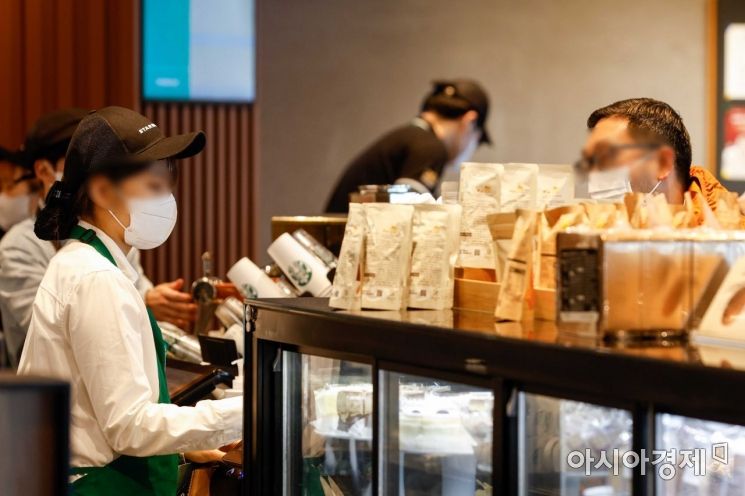
According to industry sources on the 5th, Starbucks Korea will implement a new shopping bag policy starting from the 20th of this month. Until now, Starbucks has provided shopping bags free of charge to customers carrying purchased items outside, but from now on, paper shopping bags will be charged 100 won, and reusable bags will be provided for 500 won.
Earlier, Starbucks launched the NFT Eco Project last month to increase the use rate of personal cups by customers. The NFT Eco Project rewards customers who use tumblers with NFTs. When ordering with a personal cup through the ‘Siren Order’ system within the Starbucks application, customers earn ‘Eco Stamps,’ and after collecting a certain number of stamps, Starbucks NFTs are provided.
The effects are appearing immediately. During the first two weeks of the NFT Eco Project from the 16th to the 29th of last month, the use of disposable cups decreased by about 600,000. Orders selecting personal cups via Siren Order increased by 49% compared to the same period last year, and the total number of personal cup uses also rose by 32%. Approximately 600,000 Eco Stamps were issued over two weeks, with about 260,000 Starbucks Rewards members participating in the project.
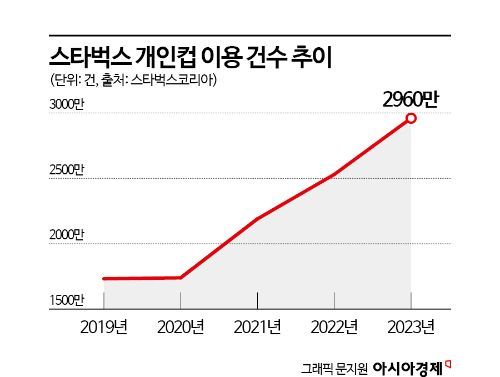
Starbucks has implemented various policies to establish an eco-friendly consumption culture. A representative example is the discount benefit for drinks using personal cups. Since entering the Korean market in 1999, Starbucks has offered a 300 won discount to customers using personal cups, and from 2022, this discount was increased to 400 won. The incentive policy has proven effective; personal cup usage, which was around 17.32 million cases in 2019, increased to 21.9 million cases in 2021 during the COVID-19 pandemic. Even after the transition to endemic, personal cup users continued to increase, recording 29.6 million cases last year, about a 17% increase compared to the previous year (25.3 million cases).
In addition, Starbucks started the ‘No Disposable Cup Store Campaign’ in 2011 and signed a voluntary agreement with the Ministry of Environment and the Resource Circulation Social Solidarity in 2018 to provide paper straws. The same year, they also introduced lids that allow drinking without straws. These policies have produced tangible results and are serving as momentum for subsequent eco-friendly policies.
Starbucks’ eco-friendly policy drive at the beginning of the year is interpreted as an effort to lead the industry’s eco-friendly policies while securing practical benefits such as cost reduction based on this momentum. A Starbucks representative said, “This policy aims to minimize the use of disposable products and encourage the use of personal reusable bags in line with the eco-friendly era. We will continue to strive to create an environment where customers can easily continue eco-friendly activities in their daily lives.”
Starbucks’ eco-friendly drive is expected to influence the entire industry. An industry insider said, “Considering Starbucks’ scale and influence, it is true that the company tends to lead policies and trends in the domestic coffee franchise industry,” adding, “The conversion to paid shopping bags is likely to become an industry standard in the near future.” Currently, among major coffee franchises, Twosome Place and Paul Bassett charge 200 won, and Hollys charges 100 won for paper shopping bags.
© The Asia Business Daily(www.asiae.co.kr). All rights reserved.
![From Hostess to Organ Seller to High Society... The Grotesque Scam of a "Human Counterfeit" Shaking the Korean Psyche [Slate]](https://cwcontent.asiae.co.kr/asiaresize/183/2026021902243444107_1771435474.jpg)

















