Lee Jae-myung Holds Emergency Press Conference in Gwangju
"Maintain the Semi-Linked System for Proportional Representation Selection"
Han Dong-hoon: "An Individual Deciding the Election System"
Lee Jae-myung, leader of the Democratic Party of Korea, decided on the party's official stance for this year's proportional representation election method as the 'quasi-linked proportional representation' on the 5th. Lee also officially announced the formation of a satellite party in the form of a 'Democratic Reform Election Grand Alliance.'
Visiting Gwangju, Lee declared at an emergency press conference at the May 18 Democratic Cemetery, "We will find the path to victory within the quasi-linked system." Previously, the Democratic Party had fierce debates between those advocating for a regional parallel system to win the general election and those insisting on maintaining the linked system promised through political reform. Eventually, on the 2nd, the Democratic Party's Supreme Council delegated the decision-making authority on this issue to Lee.
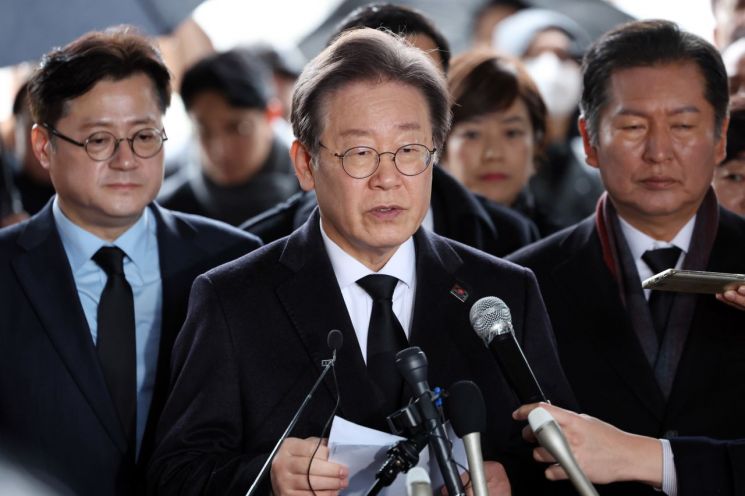
At this occasion, Lee explained the reasons for his dilemma between the parallel and linked systems and introduced the negotiation process in which he proposed a third way (allowing dual registration in regional proportional representation and guaranteeing seats for minor parties) but was rejected. He then stated, "The quasi-linked system is an 'imperfect but precious step forward,'" adding, "I believe the awakened and active citizens will open the 'path to a splendid victory,'" explaining why he chose the quasi-linked proportional representation system.
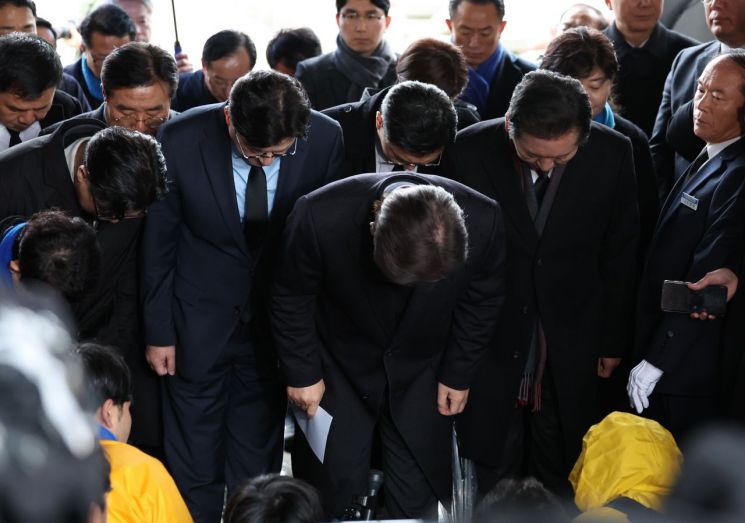
At the same time, he officially announced the decision to form a satellite party. He mentioned the incomplete legislation that failed to prevent satellite parties in the previous National Assembly, the failure to pass the satellite party prevention law in the current National Assembly, and the necessity to form a satellite party again ahead of the general election, apologizing three times. Regarding the Democratic Party's proportional representation selection, he said, "We will prepare an integrated proportional party that responds to the satellite party's foul play together with all forces agreeing on regime judgment and historical progress while preserving the spirit of the quasi-linked system," and added, "We will build the 'Democratic Reform Election Grand Alliance' to lead the victory of the Democratic Party and the people." Referring to the decision to create a quasi-satellite party rather than a satellite party, he added, "Although we cannot wield swords together, I hope you can somewhat understand the inevitability of at least raising shields."
Notably, this election alliance could extend to a constituency alliance. After the Supreme Council meeting, Lee said at a roundtable, "I came to a realistic judgment that we have no choice but to form a grand alliance for the election, including the constituency issue and proportional representation," adding, "The proportional alliance issue cannot be unrelated to this matter, so I proposed them together."
Regarding the proportional alliance, he said, "It is intended as a temporary, emergency, and self-defense measure," and added, "What if minor parties unite into a permanent political organization? Each should exist independently." He also indicated that the Democratic Party would take the lead in the proportional alliance party. Lee said, "Politics is reality, and judgments and results must bear responsibility for those results," adding, "I believe the Democratic Party, as the largest party, should lead and take responsibility."
Meanwhile, Lee, who served as the party's talent committee chair overseeing the recruitment of candidates for the general election, said regarding the proportional candidacy of recruited talents, "It was one of the many concerns," and added, "I will continue to consider it."
With Lee adopting the quasi-linked proportional representation system, it appears inevitable that the Public Official Election Act will also undergo revision. Currently, the Public Official Election Act is set to transition to a fully linked system in this election following the last general election. With Lee's announcement to maintain the quasi-linked system, some framework of the parallel proportional representation is expected to remain. However, clashes between ruling and opposition parties during the election law revision process are unavoidable.
Meanwhile, Han Dong-hoon, emergency committee chairman of the People Power Party, criticized at the emergency committee meeting, "It is truly incomprehensible that the election system, which will greatly affect 50 million people, is being decided according to the mood of one person named Lee Jae-myung." Regarding Lee's decision on the quasi-linked proportional representation method, he said, "That system has no inevitable basis," criticizing it.
© The Asia Business Daily(www.asiae.co.kr). All rights reserved.


















