Processed products like Cheongju and Sikhye are cheaper at large supermarkets
Seoul Agro-Fisheries & Food Corporation surveys 16 traditional markets and 8 large supermarkets
The cost of setting up a Seol Charye table for the upcoming Lunar New Year is on average 225,604 KRW at traditional markets, which is 12% cheaper than at large supermarkets (256,200 KRW), according to a recent survey.
On the 4th, the Seoul Agricultural and Marine Products Corporation announced the results of a price survey on agricultural, marine, and livestock products conducted at 16 traditional markets and 8 large supermarkets in Seoul. The survey was carried out on the 24th of last month, with price investigation monitors from Seoul and corporation price survey staff visiting traditional markets such as Yongsan-gu’s Yongmun Market and Gangdong-gu’s Amsa General Market, as well as large supermarkets like E-Mart, to verify prices directly.
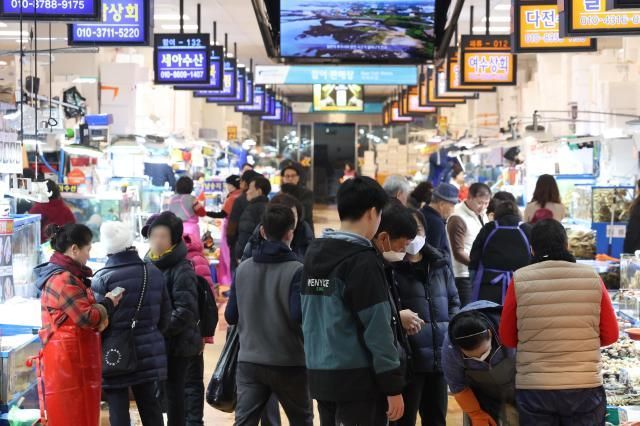 On the morning of the 31st, about ten days before Seollal, citizens are browsing seafood at Noryangjin Fisheries Wholesale Market in Dongjak-gu, Seoul.
 [Photo by Yonhap News]
For a family of 6 to 7 people, the average cost of the Charye table was 225,604 KRW at traditional markets and 256,200 KRW at large supermarkets, making traditional markets about 12% cheaper. Among them, ‘Garak Mall’ located within Garak Market had the lowest average cost at 206,657 KRW. This was 19% lower than the price at large supermarkets, allowing for more affordable preparation of the Charye table.
Overall, the cost of setting up the table is expected to rise by 2-3% compared to last year.
The corporation stated that among the 35 surveyed items, prices for fruits and vegetables increased significantly due to poor harvests caused by adverse weather conditions. However, livestock product prices remained stable due to an increase in the number of animals slaughtered and stockpiling. Seafood prices are also expected to rise slightly due to decreased production.
Prices of imported items such as early-season Chinese dried pollack and Alaska pollock have risen due to reduced import volumes. Livestock product prices remain stable. For example, beef for skewers (200g) costs 9,836 KRW, about 5% cheaper than last year (10,399 KRW). This is attributed to an increase in the number of Hanwoo cattle slaughtered and a rise in domestic pork supply.
Production of apples and pears has significantly decreased due to cold damage during the flowering period, and limited storage has caused prices to rise sharply. Prices of dried persimmons also increased due to poor harvests of the raw persimmon fruit.
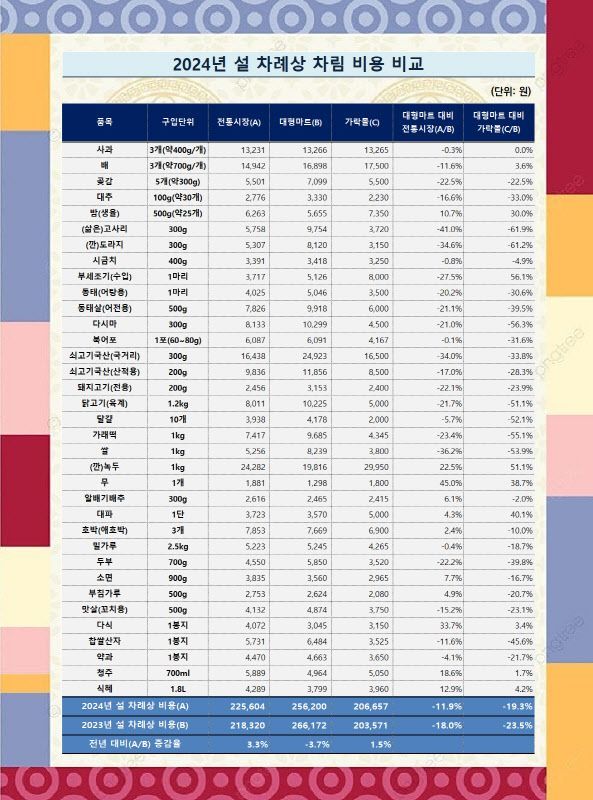
When comparing traditional markets and large supermarkets by item category, fruits are on average 8% cheaper and livestock products about 20% cheaper at traditional markets. Items such as garaetteok (rice cake sticks), rice, and tofu were also less expensive at traditional markets. On the other hand, processed foods including vegetables, cheongju (rice wine), sikhye (sweet rice drink), and dasik (traditional Korean sweets) were relatively cheaper at large supermarkets.
Kim Seung-ro, head of the Data Strategy Team at the Seoul Agricultural and Marine Products Corporation, said, “For economical shopping, it is advisable to purchase fruits and livestock products at traditional markets the day before Seol, and processed goods such as cheongju at large supermarkets.”
The results of this survey will be published on the corporation’s website before the holiday.
Meanwhile, to ease the burden on citizens preparing the Seol Charye table amid high prices, Seoul City is holding a 30% discount event at 61 traditional markets until the 12th. Participating traditional markets and shopping districts in Seoul include Yongmun Market (Yongsan-gu), Gyeongchang Market (Yangcheon-gu), Eungam Ogeori Shopping District (Eunpyeong-gu), Jungnang Dongbu Market (Jungnang-gu), Dapsimni Market (Dongdaemun-gu), Daemyeong Market (Geumcheon-gu), Hwagok Central Market (Gangseo-gu), Gireum Market (Seongbuk-gu), and Gocheok Neighborhood Market (Guro-gu), totaling 61 locations. These markets offer up to 30% discounts on Seol seasonal products and agricultural, livestock, and marine products.
© The Asia Business Daily(www.asiae.co.kr). All rights reserved.


















