Bloomberg "Weak Demand Sends Strong Message About Oversupply"
China's biggest holiday, the Spring Festival (Chunjeol·Seol), is approaching, but pork consumption, an essential food for the holiday, has reportedly declined, Bloomberg News reported on the 3rd.
Wu Aijeon, a merchant who has been operating in Beijing's Xinmin Market for 20 years, stated that although pork prices have dropped to about one-fifth compared to the previous year, sales during the holiday period have decreased by about one-third compared to previous years. Wu said, "Even though the Spring Festival is just around the corner, it is very difficult to raise pork prices this year."
Gung Cheong, a pork supplier in eastern China several hundred kilometers from Beijing, also said that migrant workers (nongmingong), who were pillars of the local construction and textile industries, used to spend about 1,000 yuan (about 190,000 won) on pork during the Spring Festival, but now they spend barely 300 yuan (about 60,000 won) or do not buy at all.
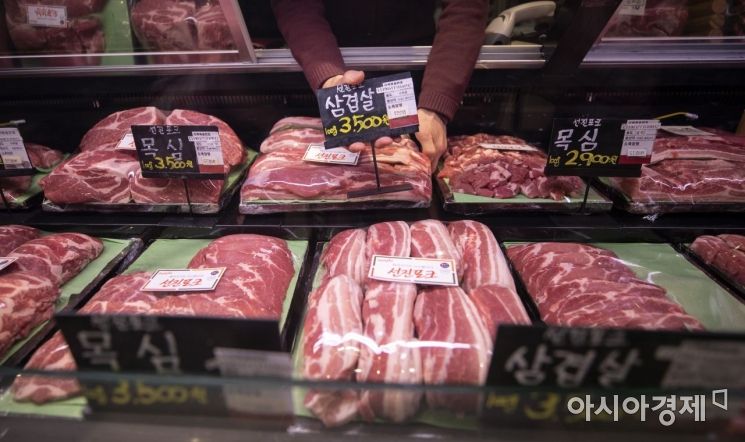 As African swine fever spreads in China, domestic pork prices are fluctuating. On the 28th, an employee at a pork shop in Seoul is displaying samgyeopsal. Photo by Dongju Yoon doso7@
Bloomberg explained, "Although pork demand in China has slowed over the past few months, the still weak demand despite the approaching peak season sends a strong message about wage reductions hitting households hard and burdening consumer prices, affecting consumption and (pork) oversupply."
According to Shanghai JCI, a consulting firm, China's pork consumption last year decreased by 1 million tons to about 54 million tons. While not a dramatic drop, it was a significant decrease during a time when families were beginning to enjoy consumption and entertainment again.
The Ministry of Agriculture and Rural Affairs of China held a press conference on the 23rd of last month, stating, "Farmers facing difficulties accelerated pig slaughtering at the end of last year, resulting in pork production reaching 57.94 million tons, the highest in nine years," and announced plans to guide the reduction of pig production scale.
China is the world's largest pork consumer, accounting for nearly half of global pork consumption and production. It consumes five times more pork annually than the United States. Pork prices hold the largest weight in the Consumer Price Index (CPI).
In fact, as pork consumption decreased, China's consumer price inflation rate recorded negative growth for three consecutive months until December last year. In December last year, China's Consumer Price Index (CPI) fell by 0.3% compared to the same month the previous year, with pork price fluctuations (-26.1%) having a significant impact.
© The Asia Business Daily(www.asiae.co.kr). All rights reserved.
![Clutching a Stolen Dior Bag, Saying "I Hate Being Poor but Real"... The Grotesque Con of a "Human Knockoff" [Slate]](https://cwcontent.asiae.co.kr/asiaresize/183/2026021902243444107_1771435474.jpg)
















