Ministry of Health and Welfare Announces 2nd Comprehensive National Health Insurance Plan
Over 10 Trillion Won Invested to Focus on Essential Medical Care
"To Where It Is Truly Needed"... Deficits and Over-treatment to Be Prevented Starting 2026
The government is shifting the direction of health insurance management from the previous focus on 'reducing medical expenses burden' to 'essential medical care-centered,' simultaneously pursuing two goals: strengthening medical coverage for all citizens and securing the financial stability of health insurance. The health insurance finances are expected to turn into a current account deficit starting in 2026. The government plans to invest more than 10 trillion won in health insurance finances over five years until 2028 to strengthen essential medical care while seeking expenditure efficiency to prevent excessive treatments from causing financial leakage.
Accordingly, support will be concentrated on raising fees in essential medical fields where supply is insufficient, such as severe and emergency medical care, or where demand is low, such as pediatrics and childbirth. To reduce medical disparities, the out-of-pocket maximum for the vulnerable lower 30% income group will be frozen. Additionally, excessive outpatient treatments will be reduced, and non-severe non-covered treatments like manual therapy, which were previously received alongside covered treatments such as physical therapy, will be restricted from receiving health insurance coverage.
On the 4th, the Ministry of Health and Welfare announced the '2nd Comprehensive Plan for National Health Insurance (2024?2028),' outlining the policy goals and directions for the health insurance system. This second plan, following the first comprehensive plan announced in 2019, focuses on strengthening essential medical care and operating a sustainable health insurance system.

◆ Introduction of 'Public Policy Fees' in Childbirth and Pediatrics... High-Risk Childbirth Policy Surcharge Expanded from 30% to 200%
The Ministry of Health and Welfare will selectively increase medical fees for essential medical items that are highly demanding and resource-intensive but undervalued. This includes undervalued surgery and procedure fees such as endoscopic surgery, fees for high-difficulty and high-risk surgeries like burns, finger replantation, pediatric surgery, and transplant surgery. Weekday daytime fees will increase from the existing 50% to 100%, weekday nighttime and holiday daytime fees from 100% to 150%, and holiday nighttime fees from 100% to 200%. Fees for closed ward intensive care and isolation protection in tertiary general hospitals will also be raised starting this year. The adjustment cycle for relative value scores will be drastically shortened from the existing 5?7 years to 2 years to quickly reflect changes in the medical environment.
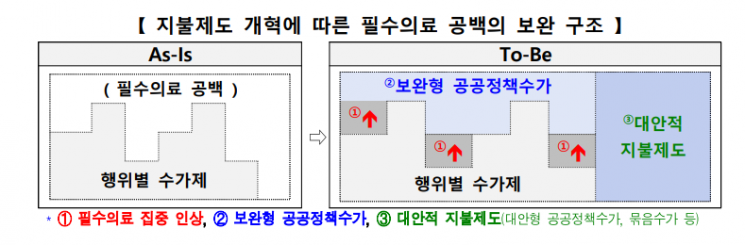
To supplement areas insufficiently compensated by the existing fee-for-service calculation method, 'policy fees' will be introduced. These reflect the difficulty, risk, urgency, skill level, and required time (waiting/on-call) of medical procedures. They will be applied first in childbirth and pediatrics. For childbirth, regional fees of 550,000 won and safety policy fees of 550,000 won will be introduced to strengthen infrastructure, and a new policy fee of 550,000 won will be established for emergency childbirth. The policy surcharge for high-risk childbirth will be expanded from the existing 30% to 200%. An alternative public policy fee will also be introduced to compensate post hoc for costs incurred in maintaining infrastructure for severe and essential medical care, such as children's public specialized medical centers and severe emergency centers.
◆ 10% Voucher Refund on Insurance Premiums for Low Medical Use... Adjustment of Screening Items According to 'Life Cycle'
Until now, health insurance coverage policies have emphasized 'universal health insurance enrollment and cost burden reduction,' but concerns about the 'sustainability' of health insurance have recently emerged due to population decline and other factors. Because coverage expansion has been pursued indiscriminately across all medical areas without prioritization, financial deterioration has occurred due to excessive medical use and expansion of non-covered treatments. Over the past 10 years (2012?2021), the average annual growth rate of insurance premium income was 7.6%, while the total medical expenses growth rate was 7.7%, 0.1 percentage points higher.
In this plan, the government focuses on operating health insurance coverage emphasizing 'prevention' and 'management.' Accordingly, for health checkups, a 'customized health screening' reflecting life cycle characteristics will be promoted by adjusting screening items to enable early disease detection. A system to refund health insurance premiums for low medical use is also under consideration. For those with significantly low annual medical use, such as less than once per quarter, a voucher worth 10% of the previous year's paid insurance premiums (up to 120,000 won annually) will be provided for use at medical institutions or pharmacies. This project will first be introduced as a pilot for young people aged 20?34 with low medical use and then expanded to all subscribers after evaluation.
Efforts will also be made to eliminate medical blind spots. The Ministry of Health and Welfare decided to freeze the out-of-pocket maximum for the lower 30% income group starting this year to reduce their medical expense burden. Currently, this amount is adjusted annually reflecting the previous year's consumer price index changes. Although the out-of-pocket maximum system applies, about 24 billion won is refunded annually due to unawareness and failure to apply; this will be addressed through strengthened publicity.
◆ Restriction on Indiscriminate Installation and Excessive Use of High-Cost Equipment
The Ministry of Health and Welfare also announced measures to prevent excessive medical services and unnecessary medical shopping. From this year, the expansion or addition of hospital beds to induce hospitalization of patients who can receive outpatient treatment will be restricted. Furthermore, installation standards for special medical equipment such as CT and MRI will be strengthened to curb indiscriminate installation of high-cost equipment.
For patients, a 'Wise Choice Campaign' will be promoted to guide appropriate medical use. Alongside this, for medical services with unclear medical effectiveness or low necessity, the out-of-pocket burden under health insurance will be increased, and outpatient treatment fees will be revised. According to the Ministry, the average annual outpatient visits per person is 15.7 times, three times higher than the OECD average of 5 times. Measures to rationally manage frequent outpatient visits will be prepared.
The mixed treatment (non-covered + covered) of non-severe excessive non-covered treatments such as manual therapy or cataract surgery will also be restricted. Specifically, cases where manual therapy and physical therapy are conducted as a package will be excluded from health insurance coverage.
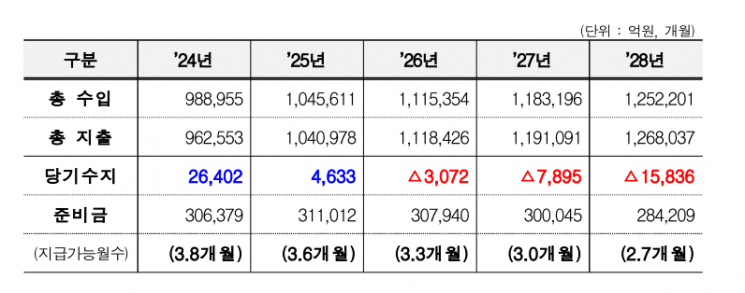
The Ministry of Health and Welfare plans to promote expenditure efficiency and structural reforms to ensure stable operation of health insurance finances, while preparing for mid- to long-term financial deterioration by promoting social discussions on appropriate premium rates and government support to increase revenue. Health insurance finances are expected to turn into a current account deficit starting in 2026. If this continues, deficits will grow to 307.2 billion won in 2026, 789.5 billion won in 2027, and 1.5836 trillion won in 2028. The Ministry stated, "The financial outlook for the next five years can be estimated to turn into a current account deficit from 2026, but various forecasts are possible depending on changes in income and expenditure variables."
Park Min-su, the 2nd Vice Minister of Health and Welfare, said, "Through this plan, we will firmly guarantee essential medical care and rationally adjust prices to normalize medical supply," adding, "We will reduce unnecessary medical shopping and abuse, and establish a stable supply chain and medical innovation support system to build a health insurance foundation that can be enjoyed continuously in the future."
He also emphasized, "We will continue to support appropriate health insurance benefits for the public and concentrate more than 10 trillion won over five years on areas directly related to citizens' lives and health, such as essential medical care, which are insufficiently supplied," and "We will do our best to ensure that essential medical care measures are implemented without disruption through stable financial support."
© The Asia Business Daily(www.asiae.co.kr). All rights reserved.



















