Top 100 Companies Down 34.2%... Halved Compared to One Month Ago
Although Chinese authorities have been consecutively introducing real estate stabilization measures such as regulatory easing and liquidity supply, the market still appears unable to emerge from the tunnel.
According to Kuailuier, a Chinese real estate big data company, the sales of the top 100 real estate companies in China last month amounted to 235.06 billion yuan (approximately 43.3944 trillion KRW), a sharp decline of 34.2% compared to the previous year. Compared to a month earlier, it is almost halved (-47.9%). Chinese economic media Caixin evaluated this as "the lowest monthly sales scale in the past five years." Even compared to February 2020 (293.11 billion yuan), when China entered the zero-COVID policy and transactions cooled down, it is only 80% of that amount.
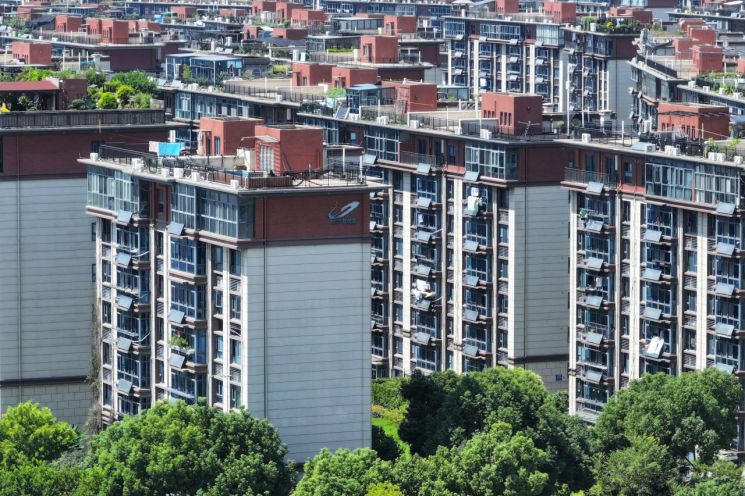
On an annual basis, the sales of real estate companies have also been continuously declining. The sales of the top 100 real estate companies, which reached 579.2 billion yuan until 2019, fell to 509.7 billion yuan in 2020, the first year of the COVID-19 outbreak, recovered to 870.5 billion yuan in 2021, and then decreased again to 525.6 million yuan in 2022. Last year, it was only 354.3 billion yuan.
The government significantly eased loan restrictions based on the number of houses and introduced policies such as lowering loan interest rates and tax benefits, but the effects did not last long. In Guangzhou, purchase restriction policies were fully adjusted for the first time in 13 years, greatly reducing the scope of restrictions, but the new housing transaction area in Guangzhou began to decline again just one month after the announcement.
In Beijing and Shanghai, where housing-related restrictions were the strictest, measures such as lowering the deposit ratio and adjusting the criteria for general housing were taken in December last year. However, Caixin evaluated that Shanghai's daily housing sales area last month, just one month after the announcement, was 49,000㎡, approaching a historic low. Before the implementation of the authorities' policy easing announcement, Shanghai's average daily housing sales area was 56,000㎡.
Changjiang Securities recently stated in a research report, "Policy effects are effective when housing sales volume and sales prices are relatively stable," adding, "However, the current market is expected to face increased downward pressure, and the effects of existing policies will be limited within the market."
Guo Xinyu, an analyst at Zhongzi Research Institute, said at a recent conference, "In the short term, demand policies in core first- and second-tier cities are expected to continue to be optimized," and forecasted, "Market activity may rebound after the Lunar New Year holiday, and some cities may expect a 'spring breeze (小?春)'."
© The Asia Business Daily(www.asiae.co.kr). All rights reserved.

![Clutching a Stolen Dior Bag, Saying "I Hate Being Poor but Real"... The Grotesque Con of a "Human Knockoff" [Slate]](https://cwcontent.asiae.co.kr/asiaresize/183/2026021902243444107_1771435474.jpg)















