'2024nyeon Gyeongjehak Gongdong Haksuldahoe' Dinner Speech
"We ask for the academic community's research."
Lee Chang-yong, Governor of the Bank of Korea, sought the help of scholars to solve tasks for desirable monetary policy management, such as estimating the neutral interest rate and setting the development direction of forward guidance.
At the '2024 Joint Economics Conference' held at Seoul National University on the 1st, Governor Lee stated in his dinner speech, "Among the monetary policy issues faced during the past two years as the Governor of the Bank of Korea, there are five topics on which I hope the academic community and the Bank of Korea can find answers together." He candidly revealed his concerns as the head of monetary policy entering the second half of his term amid a changing financial environment.
A Bank of Korea official explained, "(Governor Lee) was busy dealing with general issues such as inflation during the first half of his term, but now that internal personnel matters are settled, he has the temporal leeway to consider structural issues. He has thus assigned research topics that need to be studied in the context of a changing financial environment."
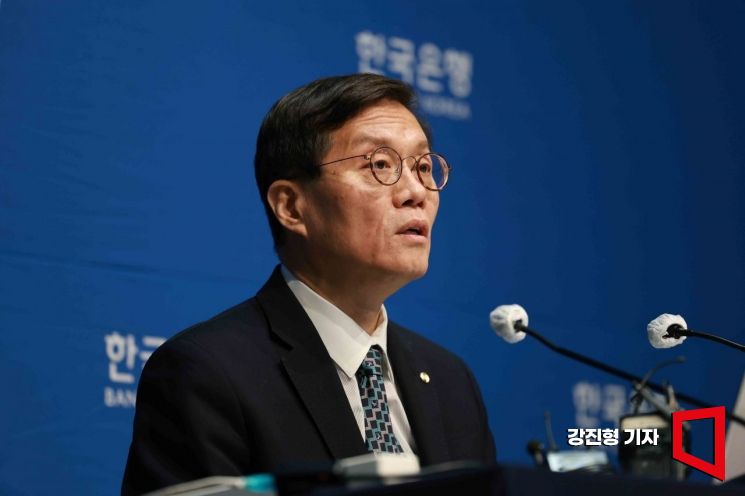
Governor Lee's questions mainly concerned the desirable role and policy tools of the central bank. First, he requested research on the development direction of the 'Korean-style dot plot,' which he introduced for the first time. He said, "Starting from the second half of this year, we plan to announce major economic forecasts quarterly instead of semiannually. In this context, I am currently considering whether it is desirable to further develop conditional forward guidance and, if so, to what extent the horizon should be extended for announcement." Since about a year and a half has passed since the introduction of the Korean-style dot plot, he judged that empirical analysis of the results would be somewhat possible.
He also mentioned the need to study whether it is appropriate for the central bank to utilize Financial Intermediation Support Loans (FISL). The Bank of Korea currently operates FISL on a scale of 30 trillion won, but it has faced criticism that this is the domain of fiscal authorities, not the central bank. Governor Lee said, "In the medium to long term, if the economy falls into a structural long-term recession and faces the zero lower bound on interest rates, FISL could become a useful tool for the central bank, which can no longer use interest rate policy." He added, "A fundamental discussion is needed on whether FISL can be one of the central bank's policy tools in a zero interest rate situation."
He also revealed concerns about improving the central bank's lending system. This includes how to cooperate with the government in supervision and investigation to include non-bank financial institutions as eligible institutions for fund adjustment loans, and how to prevent moral hazard issues that may arise while allowing financial institutions to use loan claims as collateral without fearing stigma effects.
He then asked what the optimal open market operation method would be considering the structure of Korea's short-term money market, and how the role of Monetary Stabilization Bonds should be set during open market operations. Recently, the Bank of Korea decided to include asset management companies as target institutions for open market operations to enhance the effectiveness of monetary policy management.
He also requested academic research on estimating the neutral interest rate. The neutral interest rate is the rate at the potential growth level where the economy is neither overheated nor in recession, playing a key role in determining the monetary policy stance. Interest in this has increased since last year, especially among U.S. economists, due to the possibility of a rising neutral interest rate. Governor Lee emphasized, "In Korea's case, due to domestic factors such as demographic changes caused by low birth rates and aging, the neutral interest rate may decline in the long term," and "In an open economy heavily influenced by external factors, how the neutral interest rate is determined when domestic and external factors act in different directions is a very important factor in deciding future monetary policy."
© The Asia Business Daily(www.asiae.co.kr). All rights reserved.

















