Demand deposits at major commercial banks decreased by 26 trillion won in just one month. Despite the deposit interest rates at commercial banks falling to the 3% range amid persistent domestic and international challenges such as real estate project financing (PF) and sustained high interest rates, idle funds are once again flowing into fixed deposits and similar products.
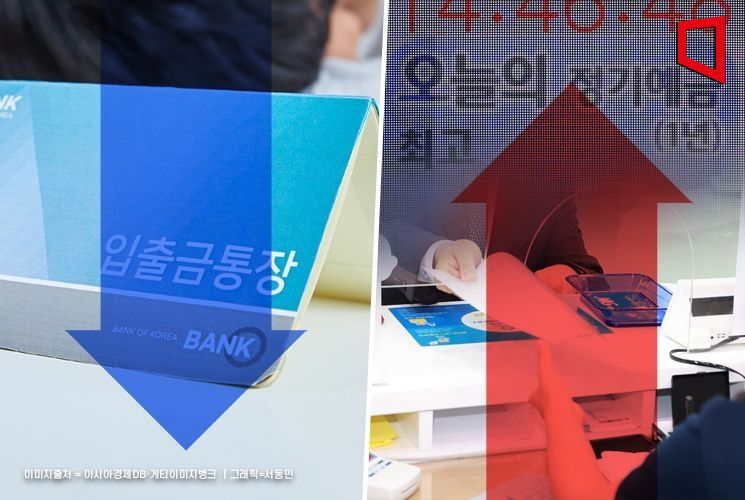
According to the financial sector on the 2nd, the balance of demand deposits at the five major domestic commercial banks (KB Kookmin, Shinhan, Hana, Woori, and NH Nonghyup) stood at 590.712 trillion won at the end of last month, down about 4.2% (26.036 trillion won) from the previous month (616.748 trillion won). Until the end of December last year, demand deposits had increased by 3.01% (18.0439 trillion won) compared to the previous month, but they switched back to a net decline within a month.
Demand deposits, which include ordinary deposits and on-demand withdrawal deposits (commonly known as parking accounts), have significantly lower interest rates compared to regular deposits but allow depositors to withdraw or deposit funds at any time. As such, they facilitate easy movement of funds into investment assets such as securities and real estate, and are classified as 'investment standby funds.'
The return to a decline in demand deposits is analyzed to be due to the base effect and uncertain future outlook. At the end of December last year, demand deposits decreased as the U.S. Federal Reserve (Fed) hinted at ending monetary tightening and companies repaid loans to manage year-end financial statements. However, entering the new year, concerns related to the PF market, such as the workout (corporate financial restructuring) of Taeyoung Construction, and the possibility of sustained high interest rates have emerged.
Supporting this, the balance of fixed deposits at the five major banks at the end of last month increased by 13.3228 trillion won from the previous month, reaching 862.6185 trillion won. Although the average interest rate for one-year fixed deposits at these banks dropped to around 3.50?3.55% as of the previous day, similar to the Bank of Korea’s base rate (3.50%), investors seeking deposits have actually increased. Fixed installment savings also rose by 6.244 billion won during the same period.
This trend aligns with investor deposits, which are considered standby funds for the stock market. Investor deposits, which had increased to 59 trillion won at the beginning of the year, fell by about 8 trillion won to 51 trillion won as of the 30th of last month.
Meanwhile, as savings and installment savings products regain attention, some banks are attracting investors with high-interest special products. Woori Bank recently launched a fixed installment savings product offering up to 7% annual interest to commemorate its 125th anniversary, and K Bank introduced a fixed installment savings product with an interest rate of up to 10% for the first 10,000 accounts. A representative from a commercial bank said, "It seems that a combination of the base effect and the complex impact of real estate PF, the Red Sea crisis, and prolonged high interest rates since the beginning of the year is at play."
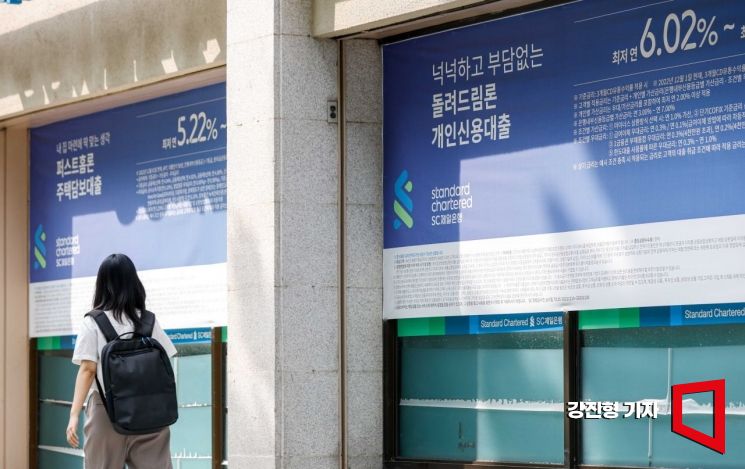 As the average loan interest rate in the banking sector has been rising for two consecutive months, a banner displaying mortgage loan and personal credit loan interest rates is hung on the exterior wall of a commercial bank in Seoul on the 31st. Photo by Jinhyung Kang aymsdream@
© The Asia Business Daily(www.asiae.co.kr). All rights reserved.


















