The Supreme Court has ruled that a signature list for a specific candidate written under the name of a fictitious person (a non-existent fictional character) cannot be the object of the crime of forgery of private documents.
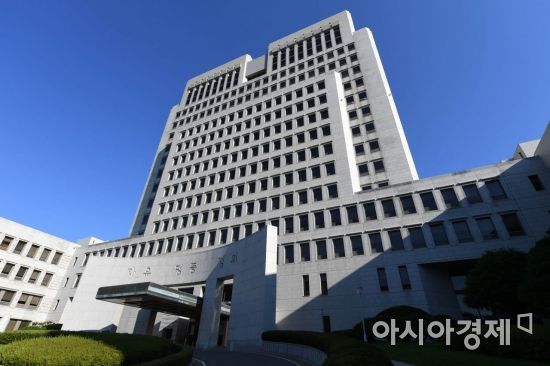
According to the legal community on the 1st, the Supreme Court's 2nd Division (Presiding Justice Cheon Dae-yeop) upheld the lower court's ruling that found Kim, who was indicted on charges of violating the Public Official Election Act, forgery of private documents, and use of forged private documents, guilty of violating the Public Official Election Act and sentenced him to a fine of 1 million won. The Supreme Court, like the appellate court, acquitted Kim of the charges of forgery of private documents and use of forged private documents.
Kim, a member of the People Power Party, created 21 signature lists by entering the names, companies, and regions of 315 non-existent individuals during a signature campaign supporting President Yoon Seok-yeol, who was a presidential candidate in February 2022, and then handed these lists to another party member, A, who was unaware of the circumstances.
Originally, Kim and other party members planned to collect 10,000 support signatures and hold a press conference to announce them, but when they failed to meet the goal, Kim committed this act. However, it was investigated that the falsely created signature lists were not actually used.
The first trial court applied the Public Official Election Act violation for the political signature campaign during the election period and sentenced Kim to a fine of 1 million won, and separately sentenced him to a fine of 1 million won for forgery and use of forged private documents for forging the signatures.
In the trial, Kim's side admitted that Kim had created the false signature lists as alleged by the prosecution but argued that "the signature lists created by Kim are not documents related to proof of facts under the Criminal Act but merely opinions or appeals."
However, the court rejected Kim's argument, stating, "The signature lists forged by the defendant in this case correspond to documents under the crimes related to documents in the Criminal Act."
The court explained, "The signature lists in this case are titled 'Declaration of Support for Candidate Yoon Seok-yeol by 10,000 Ordinary Citizens and Workers of Geoje,' and the content states: 'Ordinary citizens and workers in the Geoje region who hope for a regime change in the 20th presidential election support candidate Yoon Seok-yeol to judge the incompetent regime and to build a fair, common-sense, and just society and the development of the Republic of Korea. Supporters of candidate Yoon Seok-yeol, Geoje ordinary citizens and workers solidarity.' Signing this list means proving the fact that the signer supports a specific candidate in the presidential election, which can be evidence of a socially significant matter."
However, the appellate court ruled that Kim could not be punished for forgery and use of forged private documents and overturned the first trial court's guilty verdict on these charges. The appeal against the Public Official Election Act violation, for which the first trial court found Kim guilty, was dismissed, maintaining the fine of 1 million won.
The court reasoned, "The signature lists created by the defendant contain political slogans or appeals for support for a specific politician ahead of the election but do not include any statements or matters directly or indirectly related to or affecting rights, obligations, or legal relationships, so they cannot be considered documents related to rights or obligations or documents proving important facts in transactions."
Furthermore, the court stated, "There is no evidence that the defendant presented the signature lists to anyone other than A or planned to use them for purposes other than a press conference for political support declarations. Therefore, the 21 signature lists created by the defendant cannot be considered 'documents' subject to forgery under the Criminal Act, and there is no other evidence to recognize them as such. Thus, the first trial court's guilty verdict on forgery and use of forged private documents was a legal error."
The Supreme Court also found no problem with the appellate court's judgment.
According to Supreme Court precedents, to punish forgery of private documents, the document must contain matters concerning the occurrence, change, or extinction of specific rights or obligations or prove important facts in transactions.
The court stated, "The main purpose of the document should not be merely the expression of personal or collective opinions, but there must be a recognized connection to specific rights or obligations prescribed by substantive or procedural law."
Then the court explained, "The 21 signature lists created by the defendant mainly express collective political support for a specific presidential candidate and cannot be considered documents related to specific rights or obligations prescribed by substantive or procedural law or documents proving important facts in transactions. Therefore, the appellate court's judgment, which reflects this understanding of the law on private documents under the Criminal Act, does not contain legal errors affecting the verdict," thus dismissing the appeal.
© The Asia Business Daily(www.asiae.co.kr). All rights reserved.
!["I'd Rather Live as a Glamorous Fake Than as a Poor Real Me"...A Grotesque Success Story Shaking the Korean Psyche [Slate]](https://cwcontent.asiae.co.kr/asiaresize/183/2026021902243444107_1771435474.jpg)
















