Democratic Party 81%, People Power Party 74% Running in Constituencies
Many People Power Party Proportional Representatives Challenge Incumbent Democratic Party
Pro-Myeong Democratic Party Proportional Representatives Establish Bases in Anti-Myeong Areas
The proportional representation system was first introduced during the 6th National Assembly in 1963 under the name "nationwide district." The rationale was to reduce wasted votes and pursue diversification by occupation and region. Through this, candidates with unclear regional bases, such as North Korean defectors, could enter the National Assembly, and the voices of citizens supporting minor parties could also be reflected. However, there has been strong criticism that "it led the way in representing factional logic. Regardless of the original purpose, it has degenerated into a stepping stone to becoming a constituency member."
Is proportional representation a 'stepping stone' to constituency seats?
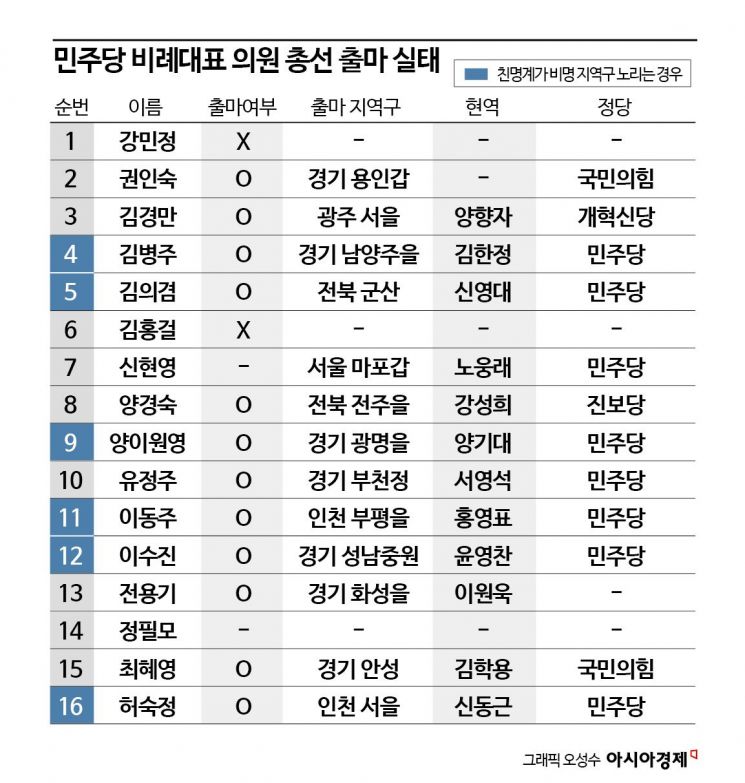
This tendency has become stronger recently. Among 16 Democratic Party proportional representatives, 13 (81%) have declared their candidacy for constituency seats. Of these, 7 emphasized being 'pro-Myeong' and ran in constituencies held by incumbent Democratic Party members from the anti-Myeong faction. Among the People Power Party proportional representatives, 15 out of 22 (68%) have either officially declared or are preparing to run for constituency seats. Overall, 74% of proportional representatives are running for constituency seats.
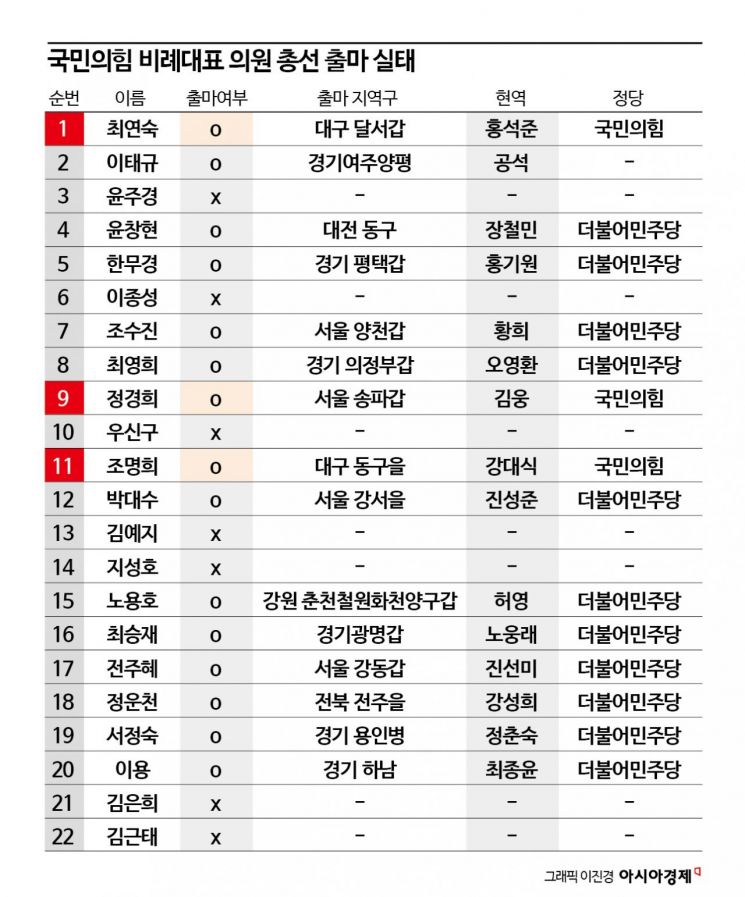
Most People Power Party proportional representatives challenging in the general election are running in districts held by Democratic Party incumbents. Representative examples include Yoon Chang-hyun, who is challenging in Daejeon Dong-gu, the constituency of Democratic Party member Jang Cheol-min; Jeon Ju-hye, who is running against Democratic Party member Jin Sun-mi in Seoul Gangdong-gap; and Jo Su-jin, who is challenging Democratic Party member Hwang Hee in Seoul Yangcheon-gap. On the other hand, Jo Myeong-hee ran in Daegu Dong-gu Eul (where People Power Party member Kang Dae-sik is incumbent), and Choi Yeon-sook ran in Daegu Dalseo-gap (where People Power Party member Hong Seok-jun is incumbent).
The situation is somewhat different for Democratic Party proportional representatives. Among 13, 8 have declared candidacy in constituencies held by Democratic Party incumbents. Representative cases include Kim Byung-joo challenging Kim Han-jung (Gyeonggi Namyangju Eul), Kim Ui-gyeom challenging Shin Young-dae (Jeonbuk Gunsan), and Lee Soo-jin challenging Yoon Young-chan (Gyeonggi Seongnam Jungwon). Particularly, many have challenged members classified as 'anti-Myeong' while claiming to be 'pro-Myeong (pro-Lee Jae-myung).' Yang Yi-won-young, who says she has shared political ups and downs with Representative Lee Jae-myung, is a representative example. She criticized anti-Myeong faction member Yang Ki-dae as an 'un-Democratic Party-like politician' and declared her candidacy.
As proportional representatives continue to challenge constituency seats, opinions have emerged that proportional representation has become a stepping stone to becoming a constituency member. Professor Shin Yul of Myongji University's Department of Political Science and Diplomacy said, "It seems that a considerable number of proportional representatives serve as proportional members to transition to constituency seats. Although the survival (constituency election) rate is not high, the very attempt itself is wrong."
The lack of transparency in selecting proportional candidates is also cited as a problem. Professor Shin added, "Except for one or two symbolic candidates, we do not know how the order of proportional candidates is determined." This means there is no way to prevent candidates without verified political skills from receiving top spots on the proportional list.
Verification of legislative capabilities should take precedence over functional diversity
There is also an opinion that proportional representatives representing specific groups do not play a significant role in the National Assembly because only functional diversity is pursued. Kim Man-heum, a distinguished professor at Hansung University, said, "Proportional representatives with expertise and diversity are needed in the National Assembly, but having political skills should come first," adding, "Currently, people talk too much about only functional diversity." He also said, "There have been cases where proportional representatives assigned by occupation entered the National Assembly but had limited roles as lawmakers."
Perhaps due to these negative evaluations, there is also public opinion that the number of proportional representatives should be reduced. According to a survey conducted by the Korea Institute of Public Administration in April last year targeting 1,000 citizens, 51.1% said the number of proportional seats should be reduced or abolished altogether. Those who responded that the current system should be maintained accounted for 31.1%, while 17.9% said the number of proportional seats should be increased.
© The Asia Business Daily(www.asiae.co.kr). All rights reserved.


















