Keynote Speech at Korea Employers Federation CEO Forum
"Premature Interest Rate Cuts Raise Concerns Over Real Estate Price Surge"
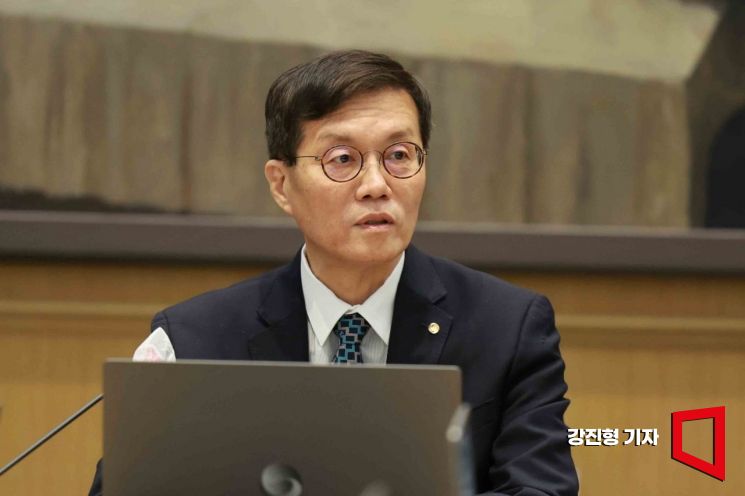 Lee Chang-yong, Governor of the Bank of Korea, is presiding over the Monetary Policy Committee meeting held at the Bank of Korea in Jung-gu, Seoul, on the 11th of last month.
Lee Chang-yong, Governor of the Bank of Korea, reiterated his stance against an early cut in the base interest rate. He judged that a hasty rate cut could stimulate domestic inflation and real estate prices, which are stabilizing.
Governor Lee made these remarks during a keynote speech on "2024 South Korean Economic Outlook" at the Korea CEO Forum hosted by the Korea Employers Federation, held at the Westin Chosun Hotel in Seoul on the 1st.
He said, "Given the significant inflation uncertainty due to recent geopolitical risks and the higher living cost inflation compared to major countries, it is necessary to maintain a tightening stance for a sufficiently long period."
He added, "An early and premature rate cut could trigger expectations of rising inflation and real estate prices," and explained, "We plan to operate monetary policy by monitoring data on monetary policy, inflation, and financial stability in major countries going forward."
After the Monetary Policy Committee decided to keep the base rate unchanged on the 11th of last month, Governor Lee stated that "it will be difficult to lower the base rate for at least six months." This is interpreted as a reaffirmation of his position against an early rate cut.
Regarding the South Korean economy this year, he predicted that although the recovery in consumption is slow, growth will expand compared to last year due to improved exports. South Korea's economic growth rate was 1.4% last year, and the Bank of Korea's forecast for this year is 2.1%. The consumer price inflation rate is expected to fall from 3.6% last year to 2.6% this year.
Governor Lee evaluated, "Exports centered on semiconductors, automobiles, and machinery are recovering better than initially expected, and consumer sentiment is improving, but the recovery momentum is not as strong as anticipated."
He viewed the possibility of real estate project financing (PF) or household debt issues escalating into systemic risk (structural crisis) as low. Governor Lee said, "The possibility of real estate PF issues becoming systemic risk is low, but continuous restructuring is necessary," and predicted, "Household debt problems will also gradually ease in the medium to long term through stabilization of real estate prices."
He also explained changes in the trade structure with China. He warned, "South Korea's trade structure with China is shifting from a complementary relationship to a competitive one," and "the benefits we have enjoyed from China's growth are gradually diminishing." Accordingly, he advised, "We need to diversify our industries by reducing the high manufacturing ratio and dependence on China compared to major countries."
He emphasized the need to promote changes in the demographic structure to expand potential growth. Governor Lee said, "Despite balanced development policies over the past 20 years, regional populations are declining, and industrial competitiveness has deteriorated," and added, "We must expand potential growth by easing concentration in the metropolitan area and increasing the birth rate."
Among major overseas countries, he was relatively optimistic about the U.S. economic situation. Governor Lee diagnosed, "The U.S. economy is increasingly likely to achieve a soft landing due to solid growth and continued inflation slowdown." However, he cautioned about the rising political risks related to the U.S. presidential election in November.
Regarding China, he assessed that economic growth is slowing due to real estate stagnation and weakened private sentiment. In particular, the deleveraging process in the real estate sector may constrain medium- to long-term recovery, and uncertainty remains over China's ability to maintain competitiveness in advanced manufacturing due to U.S. export restrictions on advanced semiconductors.
© The Asia Business Daily(www.asiae.co.kr). All rights reserved.

















