'Success Strategies Seen Through Climate Tech Industry Trends and Outstanding Company Cases'
There has been a call for active support of the 'climate tech' industry to achieve carbon neutrality. The industry size is expected to grow nearly tenfold from $16.9 billion (approximately 22 trillion KRW) in 2016 to $148 billion (approximately 197 trillion KRW) by 2032.
The Korea International Trade Association (KITA) International Trade and Commerce Research Institute announced this on the 1st in a report titled "Success Strategies Seen Through Climate Tech Industry Trends and Outstanding Company Cases."
Climate tech refers to all technologies that help reduce greenhouse gas emissions and address the climate crisis. Recently, climate tech has been recognized as an indispensable element and a new area of business planning, leading to increased investment in the field. The industry is rapidly growing, showing a faster technological growth rate than experts had anticipated.
According to the report, the IEA revised its renewable energy growth forecast for 2022 upward by 76% compared to 2020, marking the largest upward revision ever. As of 2022, there are 83 climate tech unicorn companies with a total corporate value estimated at about $180 billion. Global investment in climate change response is also approaching $1.6 trillion.
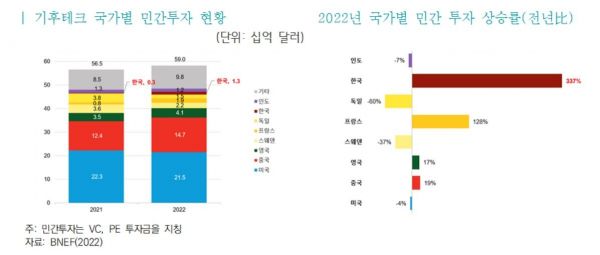
Although the scale of South Korea's climate tech industry is small, it is growing rapidly. As of 2022, South Korea's private investment in climate tech stands at $1.3 billion, which is still modest, but it shows the highest private investment growth rate among major countries (a 337% increase compared to 2021), indicating an active investment market.
The report suggested strategies for companies to successfully enter the climate tech industry, including ▲expanding customer base through disclosure of carbon reduction performance ▲developing technologies easily integrated into existing infrastructure ▲technology development through open innovation ▲investing in technology development with a long-term perspective ▲and establishing a foundation for technology growth by actively utilizing government support systems and projects.
In particular, when analyzing South Korea's climate tech technological capabilities (based on subtotal) by the possession of triadic patents registered with the patent offices of the U.S., Japan, and Europe, it shows a higher growth rate (an average annual growth rate (CAGR) of 25% from 1999 to 2021) compared to major countries. However, the patent holding share is low at around 7%, urging the government to urgently prepare active nurturing policies.
Lim Ji-hoon, senior researcher at the Korea International Trade Association, said, "Climate tech has limited opportunities for technology demonstration and cannot generate profits in the short term, resulting in high investment uncertainty, which limits private sector leadership." He added, "The government should institutionalize the support needed by the climate tech industry to narrow the gap with advanced countries and focus on investing in technologies that have not been developed due to economic feasibility concerns."
© The Asia Business Daily(www.asiae.co.kr). All rights reserved.
![User Who Sold Erroneously Deposited Bitcoins to Repay Debt and Fund Entertainment... What Did the Supreme Court Decide in 2021? [Legal Issue Check]](https://cwcontent.asiae.co.kr/asiaresize/183/2026020910431234020_1770601391.png)















