On the 1st, Ministry of Science and ICT Holds National Strategic Technology Special Committee
Establishes Roadmap for 5 Areas Including Big Science and Essential Infrastructure Technologies
Selects 4 Core Project Candidates Including K-Cloud
The Ministry of Science and ICT has completed a roadmap for 12 national strategic technology fields and selected four additional candidate projects requiring research and development, expressing its ambition to gain an advantage in the global technological hegemony competition.
On the 1st, the Ministry of Science and ICT held the 'National Strategic Technology Special Committee' under the National Science and Technology Advisory Council and announced that it had established and approved mission-oriented strategic roadmaps in five major fields directly related to national security in the mega-science sector: ▲next-generation nuclear power ▲aerospace and ocean, and essential foundational technologies in the digital transformation era such as ▲next-generation communications ▲advanced robotics ▲cybersecurity.
The mission-oriented strategic roadmap for national strategic technologies is the highest-level national technology strategy that sets visible missions to be achieved by 2030, identifies the technologies necessary to accomplish these missions based on expert consultations, and then presents key investment directions and related ecosystem development plans to secure these technologies.
This roadmap includes the commercialization of the world’s top-level small modular reactor (i-SMR) leading carbon neutrality, and the localization of core components such as synthetic aperture radar (SAR) antennas for the new space era centered on an independent supply chain, including launch vehicles, satellite payloads, and lunar landers.
The National Strategic Technology Special Committee, through this roadmap establishment and approval, has created roadmaps for 12 national strategic technology fields, including the existing seven fields of semiconductors and displays, secondary batteries, advanced mobility, advanced bio, hydrogen, artificial intelligence (AI), and quantum.
Additionally, it identified core technologies that will be the starting point for the everyday use of super-large AI, such as securing international standards for 6G mobile communications, overcoming challenges in robotics like obstacle avoidance and manipulation of irregular objects, and pre-identifying hacking vulnerabilities in software.
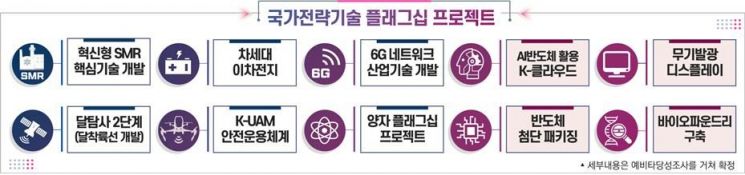
Furthermore, four projects linked to securing a competitive edge in the technology hegemony competition?such as AI semiconductor-based K-Cloud, electroluminescent displays, advanced semiconductor packaging, and bio foundry establishment?were selected as core candidate projects. The actual implementation and detailed contents of these projects will be finalized after preliminary feasibility studies.
The government has previously selected six projects, including the development of core technologies for innovative SMRs, next-generation secondary batteries, 6G network industrial technology development, the second phase of lunar exploration, K-UAM safety operation systems, and the quantum flagship project.
Based on the roadmap and projects, the government plans to make strategic investments aiming to secure 'super-gap and convergence technologies.' Ju Young-chang, Director of the Science and Technology Innovation Bureau at the Ministry of Science and ICT and chairman of the National Strategic Technology Special Committee, stated, "We will focus our policy capabilities on becoming a nation that leads the technology hegemony competition, surpassing the past paradigm of being a follower."
Meanwhile, the Strategic Technology Special Committee is a civilian-government joint special committee under the Presidential National Science and Technology Advisory Council, responsible for the overall coordination and deliberation of national strategic technology development policies selected to respond to the technology hegemony competition and to secure technological sovereignty and future growth.
© The Asia Business Daily(www.asiae.co.kr). All rights reserved.

















