Tied Debate Over Maintaining Linked System vs. Returning to Parallel System
Political Reform Promise Broken, Return to 'Parallel System' Expected
'Satellite Party Trick' Followed by Criticism of "Avoiding Responsibility"
The Democratic Party of Korea has decided to hold a party-wide vote on the direction of proportional representation system reform in the upcoming general election. As opinions within the party sharply diverge between 'maintaining the semi-linked system' and 'returning to the parallel system,' there is speculation that the party is moving toward pushing for a return to the parallel system by emphasizing the 'party base' sentiment.
A key Democratic Party official stated on the 31st, "We have begun practical preparations for a party-wide vote to gather opinions on the direction of electoral system reform." Although the leadership is known to favor a return to the parallel system, there is strong opposition within the party to uphold the promise made during the last presidential election to prevent satellite parties through a linked system. As the political burden of the choice grows, the party intends to decide by asking the members' will.
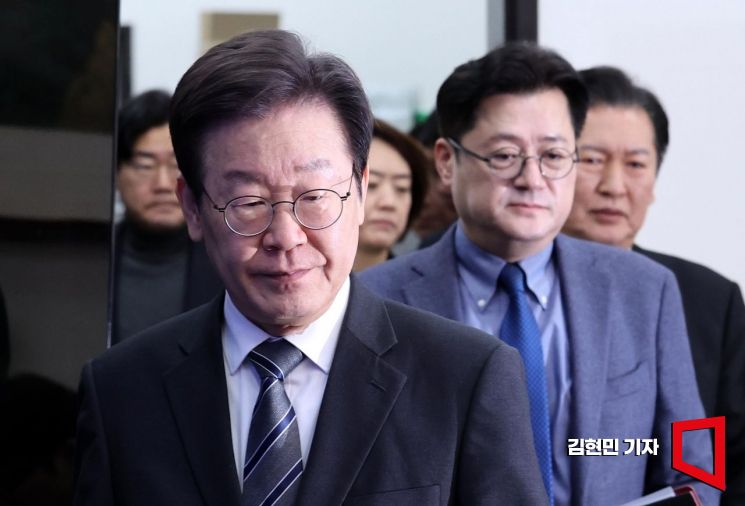 Lee Jae-myung, leader of the Democratic Party of Korea, is attending the Supreme Council meeting held at the National Assembly on the 26th. Photo by Kim Hyun-min kimhyun81@
Party leader Lee Jae-myung said at a New Year's press conference that morning regarding the electoral system reform, "Since there may be vested interests involved, we are carefully collecting opinions," and added, "Within a short time, we will have frank discussions and dialogues." Although Lee did not give a definitive answer, considering that less than 70 days remain until the general election, it appears that the decision to hold a party-wide vote was made under the judgment that the decision can no longer be delayed.
Within the party, a mediation proposal suggested by Speaker Kim Jin-pyo and others is also being discussed. This plan guarantees seats for minor parties under a regional parallel proportional representation system and supplements the dual registration system. From the Democratic Party's perspective, it is advantageous for securing seats while being relatively free from satellite party controversies.
However, opposition remains strong. Recently, after Supreme Council member Jeong Cheong-rae proposed a 'party-wide vote,' criticism arose that the hardline supporters are being used to push for a return to the parallel system. There are concerns that the leadership is shirking responsibility by shifting the burden of the decision onto party members. Floor leader Hong Ik-pyo's statement on CBS Radio on the 29th that "(regarding the direction of electoral reform) it would be better for the leadership to decide to some extent and then get approval at the party caucus" is also interpreted as being mindful of such public opinion.
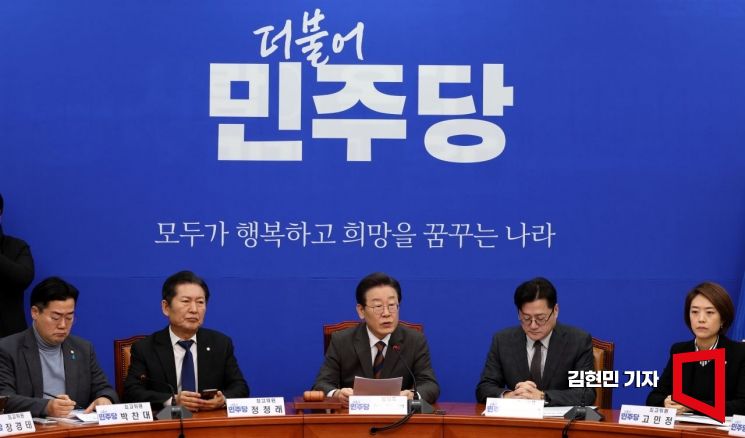 Lee Jae-myung, leader of the Democratic Party of Korea, is speaking at the Supreme Council meeting held at the National Assembly on the 29th. Photo by Kim Hyun-min kimhyun81@
A senior metropolitan area lawmaker said in a phone interview with Asia Economy on the same day, "Holding a party-wide vote whenever things get difficult is not responsible leadership," and expressed concern, "If we keep breaking promises relying only on hardline supporters, it may be our party, not the Yoon Seok-youl administration, that ends up on the judgment stand."
The Democratic Party also decided by party-wide vote in March 2020, ahead of the 21st general election, whether to participate in satellite parties. At that time, when faced with controversy over the 'satellite party trick,' criticism arose that the responsibility was being shifted to party members. In November 2020, during former leader Lee Nak-yeon's tenure, the party also decided by party-wide vote whether to nominate candidates for the Seoul and Busan mayoral by-elections triggered by sexual misconduct scandals involving former mayors Park Won-soon and Oh Keo-don. This was an attempt to circumvent the party constitution rule that prohibits nominating candidates in by-elections caused by party-affiliated politicians' fault.
Ultimately, even if the party-wide vote leads to a decision to return to the parallel system, the 'Lee Jae-myung leadership' will have to bear the burden of criticism. This is because it breaks the political reform pledge Lee made during the last presidential election. The Democratic Party was the one who pushed for the semi-linked system ahead of the 21st general election in the first place, so there is a possibility of a self-defeating outcome just before the election. Since the People Power Party also favors a return to the parallel system, there is concern that the party may be trapped in a 'collusion' frame, disrupting the general election strategy aimed at promoting a regime judgment narrative.
Meanwhile, the ruling party has long set 'returning to the parallel system' as its party stance and is continuously criticizing the Democratic Party for failing to find a clear direction on electoral reform. Internally, they are increasing pressure on the Democratic Party by holding a founding meeting for a satellite party and deciding to name it 'Gukmin-ui Mirae' (People's Future).
© The Asia Business Daily(www.asiae.co.kr). All rights reserved.


















