New Year's Press Conference Held at the National Assembly
"Stop the War Game for Political Gain Immediately"
Proposes 'Birth Basic Income' as a Follow-up to Basic Income
No Comment on Election System Reform and Nomination Conflicts
Lee Jae-myung, leader of the Democratic Party of Korea, strongly criticized the Yoon Seok-yeol administration in his New Year's message. He appealed for support in the upcoming general election by invoking somewhat partisan topics, including the so-called 'North Wind Incident.' However, he refrained from expressing any particular stance on pressing issues such as 'electoral system reform' or factional 'nomination conflicts,' raising concerns about his 'silent leadership.'
On the morning of the 31st, Lee held a New Year's press conference at Sarangjae in the National Assembly, stating, "South Korea is collapsing due to the arbitrary and incompetent rule of the Yoon Seok-yeol administration," and added, "The South Korean economy, once the focus of global attention, is declining, and an unexpected war crisis is looming." He defined the upcoming general election as "the day South Korea regains its lost vision" and pledged, "We will renew the Democratic Party, which the people have relied on and supported."
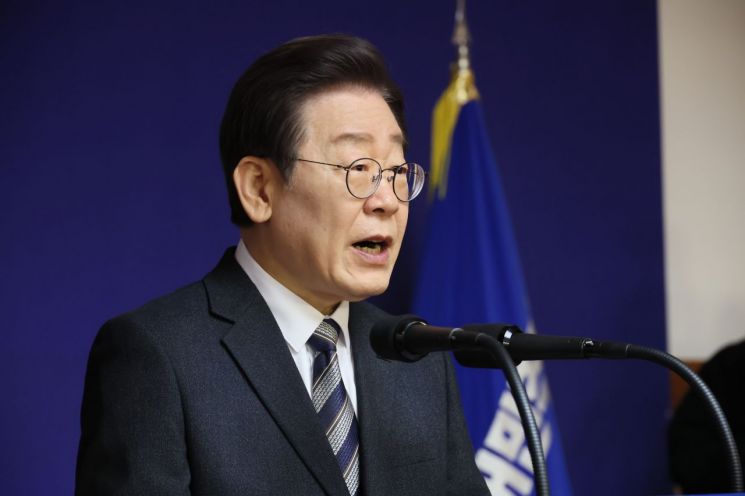 Democratic Party leader Lee Jae-myung is holding a New Year's press conference on the 31st at Sarangjae, the National Assembly in Yeouido, Seoul. [Image source=Yonhap News]
Regarding the recent series of provocations by North Korea, Lee said, "There has never been a time when inter-Korean relations were easy, but the current situation where people are worried about war is clearly abnormal," and criticized, "The 'Bold Initiative' announced by President Yoon at his inauguration is turning into a 'huge time bomb' hanging over the heads of all citizens." He specifically mentioned the 'North Wind Incident' and the 'Shooting Incident,' asserting, "If war games are being attempted at the expense of citizens' lives for political gain, they must stop immediately."
Furthermore, emphasizing national issues such as the livelihood economy and the 'crisis of democracy,' he criticized, "The people are the owners of South Korea, but the Yoon Seok-yeol government rejects the people." This is interpreted as criticism of the administration's repeated use of veto power on nine bills since its inauguration, including the Itaewon Special Act the day before. Lee warned, "If the current government policy continues, laws and systems will become tools of domination for a privileged minority," and added, "Japan, which has been completely exonerated for past issues and contaminated water discharge, might threaten us by demanding 'Dokdo Island.'"
On the low birthrate issue, Lee proposed alternatives linked to his signature policy from his time as Governor of Gyeonggi Province, the 'basic income.' He aims to solve the ultra-low birthrate problem through measures such as 'birth basic income' and a 'national dialogue body on low birthrate' encompassing the ruling and opposition parties as well as academia and industry. He emphasized, "If necessary, we must create universal support measures to an excessive degree, including covering all education expenses such as university tuition."
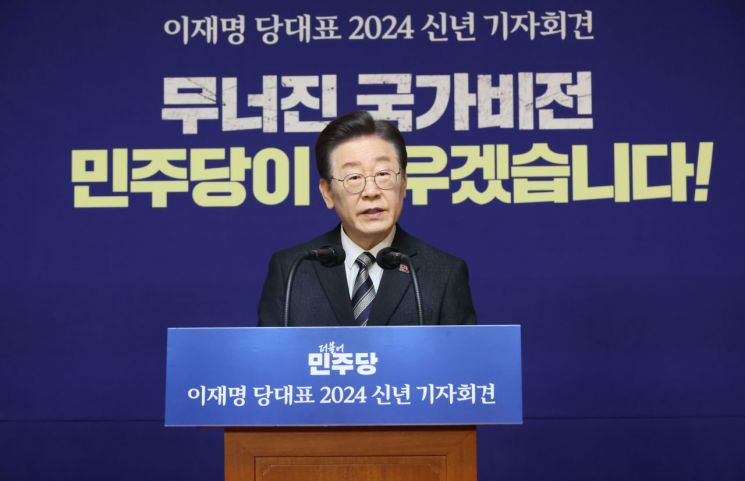 Democratic Party of Korea leader Lee Jae-myung is holding a New Year's press conference on the 31st at Sarangjae, the National Assembly in Yeouido, Seoul. [Image source=Yonhap News]
Lee Jae-myung's New Year's message is interpreted as an appeal for support for the Democratic Party in the general election by raising a judgment against the Yoon Seok-yeol government's failures. However, he has not expressed any particular stance on pressing issues such as electoral system reform, drawing criticism for not resolving internal party confusion.
So far, the leadership has been unable to find a clear direction between returning to the 'parallel voting system' and maintaining the 'semi-proportional representation system' regarding the selection method for proportional representatives. Various calculations intersect, including the possibility of Lee running as a proportional representative amid the reality of 'judicial risks' pressuring his position. Recently, with Im Hyuk-baek, the head of the nomination management committee, repeatedly mentioning the necessity of a regional parallel voting proportional system to preserve seats for small parties, there has been an interpretation that the leadership is building justification for a return to the parallel voting system. However, about half of the party's lawmakers oppose the return to the parallel voting system, deepening the leadership's dilemma.
In particular, as the official nomination process begins, factional discord has intensified, putting Lee's 'crisis management ability' to the test. Even after the departure of the reformist group 'Principles and Common Sense' lawmakers, pro-Lee non-incumbent figures have declared candidacies in constituencies held by anti-Lee incumbents, continuing the 'pro-Lee vs. anti-Lee' conflict. Additionally, pro-Lee figures have pressured former Moon Jae-in government members not to run in the general election under the pretext of 'personnel reform,' sparking conflicts between 'pro-Lee and pro-Moon' factions. The lack of efforts to reconcile these conflicts has raised concerns about a chain reaction of defections.
© The Asia Business Daily(www.asiae.co.kr). All rights reserved.
!["I'd Rather Live as a Glamorous Fake Than as a Poor Real Me"...A Grotesque Success Story Shaking the Korean Psyche [Slate]](https://cwcontent.asiae.co.kr/asiaresize/183/2026021902243444107_1771435474.jpg)

















