With the low birthrate becoming entrenched and the total fertility rate (the average number of children a woman is expected to have in her lifetime) dropping to the 0.5 range in Seoul, each district is putting effort into supporting pregnancy and childbirth.
Each district office is implementing policies tailored to their own budgets and characteristics, such as increasing the amount of childbirth congratulatory money (called childbirth and childcare support money or birth congratulatory money depending on the district office) or expanding medical expense support for pregnancy and childbirth.
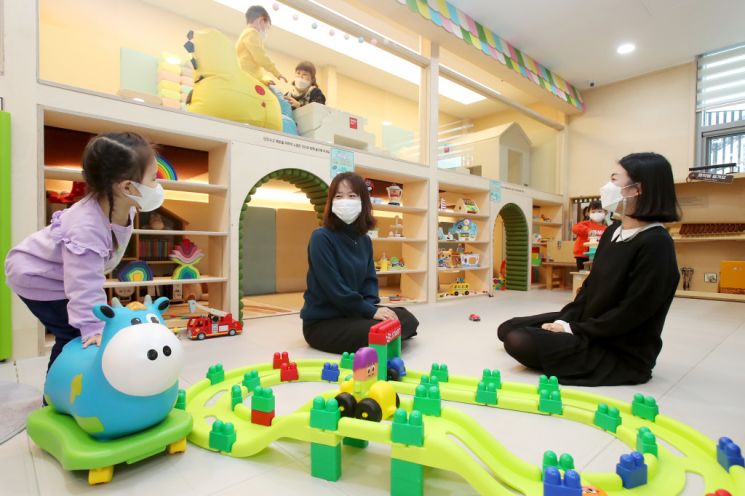 There are six districts in Seoul, including Gangnam-gu, Jung-gu, and Seongdong-gu, that provide childbirth grants to families with newborns. (Photo by Seongdong-gu Office)
In Seoul, six districts?Gangnam-gu, Jung-gu, Gwangjin-gu, Dongjak-gu, Seongdong-gu, and Geumcheon-gu?provide childbirth congratulatory money to families with newborns. Among these, four districts including Gangnam-gu give congratulatory money starting from the first child, while Seongdong-gu and Geumcheon-gu provide it from the third child onward.
Until 2021, a significant number of the 25 district offices in Seoul provided childbirth congratulatory money to families with newborns, but when the government started issuing the First Meeting Voucher worth 2 million KRW (3 million KRW from the second child this year) to newborns in 2022, most district offices discontinued their separate childbirth congratulatory payments.
However, Gangnam-gu has significantly increased its district-funded congratulatory money, which used to range from 300,000 to 1 million KRW, to 2 million KRW for the first and second child, 3 million KRW for the third child, and 5 million KRW from the fourth child onward since last year.
Gangnam-gu explained, “The total childbirth support amount combining district, national, and city funds for the first child is 7.4 million KRW, the highest among the 25 districts in Seoul,” and added, “Internally, we analyze that there has been some policy effect.”
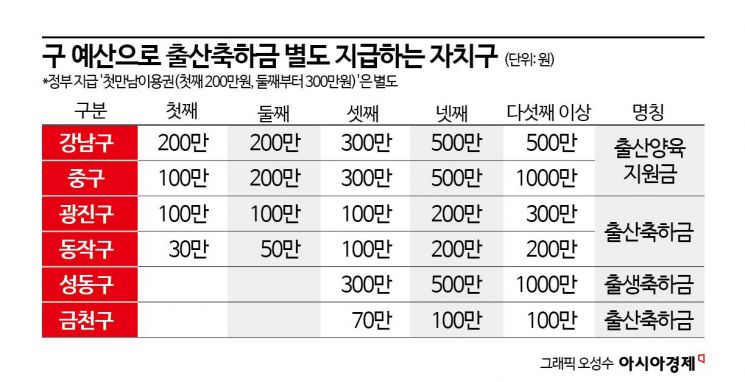
Gwangjin-gu, which previously provided congratulatory money only to families with the third child or more, has decided to provide it starting from the first child this year. It offers 1 million KRW each for the first to third child, 2 million KRW for the fourth child, and 3 million KRW for the fifth child or more. This expansion was made by revising the ordinance on childbirth and childcare support in July last year.
Jung-gu provides 1 million KRW for the first child, 2 million KRW for the second child, 3 million KRW for the third child, 5 million KRW for the fourth child, and 10 million KRW for the fifth child to parents who have resided in the district for more than 12 months as of the child’s birth date. Seongdong-gu, which supports from the third child onward, provides 3 million KRW for the third child, 5 million KRW for the fourth child, and 10 million KRW for the fifth child.
A representative form of cash support at the district level, besides childbirth congratulatory money, is postpartum health care expenses. Some districts provide about 500,000 KRW in postpartum health care costs as a payback in addition to the postpartum care expenses voucher (1 million KRW) supported by Seoul City.
Meanwhile, at the government level, families with newborns receive support such as the First Meeting Voucher, parental allowance, and child allowance; at the Seoul City level, support is provided under names like postpartum care expenses, transportation expenses for pregnant women, and Seoul Mom and Dad Taxi fares. When combining support from the government, Seoul City, and district offices, there are more than ten types. Due to the large number and complexity, some supports may be missed if not directly applied for or managed.
© The Asia Business Daily(www.asiae.co.kr). All rights reserved.


















