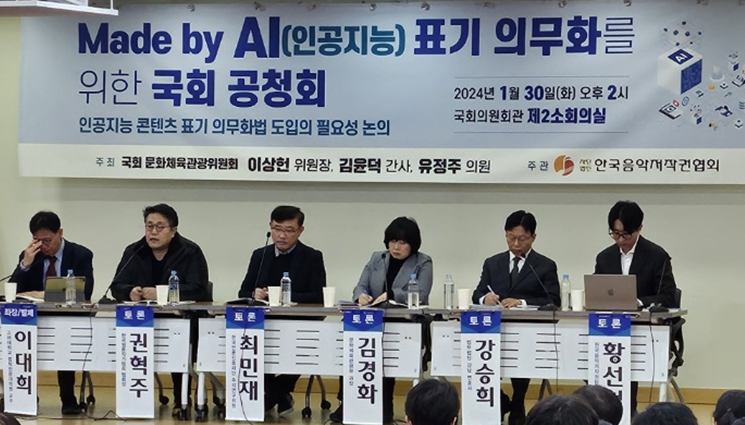
 The Korea Music Copyright Association and the National Assembly's Culture, Sports and Tourism Committee held a "National Assembly Public Hearing for Mandatory 'Made by AI' Labeling" on the 30th at the National Assembly Members' Office Building. Photo by Korea Music Copyright Association
There have been calls for mandatory AI labeling and enforcement measures for content created by generative artificial intelligence (AI).
The Korea Music Copyright Association and the National Assembly’s Culture, Sports and Tourism Committee held a public hearing titled "Mandatory 'Made by AI' Labeling in the National Assembly" at the National Assembly Members’ Office Building on the 30th. Earlier, Lee Sang-heon, Chair of the Culture, Sports and Tourism Committee, proposed an amendment to the Content Industry Promotion Act in May last year to mandate labeling for content produced using AI.
On the day, Professor Lee Dae-hee of Korea University Law School gave a presentation on "The Necessity of Amending Article 26, Paragraphs 3 and 4 of the Content Industry Promotion Act." Article 26, Paragraphs 3 and 4 of the Content Industry Promotion Act respectively stipulate that content creators must indicate when content is produced using AI technology, and that the details and methods of such labeling shall be prescribed by Presidential Decree.
He argued that appropriate sanctions are needed to enforce the labeling requirement. Professor Lee stated, "It is desirable to establish appropriate penalties for failure to comply with labeling obligations, as well as for manipulation, deletion, or alteration of labels," adding, "Sanctions should consider the subjects and violators according to the generative AI supply cycle, violations committed intentionally or negligently, and issues such as deception, fraud, and unfair competition."
However, since there are opposing views regarding conflicts with freedom of expression, it was explained that considerable discretion should be granted in implementing the labeling. Professor Lee said, "There seems to be a general consensus on labeling AI-generated content, but solutions must be devised for detailed issues related to labeling," adding, "It is necessary to impose flexible labeling obligations within an appropriate scope."
He also emphasized, "Differentiation in labeling obligations, degree, and methods is needed depending on the industry, media, content, and the risks of specific generated works," and "Consideration should be given to the purpose of labeling, the level and method of information delivery, and the parties benefiting from the provision of information."
The public hearing also raised the need for protective measures regarding AI training data. Kwon Hyuk-joo, President of the Korea Webtoon Artists Association, expressed concerns, saying, "If the 'TDM (Text and Data Mining) exemption regulation' currently pending in the National Assembly passes, AI could learn from webtoon data without the original creators’ permission, which raises serious concerns," and stressed, "All AI must clearly disclose the sources of their training data, and when webtoon works are used to train AI developed for commercial purposes or intended to be changed to commercial use later, contracts specifying the scope, purpose, and duration of use must be concluded."
He added, "A management system must be established to block unauthorized use of webtoon data and the use of illegally distributed works, as well as to monitor and respond to such cases."
The government sympathizes with these concerns and plans to conduct thorough discussions. Kim Kyung-hwa, Director of the Cultural Industry Policy Division at the Ministry of Culture, Sports and Tourism, explained, "We will form a separate AI copyright system working group starting this year," and said, "Since there are many considerations and stages involved in labeling the sources of training data and mandating AI output labeling, we will create a working group and develop legislative and institutional improvement measures based on its outcomes."
She continued, "In the case of 3D content, there is no watermarking, so we plan to support related technology development," and added, "While the necessity of mandatory labeling is now an obvious proposition, there needs to be more discussion on how and by what methods it should be implemented, and we plan to create a forum for such discussions."
© The Asia Business Daily(www.asiae.co.kr). All rights reserved.
![User Who Sold Erroneously Deposited Bitcoins to Repay Debt and Fund Entertainment... What Did the Supreme Court Decide in 2021? [Legal Issue Check]](https://cwcontent.asiae.co.kr/asiaresize/183/2026020910431234020_1770601391.png)