Nearly 7,000 People... 1 in 16 Refuse Police Investigation Visits
No Means to Enforce Refusal
Lack of Management Personnel Also a Problem, "Need to Prepare Supplementary Measures"
Last year, nearly 7,000 sex offenders violated the obligation to register their personal information, marking an all-time high.
This means that one out of every 16 sex offenders subject to personal information registration broke the law. However, there is a severe shortage of personnel to manage this, and since there is no way to enforce compliance if sex offenders refuse police investigation visits, critics point out significant institutional loopholes.
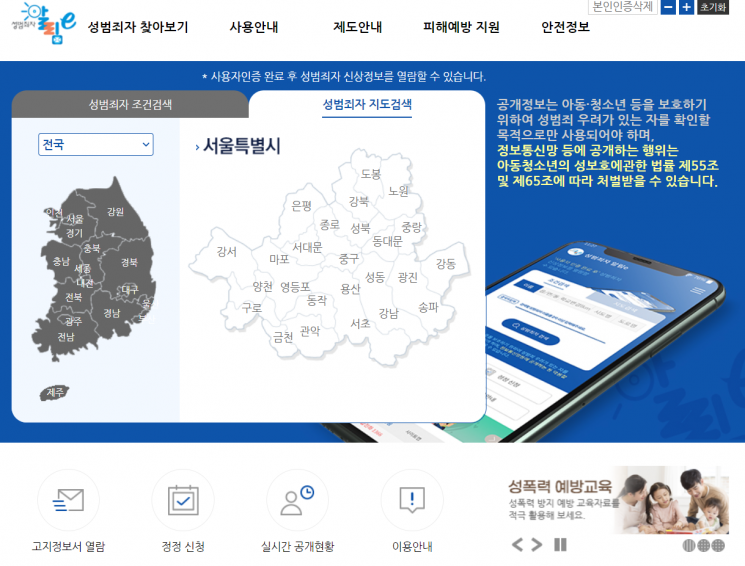
6,912 Cases of Registration Obligation Violations... Severe Shortage of Management Personnel
According to statistics on 'Sex Offender Personal Information Registration Subjects and Obligation Violations' obtained by Asia Economy from the National Police Agency on the 31st, the number of criminal cases filed last year for violating personal information registration orders was 6,912, a 53.5% increase compared to 4,503 cases in 2019.
The most common type of violation was failing to register changes in personal information due to moving, with 5,017 cases. There were 1,398 cases of failing to register new information after a confirmed order to disclose personal information and 497 cases of violating the obligation to have photos taken.
Under the Sexual Violence Punishment Act, those sentenced to register personal information must register their actual residence and photos at the police station with jurisdiction over their residence within 30 days of a confirmed judgment or release. They must also appear once a year at the jurisdictional police station to have their photos retaken.
The increase in violations of the registration obligation is largely attributed to the rise in the number of sex offenders subject to registration. Last year, the cumulative number of subjects required to register personal information was 109,367, an increase of 56.2% (39,366 people) compared to 2019.

However, there has been little change in management personnel or systems, making it difficult to keep up. Currently, sex offender personal information is managed through a system where the police, Ministry of Justice, and Ministry of Gender Equality and Family each share roles. The police manage violations of registration obligations, the Ministry of Justice manages new registrants, and the Ministry of Gender Equality and Family handles the final notification of personal information.
Because the work is dispersed without a dedicated department, personnel are insufficient, and personal information management is carried out alongside other duties. Currently, the Ministry of Justice has a total of 25 staff members (4 public officials and 21 contract workers) responsible for personal information registration and management. This means one person manages about 4,300 cases of personal information. The Ministry of Gender Equality and Family has only six personnel responsible for final notification of personal information.
In the case of the police, there is currently no dedicated personnel; the Women and Youth Investigation Team manages sex offender personal information additionally along with investigations of stalking and dating violence. The Women and Youth Investigation Team nationwide has 3,318 personnel, and the police plan to transfer this task to the Women’s Safety Planning Division in the future.
"Lawsuits for Human Rights Violations"... No Enforcement Even if Police Investigation Is Refused
The lack of enforcement power in police investigations of registration subjects is also cited as a problem. The police must visit the registered address of the subject at intervals of 3 months, 6 months, and 1 year to check whether there are any changes in the information submitted by the registrant.
However, even if they refuse the investigation, there is no effective method. A police official said, "Without the person's consent, the police cannot enter their home," adding, "We mostly confirm whether the actual residence matches by directly calling the registrants and meeting them near their homes."
There are frequent cases where police officers are verbally abused or threatened during investigations. According to a 2021 survey by the Korea Institute of Criminology and Justice Policy, 35.1% of 388 police investigators reported being verbally abused or threatened by sex offenders during on-site inspections, and some even suffered physical assault.
Some even file complaints alleging human rights violations by the police. A police official sighed, "Some subjects file complaints or lawsuits with the National Human Rights Commission, citing reasons such as the police conducting inspections too frequently," adding, "From the investigator's perspective, they have no authority but are burdened only with the obligation to manage the registrants."

Under current law, sex offenders subject to personal information registration who fail to submit information without justifiable reasons can face imprisonment of up to one year or a fine of up to 5 million won. However, even if they violate the registration obligation, they generally receive light punishments such as fines. For example, last year, sex offender A, who moved from Gyeonggi Province to Gangwon Province and failed to submit personal information to the police for over a month, was fined 3 million won.
Experts suggest that to prevent the sex offender personal information system from becoming ineffective, enforcement should be strengthened, such as imposing legal penalties when police investigations are refused.
Lee Yun-ho, honorary professor of the Department of Police Administration at Dongguk University, said, "If the system operates as it currently does, the police will be inconvenienced, the registrants will be inconvenienced, and citizens will receive no real help," adding, "There should be supplementary measures to legally punish those who refuse police on-site investigations."
© The Asia Business Daily(www.asiae.co.kr). All rights reserved.



















